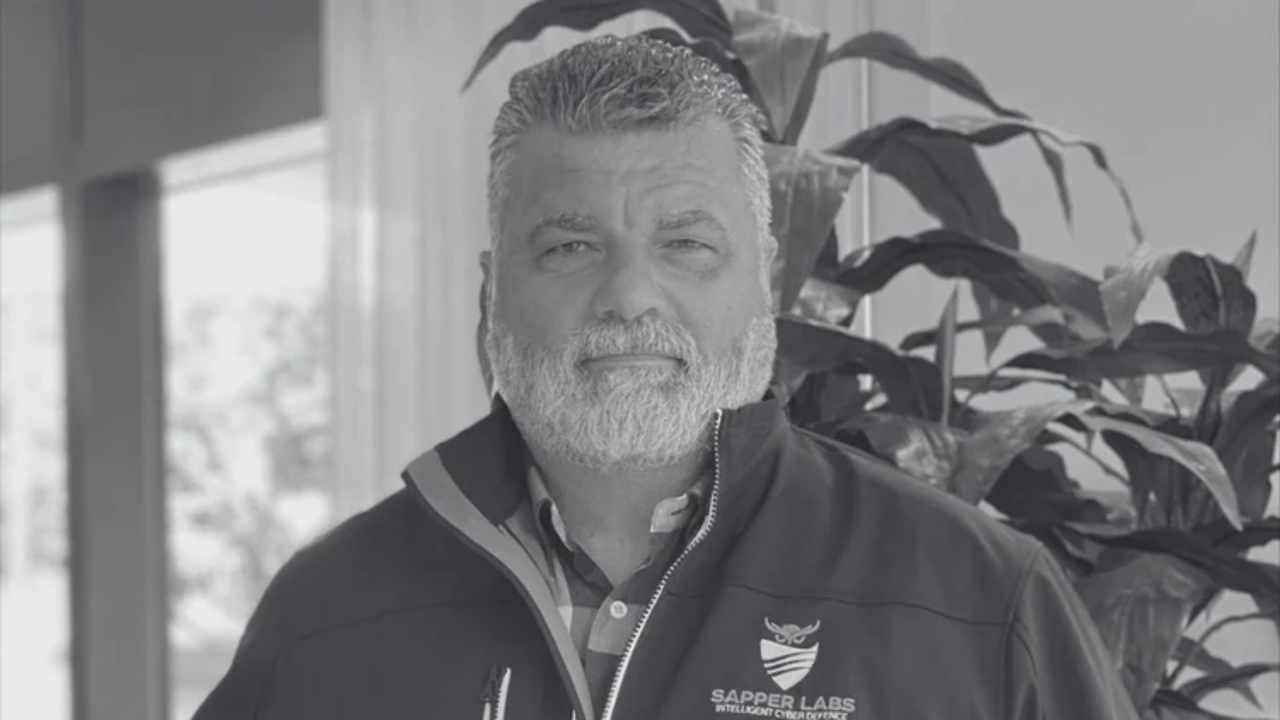
A few months before Russia’s full-scale invasion of Ukraine in 2022, an Ottawa-based defence-tech company was already tracking the Wagner Group, Russia’s shadowy mercenary army, and passing intelligence about it to the Canadian, American and Ukrainian governments, according to Sapper Labs Group CEO Allen Dillon. In a recent interview with OBJ, Dillon said it’s the […]
Already a Subscriber? Log in
Get Instant Access to This Article
Become an Ottawa Business Journal Insider and get immediate access to all of our Insider-only content and much more.
A few months before Russia’s full-scale invasion of Ukraine in 2022, an Ottawa-based defence-tech company was already tracking the Wagner Group, Russia’s shadowy mercenary army, and passing intelligence about it to the Canadian, American and Ukrainian governments, according to Sapper Labs Group CEO Allen Dillon.
In a recent interview with OBJ, Dillon said it’s the type of work that illustrates what Sapper Labs does: open-source intelligence gathering, cyber-attrition and decision support for defence and government clients.
Sapper Labs was founded in 2006 in the heart of Ottawa on Elgin Street. The company recently partnered with Calgary-based Denvr to deliver intelligence and cyber-defence capabilities on the Canada AI Platform (CAIP), a sovereign AI infrastructure initiative for Canadian defence users, according to the Canadian Defence Review. The firm also completed an $8.7-million contract with the Department of National Defence’s IDEaS program, and has worked with the Canadian Special Operations Forces Command on a cyber-defence test drive. Soon the company will open a new national open-source intelligence centre on Robertson Road in Kanata.
“The intelligence systems and the capabilities around it has to be systemically embedded within the National Capital Region,” Dillon said. “So much of our intelligence creation and processing resides within the entities that are headquartered here.”
Collaboration with government clients on innovation and mission support needs to happen in the NCR, he added.
The company was co-founded by Shawn Covell, now its chief technology officer, and a small group of military and intelligence veterans, including co-founder and chief intelligence officer Dave McMahon, who has a 40-year career across CSIS, the Communications Security Establishment and the Canadian Armed Forces.
“Shawn and Dave and the guys that built Sapper Labs initially were all embedded for 20 years or more within the special forces and intelligence community, doing advanced technological work for them,” Dillon explained.
Sapper Labs offers intelligence-as-a-service, operational security, infrastructure-as-a-service, and advanced training for military and law enforcement clients. Dillon said the company’s model is designed to give defence clients the continuity that uniformed personnel cannot always provide.
“Uniforms come and go,” he said. “They’re going through career progression and training and all these things. The tactical capability and the operational capability gets impacted by the flow of those people as they progress through their agenda and what we need is some stability within the environments that give you a leg on the ground.”
Four years ago, in February 2022, Sapper Labs tracked the Wagner Group’s funding in preparation for the invasion of Ukraine and its activities in other regions.
“Wagner is not a small organization,” Dillon said. “It is an organized crime capability that scales as a private army.”
The group operates with the philosophy of winning influence in communities where it can buy loyalty, or enforcing its will with violence, Dillon said. Sapper Labs tracked Wagner’s influence operations as it prepared for the invasion of Ukraine.
“Their preparations included the refinement of gold,” he said. “And the provision of gold to various entities and other nations that were supporting the Russians through cloaked or clandestine support.”
Sapper Labs provided those insights to industry organizations operating in the region, as well as to governments in Canada, the U.S. and Ukraine. Dillon said the work used an in-house AI program called Hunchly, which Sapper Labs has since sold to a German company.
Dillon himself is a sixth-generation soldier. He joined the reserves in London, Ont., at 16 with his father’s permission, then served in the regular forces as an infantry soldier and later as an armour corps officer. He started his first tech company in 1993 while still in uniform, and sold it to Bell. He then worked on the creation of X-Wave.
“I like technology but I like technology for a reason and a purpose,” he said. “And my raison d’etre seems to be the military.”
He said the people at Sapper Labs share that motivation. “These people that I work with are like me,” he said. "They're passionate patriots. We give a shit about our country.”
Dillon said Canadian companies often lead on technology but lose the commercial benefit, calling it a serious drain on the national economy.
“Often Canada is the leader, but our capital systems haven’t supported the exploitation of Canadian-made technology,” he explained. “The government hasn’t exploited the capability itself, so it ends up going to a valley in California or somewhere in Europe.”
He said he would only sell Sapper Labs to a Canadian company. “I will never sell my company to anybody that isn’t Canadian. It would have to be a Canadian company from top to bottom. I would never sell it to anybody else.”
That conviction runs through the company’s work with DND. Under the Innovation for Defence Excellence and Security program (IDEaS), Sapper Labs competed in the Cyber Attribution for the Defence of Canada challenge, according to government records. The company received $200,000 for a proof of concept, then another $1 million for a fully functional design of an active cyber-defence system. The final phase was a $7.5-million test drive contract that ran for 24 months on tactical networks in domestic and foreign environments. DND records indicate the Canadian Armed Forces is considering wider integration of Sapper Labs’s services.
That track record underpins Sapper Labs’s current push into sovereign AI. Through CAIPs, the company and Denvr aim to deliver defence-grade AI and cyber-capabilities on Canadian-owned infrastructure. Dillon explained that hyperscalers such as Microsoft are not the enemy of sovereignty, but are not the whole answer, either.
“The hyperscalers are actually investing billions of dollars into the country,” he said. “The complication is ownership, because foreign-owned providers are subject to foreign law.”
Denvr’s model favours smaller, containerized facilities of two or three megawatts that can be deployed and stacked, rather than large fixed data centres, according to Dillon. But he pointed out that intelligence work cannot rely on sovereign infrastructure alone.
“The intelligence mission must be done on both commercial and specialized infrastructure,” he said.
The new Kanata facility is meant to pull all those threads together. Sapper Labs is taking possession of a multi-storey building on Robertson Road, with a couple of months of upgrades needed for the open-source floor before it opens. The site will house secure labs, open labs and partners including Denvr and the Canadian Armed Forces.
“Industry and uniforms can come together to work on these complex problems,” Dillon said. “I want an operational model that can move quickly. We’re not talking about 10-year procurement models.”
The Kanata site is the first step toward a broader footprint for the sector in the capital, according to Dillon. The goal is the expansion of campus-level facilities within the NCR, he added, in describing his long-term vision for intelligence innovation and mission support. He compared the project to his work in New Brunswick in 2017, where he opened a 45,000-square-foot facility hosting tenants such as Siemens and Canadian Nuclear Laboratories.
Dillon said Canada is at a decision point on whether it will own its own defence-technology future, or rent it from somewhere else.
“We’re at an inflection point as a country,” he said. “And we need to make that decision now, or agree that we’re not going to own the decisions.”