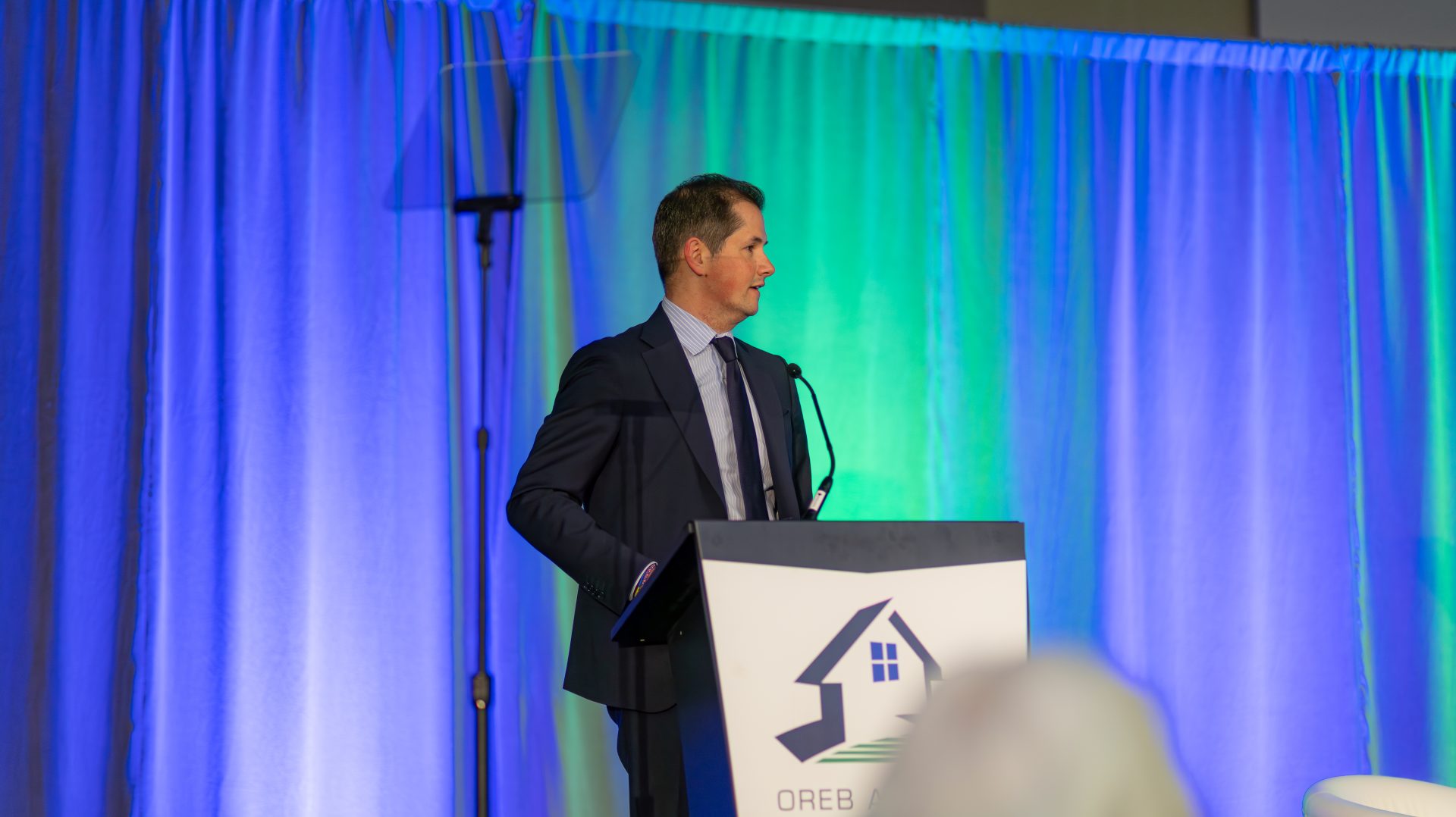
Housing is set to be a major factor in Ottawa’s upcoming municipal election, according to the Ottawa Real Estate Board. At its annual housing symposium on Friday, OREB presented its 2026 policy platform. “More Homes for Ottawa is an evidence-based plan focused on improving affordability for buyers, renters and those in need of affordable and non-profit housing,” said OREB CEO Nicole Christy in her opening remarks. With nine months to go until Ottawans go to the polls, OREB is calling on municipal candidates to campaign on housing platforms to help lower the cost of new homes, allow more types of housing in every neighbourhood and speed up the development approval process. For renters, OREB calls for measures to increase purpose-built rental supply while avoiding policies that would reduce availability. OREB partnered with Abacus Data to survey 1,000 local residents in December to better understand public opinion around major issues, including housing. The survey found that cost of living, housing affordability and transit reliability are the top three issues on voters' minds. Housing is especially relevant, with 82 per cent of respondents saying it would be important in determining their vote. According to OREB, the city isn’t building the housing needed to keep up with population growth, saying that, for more than two decades, housing starts haven’t kept up with the city’s needs by a significant margin. The city, it said, has never come close to building the 15,000 new homes needed each year to keep up with demand. “Affordability isn’t a single issue, but a system that needs to work better for everyone,” said Christy. “Good policy starts with understanding public reality.”
Housing a ‘defining political force’
At the symposium, Abacus Data CEO David Coletto said that global issues over the past year have contributed to pessimism among Canadians. “For the last 18 months, we saw this real shift in how people were thinking about issues,” said Coletto. “The global context of Donald Trump, of AI, of climate, of uncertainty have been the fundamental, defining attributes of our moment. It has made the things we used to take for granted more important.”That pessimism extends to housing issues. According to the survey, 79 per cent of Ottawa residents felt housing in the city was unaffordable. Fifty-two per cent said the affordability of buying a home had worsened over the past year, while 57 per cent felt rental affordability was also worse. David Coletto, CEO of Abacus Data, at the OREB 2026 Housing Symposium on Jan. 16. Photo credit: Michael Mackinnon, OREB“Whether (or not) somebody is in the policy space, I think you have to understand where the public’s coming from: how they see the problem, what they see as solutions and the role it’s going to play in the decision they make (at the polls),” said Coletto. While survey results might not always reflect reality, Coletto said understanding the views of the public is essential, especially during an election year. “Everyone in this room knows that the market has softened and improved slightly,” he said. “Affordability is actually improving, both in rental and housing, but the perception of it has not. I always live in the world of perception, not reality. If you believe something to be true, it’s more likely to affect the choices you make in terms of where you live, where you might work and whether you decide to leave the city or not.”He added, “As rents stabilize and the housing market starts to correct, the public isn’t yet feeling that, isn’t seeing that. And that’s a big driver in how they feel now.”He pointed to results showing that, among those who don’t own a home, 76 per cent still want to buy one day and 52 per cent are at least somewhat optimistic in their ability to do so one day. Overall, Coletto said housing has become a “litmus test” for voters. “Housing connects to the cost of living, to downtown vitality, to transit use,” he said. “It’s tied to the success or failure in people’s minds around whether City Hall, whether your councillors, whether your mayor is doing what needs to be done.”If an election were held today, the survey found that Mayor Mark Sutcliffe would have the advantage against other candidates. But, Coletto cautioned, half of respondents are still undecided. “Not all of them will vote,” Coletto said. “Turnout in municipal elections is typically lower. But that is still a much higher level of undecided than when we asked the same question at the federal or provincial level.“Housing is essential to a lot of issues,” he added. “We won’t rebuild support for immigration unless we solve the housing crisis. We won’t solve the productivity crisis unless we solve the housing crisis. It’s that simple. It shapes whether young people stay or leave. It shapes whether families can grow. It’s not a niche concern. It’s a defining political force.”
MP highlights need for collaboration
Earlier this month at an event hosted by the Greater Ottawa Home Builders’ Association, Sutcliffe criticized the provincial and federal governments for not always communicating well on housing-related issues. Top-of-mind issues for builders, such as development charges and the GST, have highlighted the problem, he said. “I’ll be candid. One of the dynamics that can be frustrating sometimes is you talk to one level of government and they say, oh, we’re waiting to hear from the other level of government about what they’re going to do, then we’ll do something,” said Sutcliffe at the time. “And then you go to that level of government and they say, well, we’re waiting for the other one to do something.”At the OREB event Friday, Ottawa Centre MP Yasir Naqvi touched on the issue of collaboration and emphasized its importance in solving the housing crisis. “No one order of government, no one sector, whether it's for-profit or non-profit, can solve this crisis,” he said. “We all have to work together. Unless and until we all pull in the same direction and are able to leverage our respective jurisdictions and competencies, we will not be able to solve the housing crisis.”The role of the federal government, he added, is to drive investment and incentivize the sector. “The work that the federal government is involved in is to create capacity,” he said. “The problem we’re facing, which is not unique to Canada — it’s a challenge that exists because we’re growing as a country. Because our population is growing. People are choosing to grow their families and choosing to make Canada home. I see that as a good problem to have.”