The cities of Ottawa and Gatineau are launching a new strategy to make the National Capital Region a national defence technology hub – an effort advocates say could generate billions of dollars in economic spinoffs as the federal government ramps up military spending.
Already a Subscriber? Log in
Get Instant Access to This Article
Become an Ottawa Business Journal Insider and get immediate access to all of our Insider-only content and much more.
The cities of Ottawa and Gatineau are launching a new strategy to make the National Capital Region a national defence technology hub – an effort advocates say could generate billions of dollars in economic spinoffs as the federal government ramps up military spending.
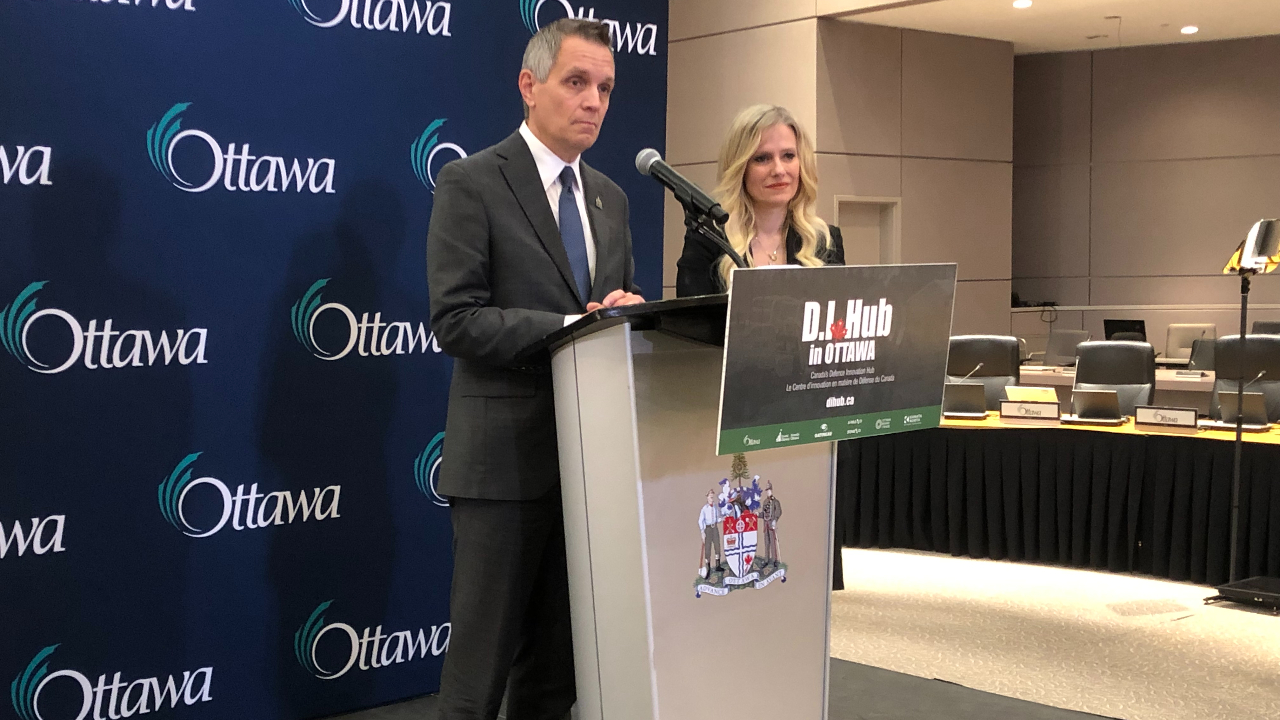
Ottawa Mayor Mark Sutcliffe and Invest Ottawa president and CEO Sonya Shorey unveiled the five-year plan on Tuesday morning at City Hall. It aims to pump up to $3 billion of public and private money into local defence firms, with the goal of helping startups and scaleups create new technologies, tap into new global markets and attract more foreign investment.
“I think this is a moment for Ottawa,” Sutcliffe told the media after the strategy was announced. “This is an opportunity where we can capitalize on the significant increase in defence spending that’s about to occur, and we have what it takes to be part of the federal government’s mission. This is the ideal place to invest in defence innovation.”
Shorey, who heads the city’s main economic development agency, said Invest Ottawa’s projections suggest every dollar invested in local defence companies will generate two to three times as much in economic output.
She told an audience of business leaders IO’s initial analysis predicts the plan could create up to 18,000 jobs and boost the region’s gross domestic product by as much as $9 billion by 2030.
The strategy’s main goals include securing more federal and NATO contracts for local firms; accelerating R&D efforts; establishing a defence aviation and propulsion centre of excellence at Ottawa International Airport to test drones and other cutting-edge technologies; expanding secure labs to trial new defence tech at Area X.O, a testing ground for new technologies that IO operates in the city’s south end; and creating a new compound semiconductor facility in the National Capital Region.
The plan’s advocates also want the federal government to streamline procurement processes for small and medium-sized businesses and hope to encourage new partnerships and joint ventures between homegrown defence firms and tier-one multinationals in a bid to help local companies succeed on the world stage.
The strategy comes as the federal Liberal government is poised to boost defence spending to two per cent of GDP this year and five per cent by 2035 to meet NATO’s targets, which would translate into total defence spending of $150 billion annually in 10 years.
As the spectre of potential cuts to other parts of the public service looms heavy over the region, Sutcliffe said doubling down on defence could help insulate the local economy from the aftershocks of layoffs.
“One of the risks and threats that Ottawa faces right now is that we are dependent on federal government employment, and have been for generations,” he said. “We know that it’s likely that there is going to be a reduction in the number of people working for the federal public service in the years ahead, so we have to work on a number of different fronts to diversify our local economy.
“This is a historic opportunity. We’re going to see billions and billions of dollars being invested in defence technology, and Ottawa is uniquely positioned to capitalize on that.”
Economic development officials said the National Capital Region already has a thriving defence-tech ecosystem that includes more than 330 companies, 10,000 workers, four NATO defence innovation accelerators, the Department of National Defence and other organizations.
“That is an incredible foundation to build upon,” Sutcliffe told the audience at City Hall. “This is our time for our region to lead.”
Sutcliffe said no city money will be spent on the strategy, which is being led by Invest Ottawa and economic development partners in Gatineau.
Shorey said organizers plan to strike a task force in the weeks ahead composed of about 20 members from industry, academia, allied forces and economic development organizations to identify the best opportunities for local businesses to capitalize on.
She cited examples such as drones and counterdrones, autonomous vehicles, semiconductors and next-generation networks as areas where the region could shine.
“These are anchor technologies and the bedrock on which our tech sector is built where we have decades of expertise,” Shorey said, adding one of the plan’s objectives is to eliminate red tape around federal procurement and open “faster pathways to commercialization” for fledgling defence-tech firms.
“It is an evergreen strategy, so we can be adaptable and agile and capitalize on new opportunities as they emerge.”
During a roundtable discussion with Sutcliffe after the strategy was unveiled, local defence-tech leaders agreed the capital region is poised to profit from the federal government’s resurgent interest in defence spending.
“There’s been a real shift over the last few years. People are excited about seeing defence companies like ours gaining some traction,” said Mike Nelson, the founder and chief executive of TACTIQL, a three-year-old Ottawa-based startup that specializes in using AI to generate accurate, high-quality video data from military aircraft.
Nelson said the company, which is profitable, has hired 10 employees – including military veterans as well as software and AI engineers – over the past 18 months and is already selling directly to the federal government.
“I think there’s a ton of opportunity here in Ottawa, and I don’t think it’s possible to get that kind of traction or create that type of value anywhere outside of Ottawa-Gatineau,” he added.
ONE9 founder Glenn Cowan, whose organization specializes in funding defence and security startups, said Canadian VCs have “tens of billions of dollars” ready to finance up-and-coming ventures in the rapidly growing space.
“The opportunity with Ottawa … is to get that capital off the sidelines,” Cowan said. “Canada is well-positioned to lead the world in how to do this properly.”