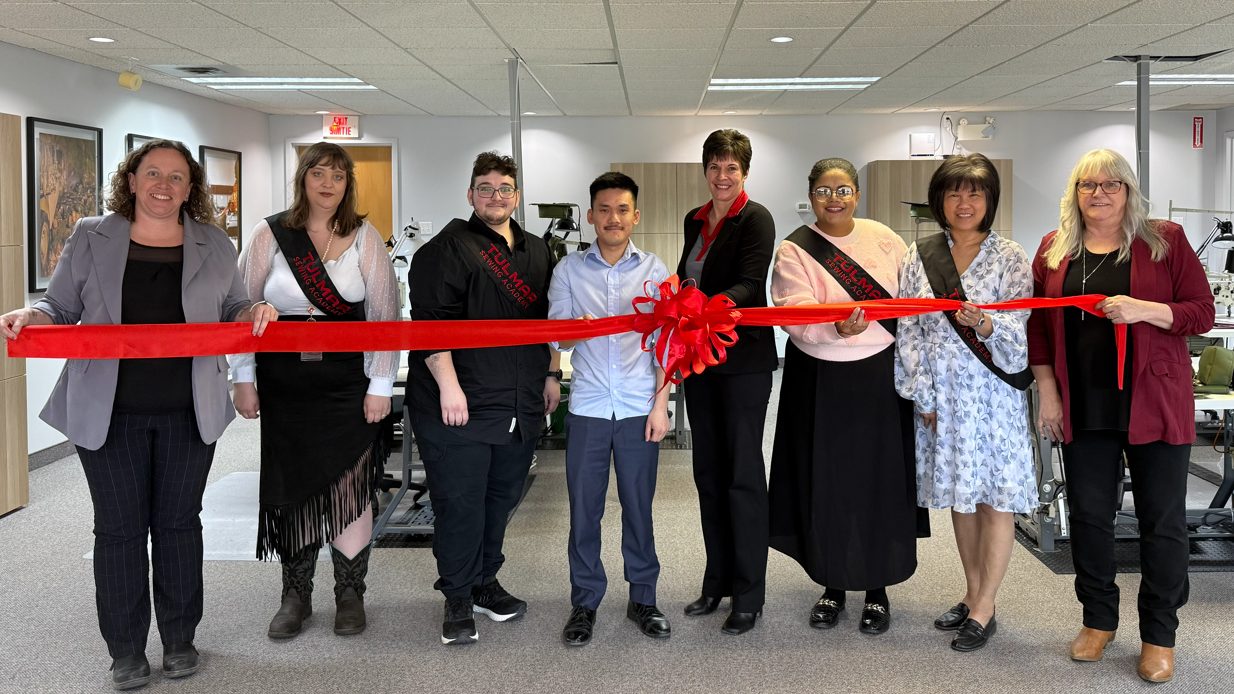

As defence spending around the globe increases, a Hawkesbury-based manufacturer of military gear has had to address an increase in demand for one skill that has nearly disappeared from the labour market: sewing.
“It’s kind of a dying trade right now in Canada,” Darren Liew, director of human resources for Tulmar Safety Systems, told OBJ on Wednesday. “Not a lot of people know how to sew and not a lot of people know how to operate an industrial sewing machine. We’d been looking for local talent, but we just couldn’t find any.”
For Tulmar, sewing is an increasingly essential skill as the company takes on more major contracts to provide its textile-based survival goods and protective gear across aviation and defence markets in Canada and internationally.
With a majority of clothing manufacturing now taking place overseas, Liew said a needle trade labour shortage exists across the Canadian textile industry. The defence industry, however, faces particular challenges due to the complexity of materials used and the products produced.
“It’s not like sewing fabric or cotton,” Liew said. “Most of the time we sew harder types of materials. Think of leather-type material, but also plastic. That kind of material, and the industrial sewing machine, are a lot stronger and more robust than what you typically have at home.”
For example, Tulmar creates tactical life preservers, which are designed for use by civil and military maritime personnel operating in high-risk environments, that it has sold to the Canadian Armed Forces and the Royal British Navy.
With demand for its goods on the rise, Liew said Tulmar needed a way to build its own talent pipeline. As a result, it launched a sewing academy to train industrial sewing specialists.
The four-week intensive program teaches students specialized sewing skills, such as machine controls, shapes, joining and functional construction.
“We looked at technical skills, stitch quality, consistency, speed balanced with accuracy, and also professional behaviour and reliability,” Liew said.
The program’s first cohort completed the program last week, and on Monday all five graduates began full-time roles with the company.
Liew added that none of the five had any previous sewing experience.
“They were completely brand new,” he said. “None of them really knew how to sew or operate a machine. And it’s a very diverse group, in terms of demographics, in terms of background experience. We always say that we can teach technical skills, but we can’t teach soft skills. So that was really the driving factor here in selecting these students.”
And the program won’t stop there.
As federal defence spending ramps up, Liew said Tulmar plans to continue increasing its manufacturing capacity by building its workforce. A second cohort of students is set to begin the sewing program in June.
In a year, Liew said the goal is to have 20 sewers starting new roles with the company.
“That’s a 33 per cent increase for our production headcount,” he said. “Future plans are going to depend on how this year goes, and those major contracts opening up. But we’re building on this manufacturing capability, so we’re ready for more. Defence right now, especially in Ottawa, is going to give us a lot of different opportunities.”
Under the new Defence Industrial Strategy announced in mid-February, the federal government says it plans to spend $6.6 billion over the next five years as part of a 10-year campaign to create tens of thousands of new jobs and raise the share of federal defence contracts awarded to Canadian-owned and -controlled companies.