As they await details of how Build Canada Homes (BCH) will engage homebuilders to tackle the country’s housing crisis, some local companies hope their prefabricated, modular processes can be part of the solution. Build Canada Homes is a new federal agency, launched this year by Prime Minister Mark Carney, that will build affordable housing at […]
Already an Insider? Log in
Get Instant Access to This Article
Become an Ottawa Business Journal Insider and get immediate access to all of our Insider-only content and much more.
- Critical Ottawa business news and analysis updated daily.
- Immediate access to all Insider-only content on our website.
- 4 issues per year of the Ottawa Business Journal magazine.
- Special bonus issues like the Ottawa Book of Lists.
- Discounted registration for OBJ’s in-person events.
As they await details of how Build Canada Homes (BCH) will engage homebuilders to tackle the country’s housing crisis, some local companies hope their prefabricated, modular processes can be part of the solution.
Build Canada Homes is a new federal agency, launched this year by Prime Minister Mark Carney, that will build affordable housing at scale. According to the agency’s website, it will leverage public lands, offer flexible financial incentives, attract private capital, facilitate large portfolio projects, and support modern manufacturers.
Paul Kealey, founder and CEO of Ottawa-based EkoBuilt, established in 2004, welcomes the government’s new initiative and hopes his firm can benefit.
“The heavy emphasis on modular, prefab building fits with our systems and values. We’re hoping there's an engagement process and a proper procurement process –– that the government is not just transfixed on large housing corporations –– because, ultimately, some of them aren't focused on the highest energy-efficiency targets or healthy-building targets.”
The exact criteria for builders to work on BCH projects are not known, but the agency will be able to partner with private-market developers. Initially, BCH plans to build non-market housing on federal land before taking a wider focus on Canada’s housing crisis.
Builders like Kealey underscore the benefit of the prefabricated approach in expediting the construction process.
“Without prefabrication, house projects –– whether they're single homes or small, multi-family buildings –– typically take 12 months,” said Kealey. “When we prefabricate, we can cut that time in about half.”
While he commends Build Canada Homes for aspiring to a sustainable approach, Kealey said he hopes concepts such as energy-efficiency are truly prioritized as the government considers its homebuilding partners.
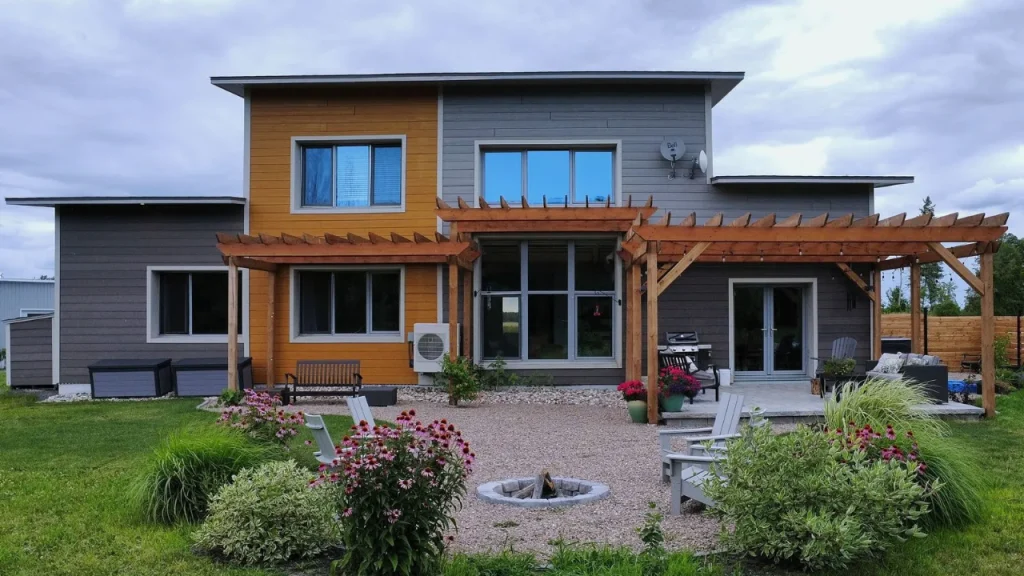
EkoBuilt specializes in “passive house” design, which utilizes a unique building standard for ultra-high energy efficiency.
“The biggest benefits are the energy savings from a heating and cooling perspective. The passive house uses 80 to 90 per cent less energy compared to houses built to code,” said Kealey. “It's easy building a home as cheaply as possible from a dollar-value perspective, but it's very difficult maintaining that low affordability cost into the future if it isn't focused on conserving energy.”
While passive homes cost about 10 per cent more than a standard build, Kealey said that’s negated through savings in utilities, making passive homes a more affordable choice as energy prices rise. Now in six provinces and more than 35 U.S. states, EkoBuilt’s houses are also “hydro-thermically protected,” meaning they are airtight but vapour-open so mold cannot grow within wall or roof systems.
Prefabrication and risk reduction
In the Bank and Heron area, Ottawa’s Theberge Group has just broken ground on its second and third prefabricated modular projects: two, eight-unit apartment buildings. Jeremy Silburt, the firm’s director of acquisitions, planning and development, said he was drawn to the idea of prefabrication as a way to mitigate risk.
“Project development is a very risky game. You run into all kinds of problems on-site with weather delays, changing prices for materials, (issues with) availability of trades,” said Silburt, adding that Theberge also has multiple 200- to 375-unit buildings in traditional, on-site construction. “I thought if I could find a way to do it better, that changes the development game.
“When we build them in a factory with a fixed-price contract, it's very easy for us to get to a tighter number in terms of what our costs are –– we have a smaller contingency to work with.”
In partnership with Guildcrest Homes, another modular builder, Theberge developed a standardized build that could be “rapidly reproduced across the city,” said Silburt. “We came up with an eight-unit design that could be put on a standard-sized lot in Ottawa. Then we could go and do this across multiple lots.”
Silburt said the company’s first modular apartment building went up near Carling Avenue and Churchill Avenue in March 2025. The modular components were built by Guildcrest in Morewood, Ont., about 45 minutes southeast from Ottawa.
“We have plans to deploy a couple more throughout the year,” said Silburt. “We’re venturing into volumetric, modular multi-family. We’re exploring the opportunity of doing that on a larger scale.”