Ottawa’s office vacancy rate jumped roughly a full percentage point in the first quarter as the federal government ditched two big chunks of space and a major retailer put a portion of its head office up for lease. Two of Canada’s biggest commercial real estate brokerages released their first-quarter office vacancy statistics Wednesday, with both […]
Get Instant Access to This Article
Become an Ottawa Business Journal Insider and get immediate access to all of our Insider-only content and much more.
Ottawa’s office vacancy rate jumped roughly a full percentage point in the first quarter as the federal government ditched two big chunks of space and a major retailer put a portion of its head office up for lease.
Two of Canada’s biggest commercial real estate brokerages released their first-quarter office vacancy statistics Wednesday, with both reports showing a rise in the amount of empty space for lease in the Ottawa region.
CBRE pegged the city’s vacancy rate at 14.3 per cent at the end of March, up from 13.2 per cent in December 2025, while Colliers said office vacancies rose 0.9 per cent quarter-over-quarter to 12.9 per cent.
(The two companies’ figures often differ based on when they consider space to be officially empty.)
CBRE reported there was more than 413,000 square feet of negative absorption in the Ottawa market in Q1, driven largely by the federal government’s decision to vacate 114,000 square feet of space formerly occupied by Public Services and Procurement Canada at 1550 Carling Ave. and 112,000 square feet at an office at 59 Camelot Dr. that was home to the Canadian Food Inspection Agency.
While that suggests the feds – the region’s larger occupier of office space – are still downsizing their overall footprint, some commercial real estate executives say they think the pendulum is about to swing the other way as the government gets set to mandate its employees back to the office four days a week starting in June.
“I think we’re in that digestion period, where we haven’t felt the full momentum of the return to office from the federal government, and yet we’re still seeing some of that older space come to market,” said Maxime Foucaud, managing director of CBRE’s Ottawa office. “We’re hopeful that we’re on the tail end of that.”
Shawn Hamilton, a principal at Proveras Commercial Realty, agreed the tide could start to turn once the feds’ four-day-a-week office policy is officially in place.
“We are the last place on the face of the planet where return-to-office seems to be a debate,” he said. “I would suggest now at this point that the (vacancy) statistics that we’re seeing right now are just a lag, and I expect them over the course of the next little while to change.”
Hamilton said he expects the federal government to resume more leasing activity after years of shrinking its footprint as it reassesses the condition of some of its existing offices that may have deteriorated since the pandemic.
“I would suggest there’s enough evidence in the math equation to suggest that public works will likely be a candidate to start … leasing (more) space,” he said, adding he wouldn’t be surprised to see some “high-profile renewals” and a new wave of requests for space from the feds in the coming months.
“I think we will start to return to something that looks much more normal or much more in line with what we were used to pre-pandemic.”
Warren Wilkinson, senior managing director of Colliers’ Ottawa office, said brokers will have a better picture of where the office market stands by the end of the year.
“I think we’re going to be in a wait-and-see pattern until the fall hits and we see the true impact of the federal government’s return-to-office policy in effect – if it actually comes into effect,” he said, adding he doesn’t anticipate any “major swings” in the vacancy rate between now and then.
The federal government wasn’t the only occupant to pull out of a significant tranche of space last quarter.
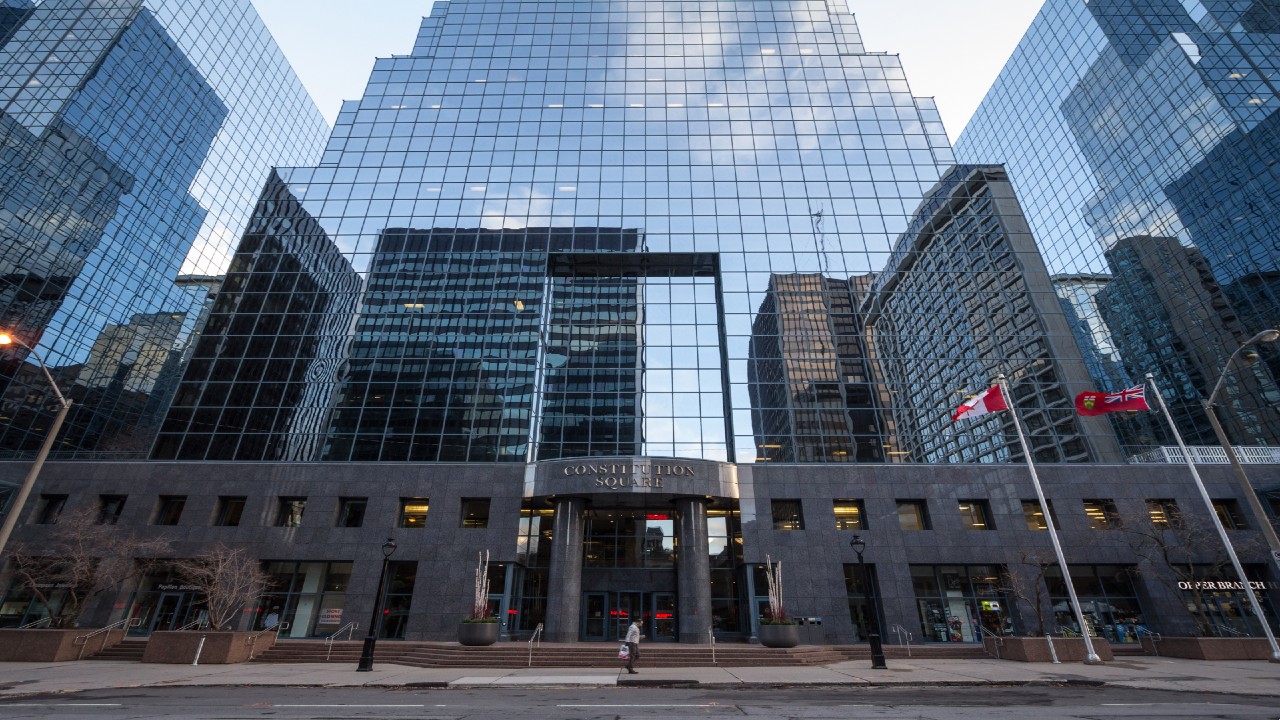
Colliers said the amount of total leased office real estate in Ottawa declined by 372,000 square feet last quarter – including three full floors at Constitution Square being put back on the market. That pushed the downtown vacancy to 13.5 per cent, up from 13.3 per cent in the fourth quarter of 2025.
The firm said the vacancy rate in the fringe core – the area just on the cusp of the central business district – rose to 17.8 per cent in the first quarter from 16.7 per cent at the end of December as multiple tenants vacated their offices.
Meanwhile, in the suburbs, Giant Tiger has put 106,000 square feet of space at its head office on Walkley Road up for lease.
Spokesperson Alison Scarlett said Wednesday the iconic retailer’s move to a hybrid work model means it does not need to occupy all of the four-storey, 173,800-square-foot building at 2480 Walkley Rd., which opened in 2021.
“As part of this approach, and in response to evolving workspace needs, we’ve optimized our office footprint and are offering a portion of our space for lease to external businesses,” Scarlett said in an email to OBJ.
While office vacancies are still on the rise, Wilkinson cautioned against reading too much into the latest statistics.
He said the first-quarter numbers were skewed by a few major tenants not renewing their leases and other long-vacant space finally being added to the city’s leasing inventory.
The Business Development Bank of Canada, for example, has moved out of a 73,000-square-foot building at 700 Silver Seven Dr. that housed its Kanata office, while an empty 26,000-square-foot building at nearby 350 Palladium Dr. is also now on the market. Both buildings were purchased by California-based cybersecurity giant Fortinet in 2022 and are now being offered for sale and lease.
Wilkinson said there has been an uptick in touring activity among tenants, while more and more smaller chunks of space are being leased.
“The numbers don’t reflect the activity that we’re seeing within the market, which continues to make us optimistic,” he said.