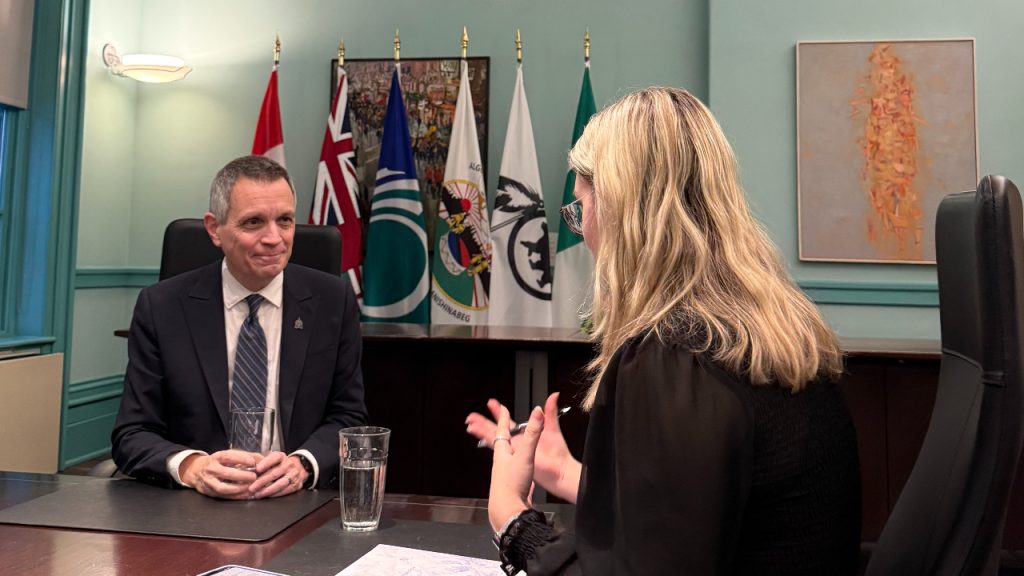
As he enters the last year of his current mandate, Ottawa Mayor Mark Sutcliffe sees challenges and opportunities ahead.
Although 2025 was marked by economic uncertainty and the lingering effects of the pandemic, Sutcliffe said it also saw levels of collaboration he has not witnessed in the three decades he’s been watching the economic development of the city. From LeBreton Flats to Lansdowne, and from tech to tourism, Sutcliffe said he’s prepared to work with all stakeholders to further the growth of the city’s economy.
With a municipal election slated for next fall, Sutcliffe sat down with OBJ to discuss what’s been accomplished in his mandate and what messaging he’ll be sharing with the business community in next year’s campaign.
The transcript has been edited for length and clarity.
Q: Over the past year, what three things has the city accomplished that have been impactful or meaningful for the business community?
“First, I'll start with housing. We heard over and over again from the (business) community that they felt that the process of building a home in Ottawa was too slow, cumbersome and expensive, so we put together the housing innovation task force. We had members of the community on that task force, working with our team at the city. They came up with a whole bunch of recommendations and we were able to move the vast majority of those recommendations forward. So we now have a housing action plan with 53 initiatives. We're in the process of implementing that now to make the process of building homes easier, faster and cheaper. We're streamlining the process, eliminating and deferring fees, cutting red tape, so that it's easier to build homes. I'm happy to say that it's been described as the most ambitious housing plan in Canada. That's a big step forward.
“Second, we've spent a lot of time working on the local economy in the past year. It's been a great year for tourism and events. We had the World Juniors. We had Ironman Canada, which is going to be a recurring event. We've brought record numbers of tourists to the city this summer. We're working on our defence innovation strategy to attract investment to the city. We've been working on a number of different initiatives to support the technology industry in our city, working with Invest Ottawa, the Kanata North Business Association. So economic development has been a huge priority as well.
“I would say a third area would be downtown and the ByWard Market. We still have a lot of progress that we need to do, but we've been doing some creative things, such as the Street Seats program in Centretown, improving security in the downtown and the ByWard Market, working with the new ByWard Market District Authority to have more of a police presence and more outreach workers in the Market, and History Ottawa, the new concert hall that's coming to the Market from Live Nation.”
Q: Over your mandate to date, what three things has the city accomplished that have been impactful or meaningful for the business community?
“Again, the economy is really important. We can't tackle all the other challenges we have as a community if we don't have a strong economy, if we're not creating jobs and working towards economic growth. I've been around the economic development scene in Ottawa for 30 years and I've never seen the kind of collaboration that's taking place right now in our city. Look at Invest Ottawa, Ottawa Tourism, the Ottawa Board of Trade, the Regroupement des gens d’affaires, the BIAs, the Kanata North Business Association – all those organizations are working very effectively together in the best interest of our local economy and that's really powerful. We have the right people and we have the right kind of collaboration to tackle some of the economic issues that we're facing. We need a strong economy and we're facing the prospect of federal government job cuts and so we need to continue to diversify our economy and invest in areas like technology, defence, innovation and tourism.”
Q: When you think of impact on the business community, what are a few things that the city has yet to accomplish or could be improved?
“We still have a lot of work to do on all of these things. We need to look at how we can bring more people downtown. We've had big growth in traffic to the ByWard Market, but we want more people living and working downtown. We want more people coming to events and attractions, coming to dine and shopping downtown. So there's still more work to be done there. I think there's an opportunity for how we might convert some downtown buildings to residential. There's still more we need to do around homelessness and supportive housing, support for the most vulnerable people with mental-health challenges, substance use issues. So we're not done yet. We’ve got to keep working on all of this.”
Q: You come from a background as an entrepreneur and business owner. How has that helped or hindered your work as mayor?
“First of all, I think City Hall is not a business. I don't think the idea is to come in and run municipal government like a business. That's not how it works. But having a business background has helped me understand the priorities around economic development in the community and the needs of business owners in our community. I have a lot of relationships with the business community in Ottawa. Again, we need to have a strong economy. We need to create more jobs. We need to grow the local economy and continue to work with the other levels of government. I think my experience in business has helped me do that. I see tourism as a huge priority, drawing more events to our city. I see the technology community as a big priority, as well as the small business community. So we're doing everything we can to make life easier for business owners, rather than what sometimes happens in government, where you're putting more obstacles in their way.”
Q: Similarly, how has your career as a journalist helped or hindered you in your political career?
“My long career in the media has helped me really understand the city. Over the course of my career, I've covered every part of the city, geographically, every sector in the community – the not-for-profit organizations, the businesses, the community leaders. So I know the city really well. From that experience, I've spent a lifetime immersed in the community. That's been very helpful. I think that part of the job of being mayor is not unlike your job, where you're taking big, complicated files and you're trying to organize them in a way that you can communicate them to the public and underscore what's important about those issues. Obviously my communications background has played a role in this job. When you work in the media, you certainly get to know the community and all the issues and all the people.”
Q: How would you describe downtown Ottawa today? Do you think it’s healthier than when you started your mandate in 2022?
“I think so. First of all, I'll say downtown Ottawa has changed a lot over the course of my lifetime. It's amazing to see how much it's changed. When I was a kid, the Rideau Centre opened as well as the convention centre. Now we have a newer convention centre, the Rogers Centre Ottawa, which has been fantastic. It's an award-winning facility. There's a lot more happening downtown than when I was a kid.
“In the last three years, I think what we're seeing has been a slow but progressive recovery from the pandemic. There's more people coming downtown now than there was in 2022. There's more people coming downtown to work, to shop, to go to events. Traffic to the Byward Market is up significantly this year, which is really encouraging. We're seeing more activity in the downtown core and I think that the opportunity that's arisen out of the pandemic is that we can think of downtown as not just a place that people go to work. Prior to the pandemic, it was very much the case that people came downtown, largely public servants, in the morning, went to the office, maybe went out for lunch or did a little bit of shopping at lunchtime, and then they went home at the end of the day. Maybe some of them stuck around and went out for a meal with their friends, that kind of thing. There will always be a significant number of people working downtown in the government and in private business, but I think we're going to see more reasons to come downtown that are not just about work. I think that's a great opportunity.”
Q: What is your view on the city potentially providing funding to help build a new arena at LeBreton Flats?
“As I've said many times, I don't think that the public wants to see their municipal government give money directly to a professional sports organization or a professional sports arena. I don't think that's something that the public wants to see. But having said that, the prospect of having a new event centre in downtown Ottawa is really exciting. I applaud the Ottawa Senators for all the work that they've done on this. I think it would be great for downtown. It'd be great for the community. Of course, we always have to make sure that, if the Senators move downtown, that there's a solution for Kanata and for the west end of our city. The Canadian Tire Centre has been a big economic driver for that part of the city, so we’ve got to make sure we're replacing that with something else. It's a huge opportunity for the city and we're ready to work with the Senators as well as our federal and provincial partners on whatever that development is going to look like going forward. There are many different ways we can play a role in that, even if we're not providing funding to pay for the construction of the arena, which I don't think anybody wants to do.”
Q: You seem to work well with other levels of government and other stakeholders. How have you accomplished this?
"It's interesting, because I think one of the most important parts of my job is to have a great relationship with the provincial government at Queen's Park and the federal government on Parliament Hill. I think that in part because I came to this job as a non-partisan. I was never part of any political party before and still am not a part of any political party. That's never been part of my background. And because I wasn’t previously elected at another level of government within a party, I was able to work effectively with the Progressive Conservative government at Queen's Park, with Premier Doug Ford, and with the Liberal government on Parliament Hill under (former) prime minister Justin Trudeau and now with Prime Minister Mark Carney. Those relationships are vitally important. I think it's impossible to be an effective mayor without building strong relationships with those two levels of government. At times, we're not going to agree on everything, but I think it's important to maintain a productive, respectful relationship. There are times when, in the past, municipal politicians have taken on the role of being a critic of another level of government, or have participated in election campaigns. I don't think that's appropriate. I think my job is to be an effective advocate for the people of Ottawa, at Queen's Park and on Parliament Hill, and that requires me to have a strong working relationship with whoever is in government at both those levels and I'm proud of the fact that I've been able to do that.”
Q: We’re entering an election year. You’ve said you plan to run for re-election. What campaign messages will you be sharing with the business community?
“I haven't spent a lot of time thinking about the campaign, because it's still 10 months away. I still have a job to do and there's still a lot of work to do all the way through next summer. I'm sure the election campaign will take place in September and October of next year, but my focus right now continues to be to do the job that I was elected to do. But I think my message will be similar to what it's been all along. I don't think we can succeed as a city if businesses are not flourishing, if we're not expanding and growing our economy, if we're not a business-friendly city and if we're not creating jobs. We won't have the resources to tackle all of the other challenges if we can’t accomplish those items. I'm very supportive of the small business community. I'm a partner with Invest Ottawa, the board of trade, Ottawa Tourism, RGA and all the local organizations that are supporting business. I'll continue to be someone who believes in the value of a strong private sector and a strong economy in our community. I’ll be prepared to do whatever it takes to support business owners as they do amazing things in our community.”
Q: If you were re-elected as mayor, what would be your priorities for the economic health of the city?
“I think we need to continue to diversify our economy. There's some huge opportunities right now that have arisen out of the unique circumstances we're facing with the federal government wanting to strengthen our national defence and the Canadian military. With the federal government wanting a more sovereign economy in light of the tariffs that have been imposed by the U.S. government, I think there's a huge opportunity. We’re also seeing the potential for enormous growth in areas like AI, autonomous vehicles and drones. Invest Ottawa has been doing great work through Area X.O by leading the way on some of those initiatives. We have some great, world-class companies in those areas. We need to continue to support that growth. We also need to continue to support the tourism industry, by bringing more events and visitors to our city. It represents a lot of jobs and it's been a great success so far. We have even more potential with new attractions with the new event centre that we're building at Lansdowne Park. That has the potential to bring more amazing events to our city.”
Q: This was your first political post. What 3-4 words would you use to describe your experience?
“It's been fascinating. It's been a great privilege to serve the people of Ottawa. I've lived here my whole life. My parents were immigrants to Canada. They chose Ottawa, met here and got married. Having an opportunity to contribute to my city and to serve my hometown has been a huge privilege and honour and it's been a fascinating experience. And I'm glad I've been given the opportunity to make a difference and I hope I'll be able to continue doing that.”
Q: Is there anything else you’d like to add?
“I think it's a really interesting time in Ottawa for our local economy. It's a challenging time. There are a lot of threats and headwinds. I know there's a lot of economic uncertainty in Ottawa because of the trade war with the United States, the shifting global environment, changes to the federal government employment situation. But I also think it's a time of huge opportunity and I'm always going to look at it that way. We have a chance now to do some really exciting things, to capitalize on some of the investment the federal government is making. We have the opportunity to bring more people to our city, bring more companies and jobs to our city. One day, we're going to look back on this time as a period when there was change, but where we built a brighter future for the city and for our country. We’ll look at how we made some big decisions that will position us well for the next 20 or 30 years. So I'm very excited about all that.”