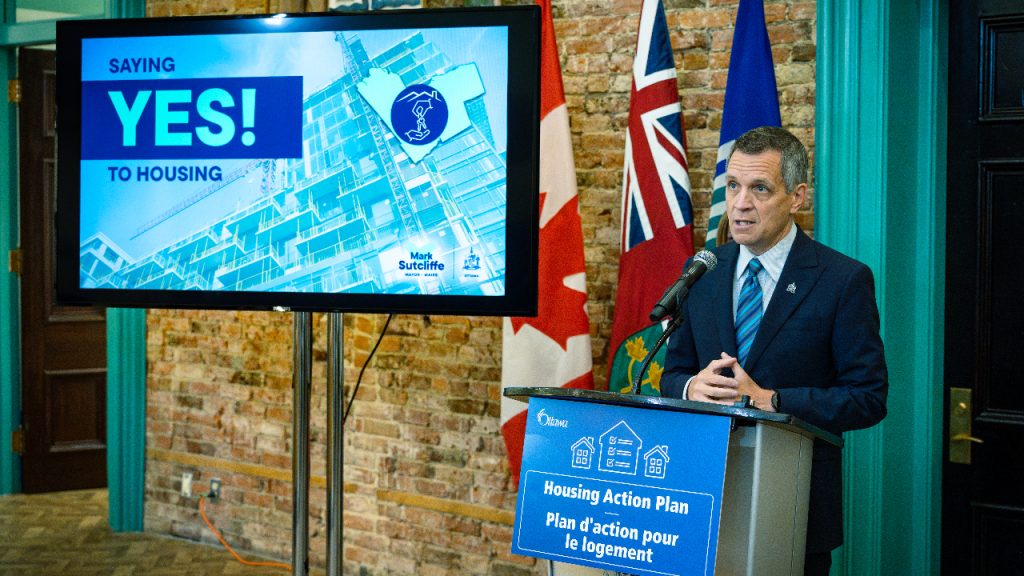
Mayor Mark Sutcliffe unveiled the plan Friday morning, saying it contains more than 50 recommendations aimed at speeding up the pace of housing starts in the city.
Already an Insider? Log in
Get Instant Access to This Article
Become an Ottawa Business Journal Insider and get immediate access to all of our Insider-only content and much more.
- Critical Ottawa business news and analysis updated daily.
- Immediate access to all Insider-only content on our website.
- 4 issues per year of the Ottawa Business Journal magazine.
- Special bonus issues like the Ottawa Book of Lists.
- Discounted registration for OBJ’s in-person events.
A group representing homebuilders says it hopes a new city plan to waive or pause fees such as development charges and cash-in-lieu of parkland fees on office-to-residential conversions will kickstart more construction in Ottawa.
Mayor Mark Sutcliffe unveiled the plan Friday morning, saying it contains more than 50 recommendations aimed at speeding up the pace of housing starts in the city.
“This is quite simply the most ambitious housing plan in our city’s history,” Sutcliffe said during a news conference at City Hall. “Building homes has become too slow, too expensive and too complicated. We’re going to make it easier to get shovels in the ground.”
The plan includes several moves to freeze or eliminate a range of fees now charged to developers, such as pausing community benefit charges for the next five years. The fees, which are charged to builders of many multi-residential housing projects, can amount to four per cent of the value of the land.
Other measures to reduce fees include deferring development charges interest-free until “much later” in the development process, a move the provincial government is also pursuing in its new Bill 17.
In addition, fees developers now pay instead of dedicating land for parks when they convert office buildings to residential complexes would be permanently scrapped.
Jason Burggraaf, executive director of the Greater Ottawa Home Builders’ Association, said moves such as deferring development charges, as well as the city’s recent decision to dedicate two lawyers to reviewing development agreements, are signs city hall is taking the housing crisis seriously.
“All of those are good, long-term structural changes that will allow us to hit our housing goals on a consistent basis over the long term,” he said. “There’s great enthusiasm that the city is really stepping up and committing to addressing these issues. This is a substantial move on the city’s part – maybe the most that they’ve done in the time that I’ve been here.”
Burggraaf also cheered the plan to eliminate cash-in-lieu of parkland fees on office-to-residential conversions, saying it would make them more financially viable for developers.
“We’ve had a handful of projects that have converted over already or are almost done, and we want to see more of those,” he said. “There’s a nice cluster of buildings in the core of Ottawa that we could really benefit from being converted to residential. Everything the city can do to smooth that process is going to help revitalize the core.”
CLV Group president Oz Drewniak also gave the move the thumbs-up. He says his firm shelled out close to $2 million in parkland fees for conversion projects on Albert Street and Laurier Avenue, and he questions why the charges are necessary for buildings that are already "part of the downtown fabric."
"The difference between a conversion and a new build is that the (converted building) is already in place, and the benefit that we’re bringing is the revitalization of downtown," he said. "Reducing or eliminating those fees is a step in the right direction.”
Sutcliffe said the city is also looking at other measures to make it easier to turn obsolete office buildings into housing, such as creating “accelerator programs” for conversions.
When asked whether the city would consider incentives such as those offered in Calgary – where developers can receive subsidies of up to $75 per square foot on completed conversion projects – he said city officials will “work with the community” to “come up with some ideas on what’s possible” and report back.
The mayor also said he’s consulting with federal officials and local members of Parliament to determine if any of the downtown office buildings on the federal government’s list of aging properties it’s planning to sell are suitable for conversions.
“We need a plan for downtown Ottawa,” Sutcliffe said. “We need to talk about how they're going to dispose of some of the buildings that they have said they no longer need and that they plan to dispose of, what’s going to happen to those properties, are any of them suitable for conversion, what other purpose can they be used for.
“I’m speaking regularly with local representatives, with the prime minister as well, on how we build a plan to dispose of those buildings in a responsible fashion in a way that leads to more housing and more residential development in the downtown core.”
The plan aims to ease the burden on homebuilders in other ways, such as reducing the number of studies builders are required to produce and looking at how AI could be used to speed up the development process.
“It seems like they’re trying to find ways to expedite the process and move developments along," Drewniak said. "Right now, we’ve got to move. Time is a killer. We’ve got to get buildings built … so affordability can become more of a reality.”
The Ottawa Real Estate Board also hailed the proposals as a positive step.
“We have urged governments to reduce bureaucratic barriers, streamline development approvals, and invest in enabling infrastructure,” the board said in a statement on Friday afternoon.
It said such measures “are critical to restoring supply and affordability in Ottawa,” adding the plan’s “commitment to simplifying the regulatory environment and expediting approvals reflects those priorities.”
The city missed out on tens of millions of dollars in provincial funding through the Building Faster Fund after reaching just 63 per cent of its target of 12,583 housing starts in 2024. Builders in Ottawa have picked up the pace this year, launching 6,694 new units in the first eight months of 2025, compared with 4,374 during the same period last year.
Sutcliffe said that while macroeconomic factors such as interest rates and rising material costs are beyond the city’s control, there’s still a lot the municipality can do to make it easier for developers to get new projects off the ground.
“We have to own our part of the problem,” he said. “We need to be accountable for our role in the housing crisis, and we need to fix it.”
Sutcliffe said he’s keen to take action on many of the recommendations as soon as possible, explaining that if council approves the plan on Oct. 8, 40 per cent of them will be implemented “immediately.” Another 40 per cent would be implemented over the next year.
“What we can control is the speed at which new units are approved and the costs associated with those new units,” he said. “We heard feedback that we need to do better, and we’re going to do better.”
The recommendations come from the housing innovation task force, an advisory group appointed by the city earlier this year consisting of developers, real estate executives and other housing officials. It is chaired by Ottawa Board of Trade chair Brendan McGuinty and Debbie Stewart, general manager of the City of Ottawa’s strategic initiatives department.