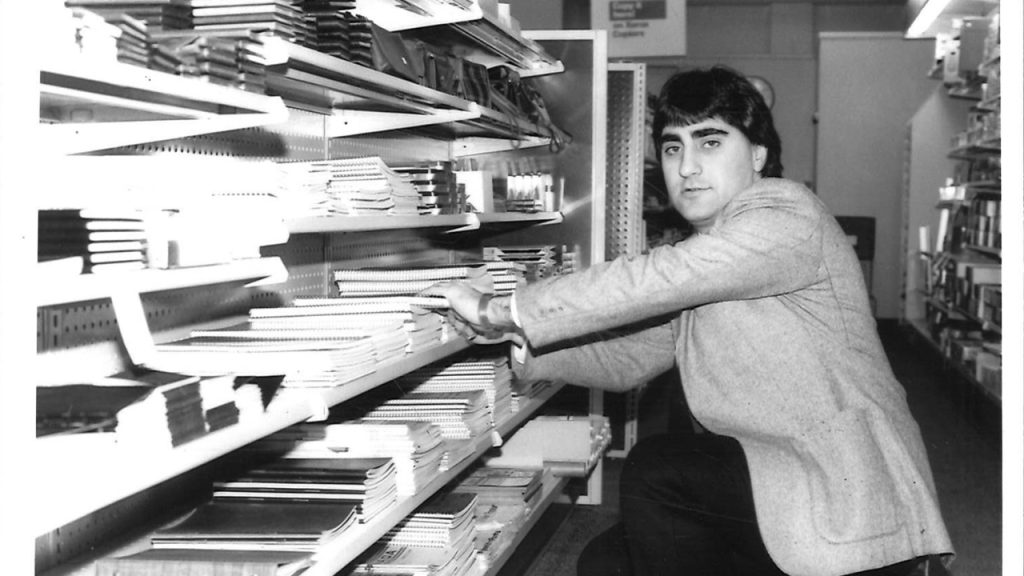
Shahé Avedissian has been adapting to the needs of his customers since before he even opened his business.
In 1980, Avedissian’s father was running a sewing machine business at 226 Laurier Ave. E., a venture Avedissian told his father was ill-suited for the prime location in Sandy Hill.
“I said, ‘This isn’t working out. This is student territory. We’ve got to look into (selling) student stuff,’” Avedissian told OBJ on Thursday.

Local businesses face hiring obstacles due to immigration pullback, flawed screening
In his 39 years of practicing immigration law, Warren Creates (a rare Law Society Certified Specialist) has never seen an environment so challenging for employers looking to hire workers from

How The Ottawa Hospital uses AI tools to boost health outcomes and streamline clinical efficiency
Dr. Douglas Manuel says it all began with the Ottawa Ankle Rules algorithm, a set of clinical guidelines developed in the early 1990s by The Ottawa Hospital’s Dr. Ian Stiell
Seeing a gap in the market in Ottawa, he wanted to introduce an idea he’d seen do well in Montreal.
“There were a lot of stationery stores in Ottawa, but they were just stationery stores. There was no printing. In Montreal, I came across several ‘papeteries,’ or office supply stores, where they offered stationery and printing. That concept wasn’t here yet,” he said.
So, in 1985 at 21 years old, Avedissian opened Laurier Office Mart in what was once his father’s sewing machine business. At the beginning, he said he sold everything students would need in the pre-digital age, from binders to loose-leaf paper and highlighters.
“We started predominantly as a retail outlet to serve the University of Ottawa clientele. Over time, we were able to obtain different marketing tools that gave us catalogues and flyers so that we (could) expand our business into commercial, selling to offices,” he recalled, adding that his business would supply offices with everything they would need, from stationery for employees to janitorial products and lunchroom supplies.
As time went on, Avedissian continued to identify areas where the business could grow, adding retail services such as key-cutting and shipping to his offerings.
“(With) the evolution from photocopying to digital printing, about seven or eight years into the business, our volumes for printing started to drop,” Avedissian said. “So we increased our services (on) the retail level (and became) an authorized shipping centre for FedEx.”
More recently, when the pandemic hit, Avedissian said that while there was an initial shock, the business prospered as it capitalized on the need for personal protective equipment.
“(Businesses) still had their employees coming in and, in order to protect employees, there was a lot of demand for hand sanitizers, masks (and) shields … It was unbelievable. The masks that are sold today go for around $7.99 a box. They were being sold for $65 for a box of 50 masks at the beginning of COVID,” he said.
As office work has evolved since the pandemic, Avedissian said he’s shifted his business focus to keep up with demand.
“As (work) models shifted to hybrid, reality started kicking in and commercial business dropped. Just like any investment portfolio, if you’re diversified, you can protect yourself. Our commercial (business) dropped, so our retail services started rising again,” Avedissian said, adding that the business recently launched passport photo services to accommodate a rising need for travel documents.
Two of the biggest challenges he’s faced have been the transition to digital tools and the rise in popularity of e-commerce sites such as Amazon.
“We used to sell binders, tabs and a whole chain-effect of things. Now we hardly sell any of these products compared to before, because everything is on (students’) laptops and phones. We used to be a dealer with HP Direct for scientific and business calculators. Students used to come in and buy these things at $350 a pop, (but) all those things are gone with technology now … With the key stroke of their computer, the consumer can have access to a lot more stuff than they did before, even at the commercial level.”
As with any other business, consumer demands at Laurier Office Mart will always change, Avedissian said, and he and his team have done their best to predict where the market will go.
With a focus on the business’s more profitable service offerings, Avedissian said Laurier Office Mart is still waiting to see where the world of work and school will go next. While he said he isn’t sure workplaces will ever look like they did 15 years ago, he is still holding out hope for what changes may happen in the coming years.
“If everybody starts going back to work five days a week, that’s a plus for us. People will hang around the coffee room areas, so they’ll need coffee cups and plates again … If it comes, we’ll be there to serve, but it’s not something that we’re going to try hard to get.”
Avedissian’s ability to adapt with a changing landscape is what’s kept the business afloat for 40 years, he said, and it’s an ability he has passed down to his son, who is preparing to take over the business.
“In every business, there’s always (a need) to follow what’s happening in the industry. If we weren’t, if we didn’t make the changes we did, we probably would have closed our doors long ago. (But) we just renewed our lease for another seven years, so obviously I have confidence in what we’re doing.”