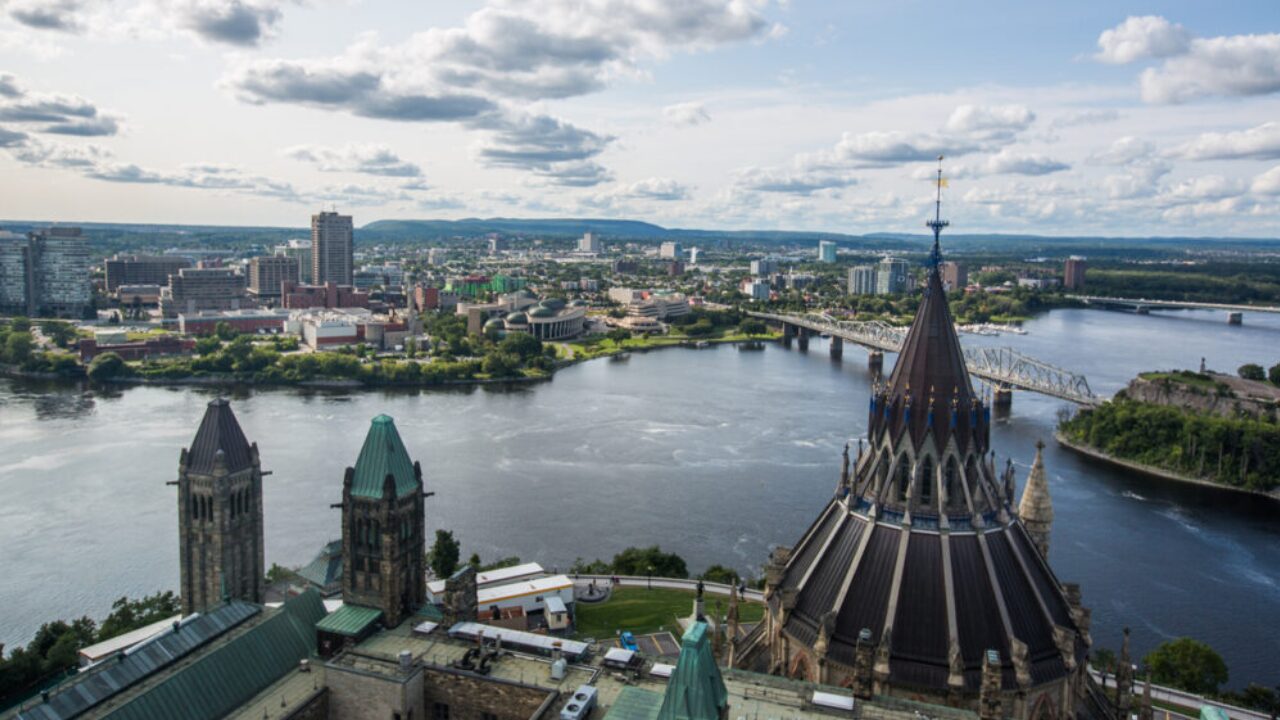
Concerns about downtown Ottawa have been top of mind for local officials, but just across the Ottawa River, business leaders in downtown Gatineau are ringing the exact same alarm bell – perhaps even more loudly.
Since the pandemic, concerns about the “hollowing out of the core” and the departure of federal employees from downtown Ottawa have been top of mind for local officials.
But just across the Ottawa River, business leaders in downtown Gatineau are ringing the exact same alarm bell - perhaps even more loudly.
According to a recent report by the Observatoire du développement de l'Outaouais (ODO), federal employees have left downtown Gatineau in droves in the past five years, as government departments moved to work-from-home and hybrid work models.
In 2021, 14,460 federal workers remained in downtown Gatineau, a drop of nearly 60 per cent from the 36,000 employees who worked in the area in 2016, the report said.
And while downtown Ottawa grapples with the repercussions of a similar exodus, the situation in Gatineau’s downtown is heightened, one official said.
“We have developed the City of Gatineau over the last 50 years around the government occupation of the downtown area,” said Stéphane Bisson, president of the board for the Gatineau Chamber of Commerce. “The situation in Ottawa — it does have other business: law, the lobbying offices, the embassies. You still have some kind of heartbeat. We don’t have that in (Gatineau).”
Bisson described one pre-pandemic decision by the federal government as being particularly impactful. In 2019, employees were removed from the Place du Portage office complex in the Hull sector, while the government undertook a major rehabilitation project on the facility.
“This is a building that, when you come in from Ottawa over the bridge, you see those two big towers that have been stripped totally of their contents,” he said. “Those buildings have been basically empty since 2019.”
Combined with the government’s current, more permanent post-pandemic hybrid work model, the impact on the area’s business sector has been significant.
“We’re seeing less traffic downtown because the amount of people who work downtown (has gone done),” Bisson said. “And basically, we have a wave of businesses that have decided to shut down. If you don’t have any pedestrians, the businesses who are there are becoming like destination businesses. You need to go there in order to spend money there. That changes the whole picture.”
Vision for the future needed
In order to address concerns in the area, Bisson said business and government leaders from both sides of the river need to come together to identify joint priorities.
“We are missing a vision for downtown,” he said.
According to Bisson, Gatineau’s urban development plan will be revised in 2024 and 2025 to adjust the city’s vision to current challenges. He said the last time it was revised was in 2010.
“It’s been a long time; the landscape has changed,” he added.
Bisson’s priorities for Gatineau’s downtown are similar to those cited by business leaders in downtown Ottawa. For him, increasing density is top of mind, in order to address a lack of affordable housing and increase traffic in the area. He also wants to see plans for dealing with vacant buildings, especially empty government offices.
“We need a plan for converting some of these buildings into residential,” he said, something that Ottawa leaders have also been prioritizing.
There are also unique opportunities in downtown Gatineau, he said.
For example, despite some uncertainty, discussions are still underway to build a 600-bed “mega-hospital” campus in the industrial district near the city centre, just west of Lac Leamy.
“That will bring more activities, more people,” said Bisson. “The hospital could drive 6,000 vehicles, but also 20,000 people per day that will go in and out. From visitor, to patient, to worker. That will bring a lot of movement to the downtown area.”
Bisson would also like to see more engagement from the provincial government, including the Quebec premier, whom he said made an election promise to build a new congress centre downtown, including a hotel.
“That will also make the area more interesting,” he said. “In concert with the (Palais des congrès de Gatineau) and the Shaw Centre in Ottawa, we could attract more people to the Gatineau-Ottawa area.”
Collaboration underway to address regional concerns: OBOT
According to Sueling Ching, president and CEO of the Ottawa Board of Trade, the similarities between downtown Ottawa and downtown Gatineau present opportunities for collaboration.
“We’ve been working with the Gatineau Chamber of Commerce for a few years because we believe that regional economic development is critically important to the prosperity of the National Capital Region,” she said. “We have a lot to gain by pooling our resources and our efforts and leveraging the whole region as opposed to two separate cities.”
According to Ching, the two organizations signed a memorandum of understanding in 2019, outlining an action plan for the region, but efforts were derailed by the pandemic. Instead, they undertook joint initiatives to address pandemic-era concerns that hit both cities hard.
“When you say there are a lot of similarities, I would say it’s almost exactly the same situation,” she said. “Ottawa and Gatineau together are disproportionately impacted because of the federal presence. Both have physically built their cores around the public service, and businesses have built to serve that work as well.”
OBOT is currently in the process of developing a Downtown Ottawa Action Plan, which Ching said is likely to be released in March or April this year. According to Bisson, Gatineau business leaders are working on their own plans to address issues in their core.
Ching said presenting a unified front for the National Capital Region is an important part of the process. But it isn’t always easy to collaborate on joint issues interprovincially.
“It’s such a unique situation here, with two separate provincial jurisdictions,” she said.
Still, both organizations hope to take advantage of less-than-ideal circumstances and turn them into positive change.
“It’s a huge opportunity to reimagine our downtowns into something that’s even more diverse, more vibrant and more resilient than we might not have otherwise ever imagined doing,” Ching said.
Bisson agreed.
“We have plenty of qualities that are complementary to each other, a couple that come from different perspectives,” he said. “When a crisis happens, it forces us to be more creative, to think outside the box. That’s what we’re doing right now.”