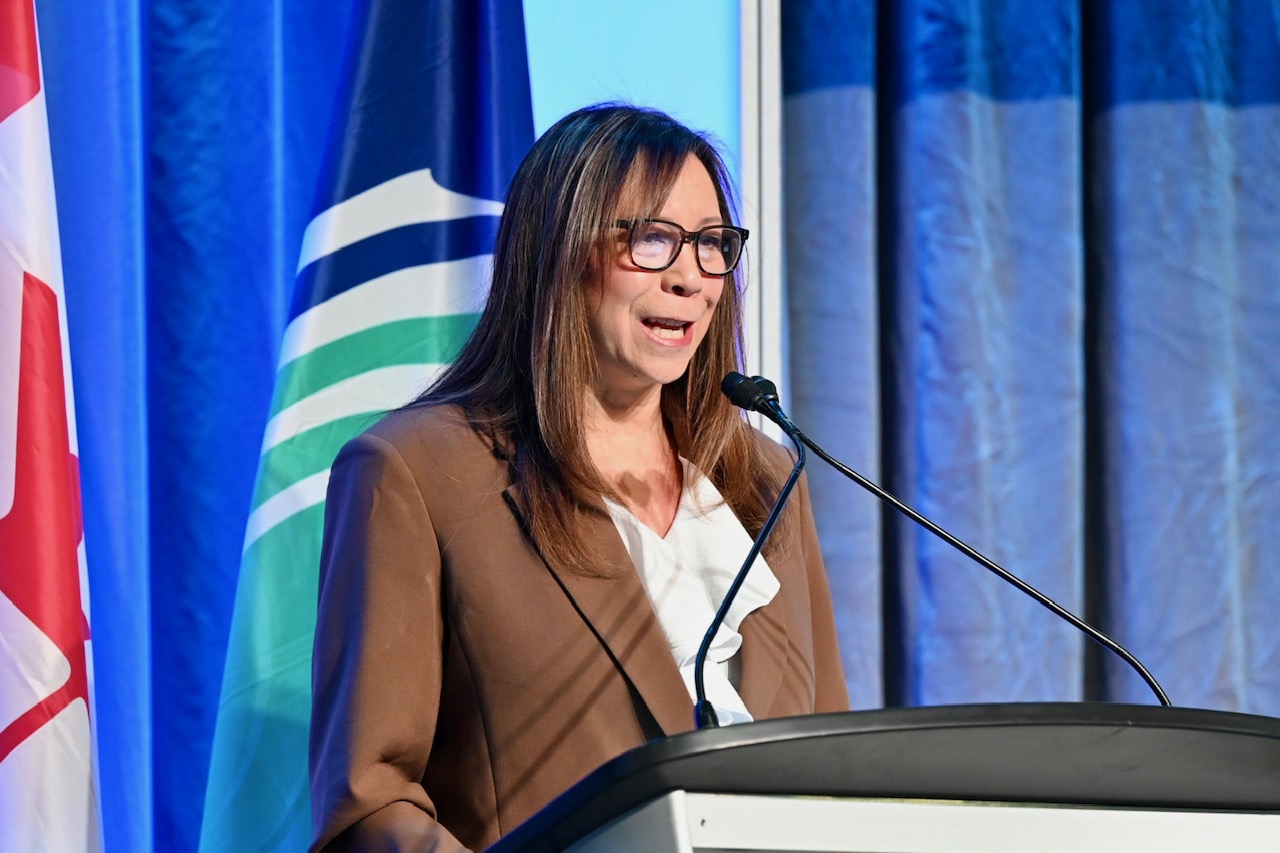
For Sueling Ching, president and CEO of the Ottawa Board of Trade, 2025 has been a year of contrast. The first few months were filled with uncertainty about U.S. tariffs and the prospect of a new federal government. But now, Ching said she sees unprecedented levels of collaboration and a drive to innovate, not only […]
Get Instant Access to This Article
Become an Ottawa Business Journal Insider and get immediate access to all of our Insider-only content and much more.
For Sueling Ching, president and CEO of the Ottawa Board of Trade, 2025 has been a year of contrast.
The first few months were filled with uncertainty about U.S. tariffs and the prospect of a new federal government. But now, Ching said she sees unprecedented levels of collaboration and a drive to innovate, not only within the business community, but also between different levels of government.
OBJ spoke with Ching about progress on downtown revitalization and what the board of trade will be prioritizing in 2026. The transcript has been edited for length and clarity.
Q: What were three highlights for you at OBOT for 2025?
“We started the year with high levels of uncertainty; with our relationship with the U.S., ongoing geopolitical issues and within the economy. What we saw coming out of that, over the course of the year, was an enhanced sense of ownership over our own economy and an acknowledgement that there was a lot that we could be doing here to drive it. Not unlike the COVID era, there was a strong sense of coming together as a community in Ottawa. You saw a real call-to-arms for people to support local and to eliminate internal trade barriers.
“We were able to cap off the year by bringing Prime Minister Mark Carney in to talk about his vision for Canada at the Mayor’s Breakfast. We were excited to hear that there's an important role for the City of Ottawa and the National Capital Region to play in that. Just prior to that, we were able to take a group from Ottawa to Queen's Park to meet with the premier of Ontario, Doug Ford, to talk about how we can better work together. We spoke about opportunities for innovation, elevating safety and security and transportation infrastructure.
“So I would say that we have seen an elevated level of support from business leaders as well as a deeper understanding of the importance of making sure that we have one strong voice of business so that we can calibrate and leverage the expertise of the business community toward the economic agenda and prosperity for all.”
Q: What were three things you wish could have gone better in 2025 or could be improved in 2026?
“I think the main areas of concern were the ability to attract the right talent and to calibrate the workforce for the future growth agenda. It was plagued with uncertainty. The No. 1 thing for us was to rebuild confidence in our markets. But we need to rebuild the confidence of investors, of entrepreneurs, of talented people, to rebuild that confidence in our markets. We need to make sure that there's a clear roadmap so that people can see where the future is going and understand what the opportunities are for Ottawa.
“Our main agenda item this year was to partner with key organizations. So at the end of last year we partnered with Invest Ottawa and Ottawa Tourism under the Ottawa Unlimited brand for the very purpose of making sure that we were aligning our messaging and promoting the Ottawa opportunity in the global marketplace.”
Q: One of the biggest topics for OBOT is downtown revitalization. It’s nearly two years after the Downtown Ottawa Action Agenda was released. If you were to revise the plan now, what changes would you make?
“We continue to be very committed to the Downtown Ottawa Action Agenda. The importance of the downtown transformation, I would say, has not diminished at all. It continues to be top of mind as a key priority moving forward. So what has changed is that we’ve gotten a lot more focused on safety and security as a top priority. We’re continuing work with the federal government around the pieces related to federal presence. We heard some things from the prime minister that gave us confidence but we are continuing to look for transparency and some forward movement on disposal or redeployment of federal assets as well as some clarity around the workforce strategy for federal employees. We’re continuing to look at how we can work together to both support our most vulnerable, but also to ensure that there is a strong sense of safety and security in our city core.
“We did a community sentiment survey earlier in the spring and it was very obvious to us that people saw downtown as a destination. They understood the importance of the downtown to our local economy. However, we have to keep working on accessibility as well as safety and security. We’re also keeping our eye on the ball in terms of placemaking and understanding that if you build a place that people want to visit, you've built a place where people want to live and vice versa.
“We’re also continuing to make sure that we are innovative. There's been some recent accolades in the media around the work of the National Capital Commission. We applaud the NCC and their visionary projects and their high level of community collaboration. The Downtown Ottawa Action Agenda was intended to calibrate the various efforts of the local stakeholders who have responsibilities. I would say it's done that 1,000 per cent and some of those things are rolling out and then some of those things are rolling out differently as new things evolve.”
Q: As more private- and public-sector workplaces return to their downtown offices in 2026, do you think there is a danger of becoming complacent about downtown revitalization?
“I don't think there's any chance of becoming complacent. I think part of the vision from the beginning was, if another pandemic-level event ever happened again, we don't want to be in the same position as we were in 2020. In a way, what happened with the pandemic was a gift, because the downtown wasn't perfect before either. There was always an opportunity for it to be more vibrant and more diverse before the pandemic. This is our opportunity to make it more diverse, more vibrant and more resilient now. So as we continue looking for those opportunities to develop the downtown as a neighbourhood, draw more residents, diversify the economy, we’re getting really ambitious about the placemaking and building it up as a place to live, work and play. We’re super-excited to continue to do that.”
Q: Another topic that emerged this year was making Ottawa into a defence hub. What would success look like as far as that project is concerned?
“Success would look like having specific investments in defence as part of the national strategy so that we can continue to build on what is already a strong sector. There's a couple of things on the docket, such as Ottawa’s bid to headquarter the Defence, Security and Resilience Bank. That would be significant for Ottawa. We believe that it makes sense for it to be in Ottawa. This is where the heart of the diplomatic community resides. So significant investments like that would definitely be a success indicator.”
Q: How can the federal government continue to invest in Ottawa as a national capital?
“By recognizing and acknowledging that the city of Ottawa, as the nation's capital, is important as a symbol of leadership and prosperity in the global marketplace … The government should continue to work with the City of Ottawa to ensure that we have a fair formula for the payment in lieu of taxes (PILT). The federal government should also continue to make strategic investments to help diversify our local economy and work collaboratively with the local government and business community in order to leverage the opportunities that are unique to the nation's capital.”
Q: Could RTO announcements mean businesses in the suburbs and on the outskirts of Ottawa lose the growth they’ve built since more people started working from home after the pandemic?
“It's possible it will change. But the reason why we sounded the alarm on downtown is because what we know, from both our data and from what we see in other cities, is that a healthy downtown is what drives a healthy city overall. An apple rots from the core out, so if the core of our city is not healthy, then it's only a matter of time before the entire economy is not healthy.
“What we're saying is that there may have been a little bump for those businesses in the suburbs because of a change in work patterns. Those remote or hybrid work patterns have only been around for about five years. Before that, work patterns were the same for decades. There's been a fundamental change to how people work now post-COVID. Employers are just going to make the decisions that are best for the bottom line and for the success of their companies. There are always going to be unknowns, depending on how good we are at diversifying the employment base. But what I do know is that the health and success of the city core is not just for the sake of the city core, but for the success of the entire region, because our city core is the economic and cultural hub of our entire region."
Q: How does OBOT plan on growing its membership in 2026? Are there specific industries or organizations you would like to target?
“Our vision for the future is that every single business in Ottawa is a member of the Ottawa Board of Trade. That's our vision. We will grow our membership by continuing to advocate at every level of government for a competitive business environment and by supporting our businesses in their growth through information, connections, access to resources, etc. We are on a very good trajectory right now.
“Continuing to build partnerships has been really the foundation of our success this year. We will continue to elevate that by working with our partners and our business leaders. We will be focused on working closely with partners regionally and on what our businesses need in order to grow. There's a lot happening around AI and digitization. We are going to be looking at promoting this idea of thinking globally and acting locally.”
Q:What are OBOT’s three top priorities in 2026?
“No. 1 is supporting our member businesses at being successful. No. 2 is making sure that we are advocating for a competitive and predictable business environment that reduces barriers and presents new opportunities by promoting what we have to offer. No. 3 is building up the voice of business so that we can continue to grow our impact and support more businesses.
“So really refining the value proposition of the board of trade. The board of trade has been around for 168 years, so we'll be having the 169th AGM next year. The business leaders that are involved with our organization now are the same type of business leaders that built the city. At this time of transformation, we're honoured to be a mechanism for galvanizing the business leaders of today with that same spirit toward building the future of our region for the next generation. We're also going to be very committed to regional economic development. So working with our colleagues, not just around Ottawa, but in Gatineau. We see a lot of opportunity as we grow our global profile to leverage the assets of the entire region.
“I'm just really excited about the support that we've received from pillar partners who've helped us to elevate our advocacy and economic development agenda, including Invest Ottawa and Ottawa Tourism. But even more broadly, Hydro Ottawa, Kanata North BIA, the Ottawa International Airport. We continue to look at the areas of commonality that we have so that we can advance projects more quickly. I have such a sense of excitement and optimism about the future.
“Right now, we are seeing just a complete contrast to how we started the year. I'm not saying there's not more work to do, but what we see is a pro-growth prime minister, a pro-growth Ontario premier and a pro-growth mayor of Ottawa. This is the highest level of collaboration that we've ever seen between those levels of government and there’s an acknowledgement that the governments or business can't do it alone. It must be done together. A pro-growth agenda and business success is the underpinning of creating city services and prosperity for all. Those are some of the key messages that will underpin our economic agenda in the future.”