As Canada ramps up military spending and Ottawa strives to become a defence innovation hub, commercial real estate brokers say there’s surging interest in industrial properties that could cater to contractors working on new fighter jets, helicopters and other equipment. “We’re seeing a large amount of defence money come into the market,” Steve Piercey, a […]
Get Instant Access to This Article
Become an Ottawa Business Journal Insider and get immediate access to all of our Insider-only content and much more.
As Canada ramps up military spending and Ottawa strives to become a defence innovation hub, commercial real estate brokers say there’s surging interest in industrial properties that could cater to contractors working on new fighter jets, helicopters and other equipment.
“We’re seeing a large amount of defence money come into the market,” Steve Piercey, a senior vice-president at CBRE’s Ottawa office, says. “That’s going to lead to more demand (for industrial space) in the Ottawa area.”
Piercey points to defence-tech startup Dominion Dynamics’ recent announcement it is opening a 25,000-square-foot factory at 103 Schneider Rd. in Kanata North next month.
The veteran industrial broker says Dominion Dynamics, which makes sensor systems aimed at monitoring Canada’s North as well as drones designed to pair with next-generation fighter jets, could be the first of many defence-related companies to expand their footprints in the Ottawa region as the federal government prepares to pour tens of billions of dollars into the Canadian military over the next decade.
“That was kind of the first shoe we saw fall,” he says.
Warren Wilkinson, senior managing director of Colliers’ Ottawa office, agrees.
While e-commerce and logistics giants like Amazon – which is expected to open a 3.1-million-square-foot fulfilment centre on Bill Leathem Drive in Barrhaven this year – continue to have a significant impact on the local market, Wilkinson said the defence sector is gaining momentum as more companies catering to military customers beef up their local presence.
“Naturally, we’re going to look at defence and security as a growing concern within the industrial market,” Wilkinson says. “If the rumours are true, we’re going to see a lot more spending in those areas and I think that’s going to have a positive influence on our industrial market.”
Nick Hannah, a vice-president at Ottawa’s Paradigm Commercial who specializes in leasing industrial space, says at least “a couple” of companies involved in the program to supply the Canadian Air Force with new F-35 fighter jets are looking to lease or build new industrial space in the National Capital Region once production gets the green light.
“There are groups just waiting for contracts like the F-35 contract to be solidified and then that’s going to double or triple their requirements (for industrial space),” Hannah says, explaining that potential tenants are “starting to look so they know what’s out there when the time comes.”
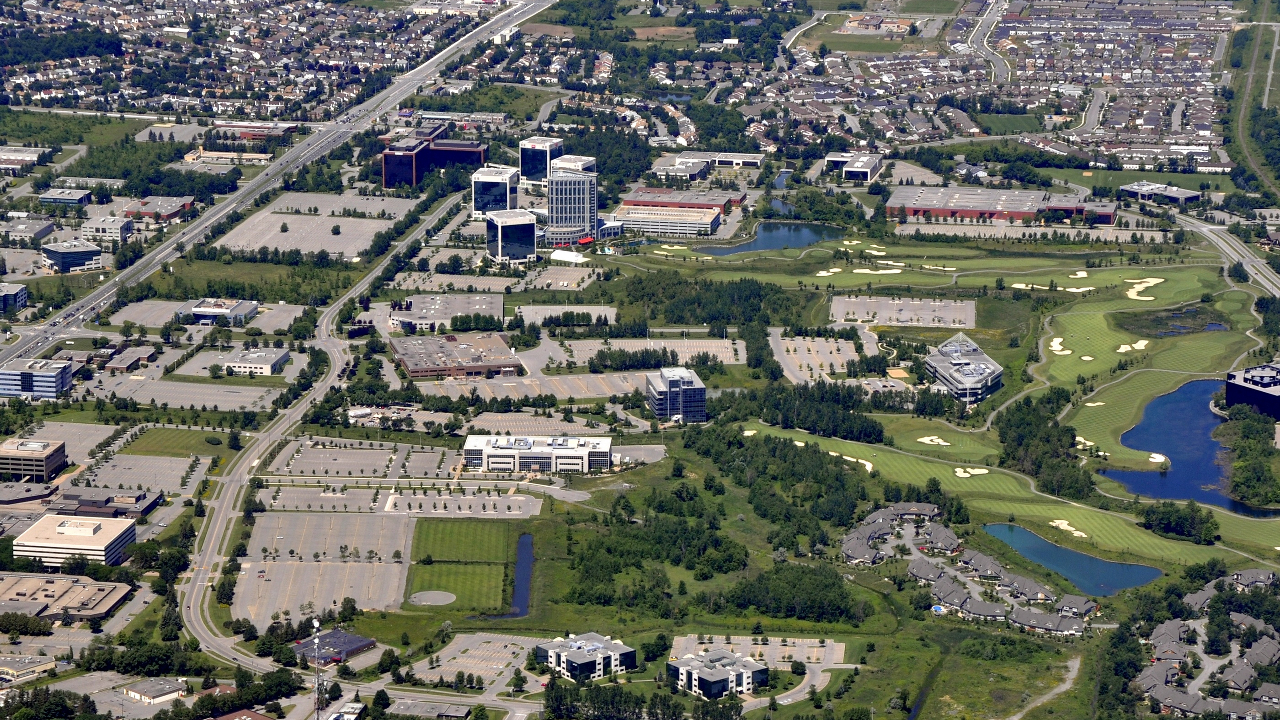
While the users Hannah knows of are “circling” potential sites in Ottawa’s far-east end, he said industrial landlords in neighbourhoods such as Kanata North also stand to benefit from the rise in defence spending.
“That has a cascading effect on our region,” he adds. “With the technology hub that we’re lucky to have out there, I think there’s definitely some opportunities.”
Leasing activity levelling off
The expected uptick in demand for local industrial space among defence-related tenants comes as sales and leasing activity in the sector is levelling off.
According to a Colliers report released earlier this week, Ottawa’s industrial availability rate – which includes vacant space as well as space that is currently occupied but is being shopped around – rose to 3.6 per cent at the end of December, up from 2.7 per cent a year earlier.
The rate climbed in the city’s largest submarkets – the east, Kanata/deep west and south – which contain nearly 90 per cent of Ottawa’s total industrial inventory of about 46 million square feet.
While average asking net rents held steady year-over-year at just over $17 per square foot, some brokers say they’re seeing a growing divide between what smaller users that make up the bulk of Ottawa’s industrial tenant base are willing to pay and the prices that landlords are asking.
Matt Shackell, a vice-president at Lennard Commercial Realty, says industrial property managers are getting “a ton of pushback” from occupiers who can’t afford $18 to $20 per square foot and are seeking options in the $12-$14 range.
The problem, he adds, is spaces in the lower price range are few and far between as supply in Ottawa’s aging stock of small-bay inventory remains tight.
“We’re in that time right now where there’s a bit of tension between landlords and tenants,” Shackell says. “Both of them need to meet in the middle. That’s the biggest challenge I’m seeing.”
Meanwhile, large swaths of space are sitting empty in new buildings, such as a 230,000-square-foot facility on Huntmar Drive in Kanata that was completed last year. Developer Rosefellow has yet to secure any tenants for the property.
Hannah notes that more landlords are dangling incentives such as free rent and fit-up subsidies in a bid to fill their buildings. He expects the trend “will continue to grow as the vacancy rate increases and new developments sit empty for longer.”
Shackell says he thinks many property owners are “going to have no choice” but to offer such perks if they want to fill their buildings.
“We’re seeing more and more large vacancies and overall traction is not where it needs to be in order to see that absorption rate change,” he says. “It’s not all doom and gloom, but we are definitely in a challenging time. We’re optimistic that it’s going to get better, but we don’t have that crystal ball.”
Piercey, however, remains optimistic. He says the local industrial market is close to “peak availability,” adding that deal velocity is picking up in Toronto and Montreal, “which usually leads to more activity in Ottawa.”
Noting that the National Capital Region has the lowest amount of per-capita industrial space of any major city in Canada, Piercey says the Ottawa sector is “still underserviced.”
He says it might not be long before developers such as Rosefellow and CanFirst Capital Management, which own dozens of acres of prime industrial development land near Amazon’s new warehouse in Barrhaven, start construction on new projects.
“I think they’re still sitting and waiting today, but I think as we start to see that stabilization occur across the country … I think they’ll start changing from developments that are maybe looking for lead tenants to maybe going out on spec,” Piercey says. “There’s a couple (new development) opportunities that are close.”
But other industry observers aren’t so sure.
“I think it’s too risky,” Hannah says of launching large-scale industrial builds in the current climate.
“I think they’re going to have to have (new properties) 50 per cent leased before they put shovels in the ground. The tenant pool is small in this region. Those (large-bay) users aren’t coming here. There is existing product within an hour’s drive that they can occupy today … where you couldn’t say that five years ago.”
Meanwhile, smaller tenants hoping for new inventory in the range of 8,000 to 12,000 square feet are likely going to be out of luck for the foreseeable future, brokers say.
“If someone could build small bay and make it affordable, it would be small bay all day,” Piercey says. “Unfortunately … the pro formas are just not viable, which is why you’re not seeing them built.”
Ottawa is “transitioning to a point where it can take more mid-bay and larger-bay,” he adds. “Economically, from a builder’s perspective, that’s what makes sense.”