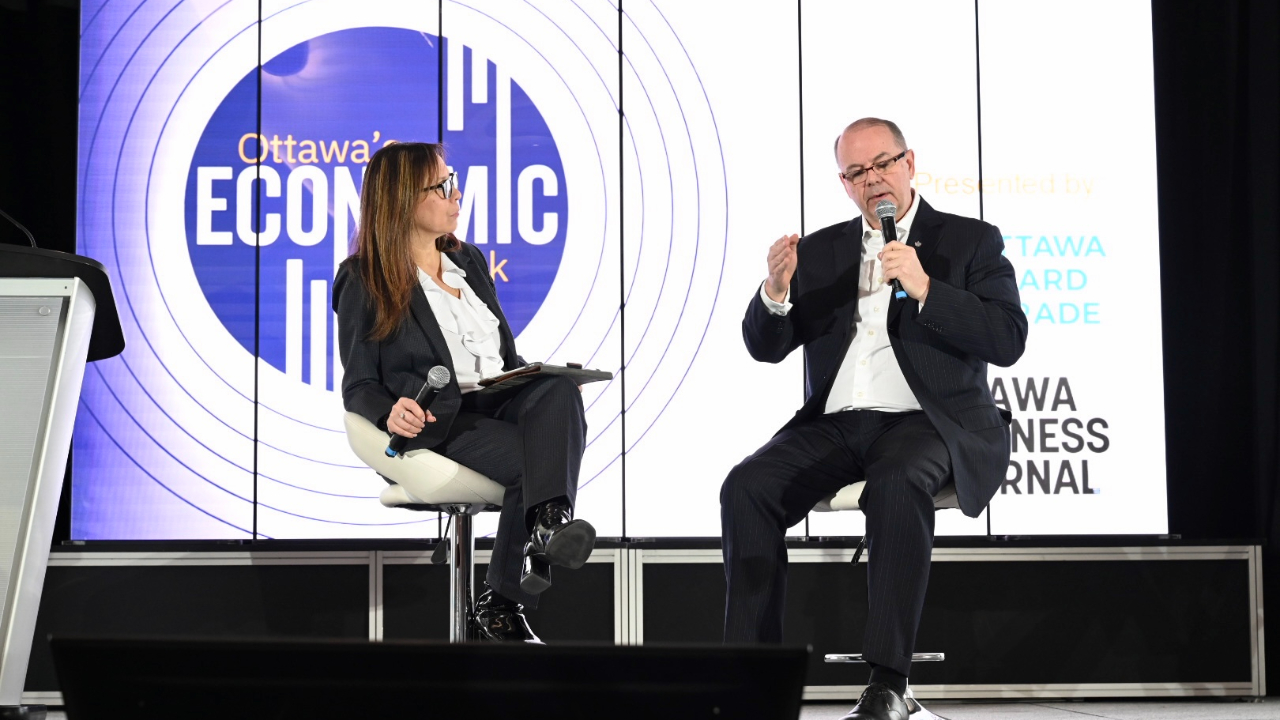
The co-founder and chief operating officer of the Defence, Security and Resilience Bank told a business audience on Wednesday that when he showed some of his colleagues Ottawa’s plans to become a defence hub, they were impressed. “They said (that) this is at a level that they haven’t seen some nations put together,” Kevin Reed […]
Get Instant Access to This Article
Become an Ottawa Business Journal Insider and get immediate access to all of our Insider-only content and much more.
The co-founder and chief operating officer of the Defence, Security and Resilience Bank told a business audience on Wednesday that when he showed some of his colleagues Ottawa’s plans to become a defence hub, they were impressed.
“They said (that) this is at a level that they haven’t seen some nations put together,” Kevin Reed said at the Ottawa Economic Forum Wednesday.
The city’s Defence Innovation Hub Strategy, spearheaded by Invest Ottawa, aims to bolster Canada’s sovereign capability, accelerate innovation and enhance support for Canada’s military. Retired Gen. Rick Hillier will serve as honourary chair of the National Defence Innovation Hub Task Force for the capital region.
One of the task force’s priorities will be pitching Ottawa as the headquarters of the Defence, Security and Resilience Bank, an international institution styled after the World Bank that is planned to be established by the end of this year and would serve 40 member countries. Ottawa is being considered for the headquarters alongside other Canadian cities, including Toronto and Montreal.
According to Reed, the DSRB would be “the only multilateral bank designed for pure defence, security and resilience.”
Reed said that Canada has emerged as an “honest broker” in the past few months and that the country “has a decent shot to get the bank headquarters.” Addressing the business leaders in the room, many of whom were from the defence sector, Reed said that “help is coming.”
“The money is going to flow, procurement is going to get faster. It’s going to get better,” Reed said.
As part of the event, a panel of officials from defence and defence-tech companies spoke about why they chose to locate in Ottawa and why it is important to invest in defence now.
Amy MacLeod, vice-president of corporate communications at MDA Space, said that company chose the nation’s capital for the city’s intersection with government, business and innovation.
“Those audiences are here, the talent is here … the end user is here,” she said. “Their needs are easy to identify because they’re here … In addition, the weather gives us an amazing advantage and ability to actually meet the mission,” she added, referring to the need to protect Canada’s North.
Dan Goldberg, president and CEO of Telesat, said Ottawa is “the most logical place to run a global, dual-use, high-tech-focused business, more so than ever when we have the government that is paying attention and is a willing partner.”
According to Glenn Cowan, founder and CEO of One9, Ottawa is a “logical air bridge” to the Arctic, adding that the Ottawa International Airport offers good infrastructure for supply chains to the North.
Mitch Carkner, co-founder and chief operating officer of Dominion Dynamics, said Ottawa is where most of the firm’s clients are located and that locating in Toronto would have been inefficient in the long run.
“You headquarter yourself as close to the customers and the talent as possible, so you can actually drive innovation faster. So Ottawa makes sense,” Carkner said, adding that he’s been able to get U.S.-based Canadians to move back to Canada to work for Dominion Dynamics.
Cowan added that it’s critical to start investing in defence now, as it will be too costly to wait.
“We're going to war. That may sound alarmist, but the spending that we’re experiencing right now is not a job creation program, it’s not an economic development (program),” Cowan said. “Defence is an expensive business and we’re going to have to make the decision whether we pay now or pay later.”
More partnerships between the private sector and public-sector stakeholders are taking place, Cowan added. “The government used to have a monopoly on capability. Now, the private sector is the wellspring of innovation. Private capital is funding it,” he said.
For Ottawa to be a defence hub, there needs to be a better understanding of the sector as a whole, MacLeod said.
“We need to truly understand the defence sector and the defence industry … It’s big business. It’s innovative, but it’s different. It’s mission-critical and that is a piece that I think this community needs,” MacLeod said.