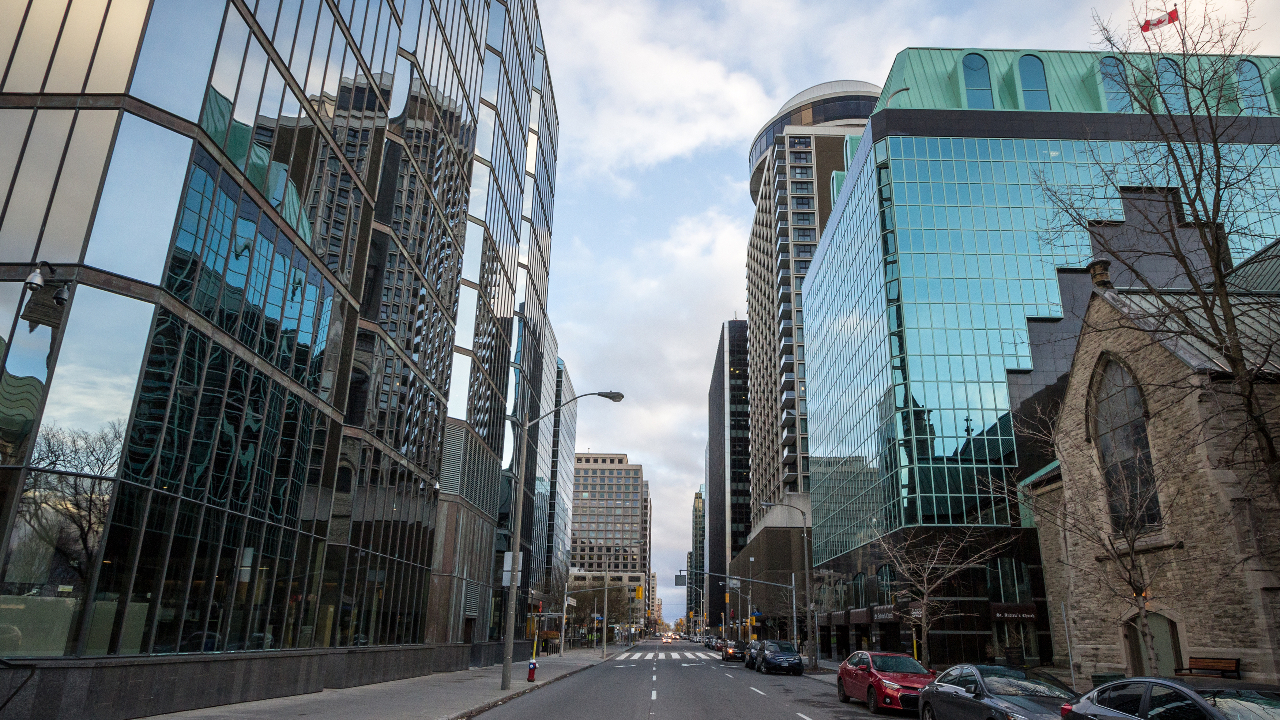

A new report says office leasing activity in Ottawa is expected to pick up this year in part due to return-to-office mandates, while the region’s industrial sector is projected to remain “resilient” even as momentum has dampened in other major cities amid ongoing trade disruptions.
Royal LePage’s 2026 commercial real estate report forecasts a gradual recovery to continue for the office sector, with leasing activity increasing across major cities as fewer companies stick to remote work models implemented during the pandemic.
Luigi Aiello, a commercial and residential sales representative with Ottawa’s Royal LePage Team Realty, said the federal government’s recent mandate that all employees must return to the office a minimum of four days a week starting in July marks a “significant shift in workplace policy” that will have ripple effects throughout the office sector.
“Looking ahead, increased in-office attendance is likely to support modest growth in rental rates and place downward pressure on vacancy levels,” Aiello said in a news release.
“However, the federal government’s commitment to reducing the size of its workforce through retirements and attrition is expected to temper the pace of recovery, keeping overall market growth measured.”
Aiello said Ottawa’s industrial sector “remains rooted in strong fundamentals” driven by “steady demand” from health, fitness and manufacturing-related businesses.
“While manufacturing has been more exposed to tariff-related pressures, operators in Ottawa have shown notable resilience. Many of the city’s industrial businesses are family-owned or multi-generational enterprises that have weathered multiple economic cycles, allowing them to take a longer-term view when navigating periods of uncertainty,” Aiello added.
“Continued interest from Toronto-based companies seeking cost-effective expansion opportunities is sustaining leasing activity. With limited new supply on the horizon and a diversified economic base, the sector is well positioned to maintain momentum into 2026, particularly if confidence in the broader economy improves.”
Two-thirds of Royal LePage commercial real estate market professionals across the country who were surveyed said they expect demand for office space to modestly increase or stay the same in their respective markets in 2026. Five per cent expect demand will increase significantly.
The survey found 42 per cent of respondents expect vacancy rates for office space to decrease in their market this year.
Among Canada’s major markets, the Montreal region had the highest commercial vacancy rate across all industry types in 2025 at 5.2 per cent. That was followed by Calgary at 3.8 per cent and downtown Vancouver at 3.6 per cent.
The Greater Toronto Area, excluding downtown, had a commercial vacancy rate of 3.4 per cent, while Greater Vancouver’s vacancy was 2.9 per cent and Ottawa’s was 2.5 per cent. Downtown Toronto had the lowest commercial vacancy rate at 2.1 per cent.
While the report said hybrid work models will likely remain part of the long-term equation for many sectors, rising in-office attendance should help “bring greater stability to the market.”
“The past two years have been pivotal for the office sector, which has steadily regained momentum following the unprecedented disruption of the pandemic, when downtown cores saw office towers largely empty during lockdown periods,” said interim Royal LePage commercial general manager Matt Jacques in a news release.
“The market is not returning to its pre-pandemic form; rather, it is evolving into something more deliberate and intentional. Employers are placing greater emphasis on how space can be used rather than how much space they take up, prioritizing layouts that support collaboration, flexibility and employee experience.”
Meanwhile, the report said industrial real estate is expected to remain one of Canada’s strongest-performing commercial asset classes in 2026, even as momentum has slowed due to uncertainty linked to trade.
Around 47 per cent of those surveyed expect occupier demand for industrial space to increase in their respective markets in 2026.
The segment has sustained high demand levels since the pandemic, driven by elevated manufacturing sales which have generally sat in a range of $65 billion to $75 billion per month. Last year, however, total manufacturing sales ticked 0.4 per cent lower driven by losses in the petroleum, coal and chemical industries, which have been more sensitive to price volatility and supply chain disruptions as a result of tariffs.
“The industrial sector has consistently demonstrated its resilience. While there are ongoing economic risks tied to trade policy, tariffs and broader global uncertainty, demand for well-located, functional industrial space remains strong,” said Jacques.
“This is especially true in logistics- and trade-connected markets, where proximity to transportation corridors, ports and population centres continues to drive occupier interest.”
– With additional reporting from OBJ staff