Albert Heller is the founder, CEO and chief technology officer of Boreal Energy Systems, a two-year-old startup designed to build mini-nuclear generators that provide affordable power to remote areas such as Canada’s North.
More than 25 years after Albert Heller hit it rich in the then-nascent field of high-speed semiconductors, he’s hoping lightning will strike twice with a new venture in another industry he believes is ripe for disruption: green energy.
Heller is the founder, CEO and chief technology officer of Boreal Energy Systems, a two-year-old startup designed to build mini-nuclear generators that provide affordable power to remote areas such as Canada’s North.
The University of Manitoba electrical engineering grad says it’s an idea whose time has come. With Arctic sovereignty becoming the topic du jour in the Canadian military, Heller thinks Boreal’s reactors – which would be small enough to fit in an average living room – are the ideal way to power the infrastructure necessary to keep the country’s soldiers fighting fit in the North.
Currently, electricity at Canada’s military bases in the Arctic – as well as at civilian communities in the Far North – is supplied by diesel-fuelled generators, Heller explains. That fuel must be flown in from southern Canada on planes that burn even more diesel, he says, further adding to the “astronomical” cost of supplying power to the North.
“I’m 100 per cent confident that the military needs a non-diesel (energy) solution for the Arctic,” Heller says.
Also, the Canadian military is poised to buy a new fleet of high-tech fighter jets to patrol the country’s northern borders, and planes like F-35s need to be housed in hangars with strict temperature and humidity controls that require “immense” amounts of energy, he adds.
“You cannot sustainably do that running on diesel generators,” he says, while other sources of renewable energy such as wind turbines “don’t like Arctic conditions.”
From Heller’s perspective, that means one thing: “The only alternative is nuclear.”
Now, after three years of research, Heller and his 14-person team at Boreal are confident they’ll soon be ready to deliver a prototype for a nuclear reactor big enough to power an individual military base or a remote northern community for up to 15 years at as little as half the cost of diesel-generated electricity.
“From an energy security and sustainability perspective, it’s really the only option (the military) has to meet their power needs,” Heller says.
The technology has its roots at NASA, which nearly a decade ago began testing a concept for a compact, lightweight fission reactor that uses a cast-uranium alloy core roughly the size of a paper towel roll to generate heat, which is then converted into electricity.
Tests proved that the system, called the Kilopower Reactor Using Stirling Technology (KRUSTY), could provide a stable, consistent source of electricity. While NASA’s goal was to show that a mini-nuclear reactor could eventually power lengthy missions to places like the Moon and Mars, Boreal’s units would be installed in other hostile environments much closer to home.
“We have essentially studied (KRUSTY) and figured out how to scale that and deploy it in Arctic conditions,” Heller says.
Boreal Energy Systems is the successor to Boreal Power Systems, a firm Heller and business partner Mark Waite launched in 2008 to develop alternative energy sources as oil prices soared.
$600M sale
At that time, Heller and Waite were looking for a new industry to conquer after their first venture, semiconductor-maker Extreme Packet Devices, sold for a whopping $600 million in 2000, when the dot-com boom was at its peak.
Heller, who grew up in Western Canada and moved to Ottawa in 1994 to take a job at Newbridge Networks, founded EPD in 1999 with Waite, a Boston-based business development specialist who came from Toshiba Corp., and former Newbridge colleagues Mark Janoska and Henry Chow.
Just 12 months later, they parlayed an initial $3-million investment into a massive windfall that had “life-changing monetary outcomes” for the firm’s first three dozen employees, Heller says.
“That kind of set me up to be a serial entrepreneur,” he adds.
Heller worked with a few telecom ventures, then reunited with Waite a few years later to try his hand at a new industry.
“There was a real need to look at renewables as an alternative energy,” he says. “We started looking at where we could essentially harness energy and convert it into electricity.”
Their first concept – which involved using empty reservoirs at abandoned oil wells to store water that could be heated to create geothermal power – didn’t pan out.
The company had developed its own heat-conversion technology and planned to partner with an oil company in North Dakota. Heller and Waite had a site picked out, but when a utility provider asked how much they planned to charge for their electricity, it quickly became clear the venture was doomed.
“We said, ‘Well, maybe 30, 35 cents a kilowatt hour,’” Heller recalls with a chuckle. “They go, ‘You realize we pay half a cent a kilowatt hour for the coal which is across the street from our coal-fired plant.’
“We had the technology, but we just couldn’t make the economics work. That in essence is the renewable (energy) business in a nutshell. There are tons of technologies out there that work, that are viable, but economically, they just don’t make sense.”
But Boreal 2.0 is different, Heller says.
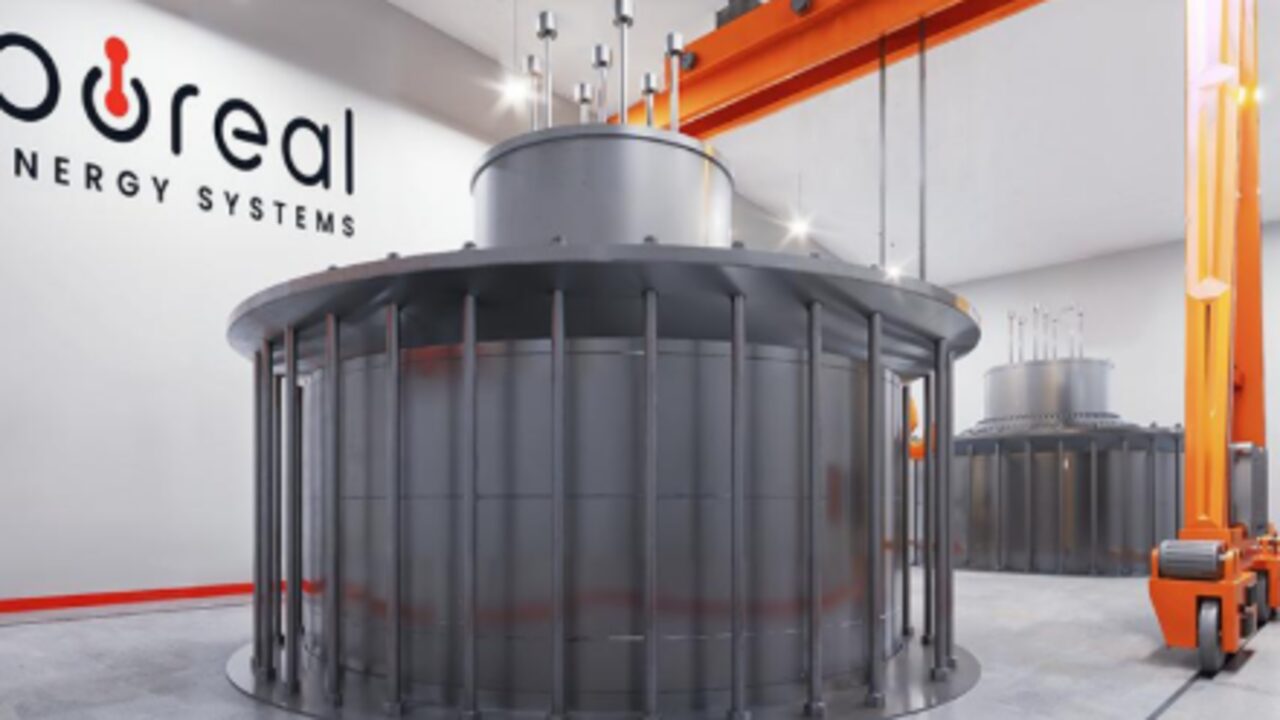
The firm’s nuclear technology is proven, he explains. Boreal’s reactors – which would be about four metres wide and three metres high and house a nuclear reactor about two metres in diameter – would use pipes made of “superconductor” niobium alloy to transfer heat almost instantly from the reactor’s core to a mechanism that creates steam, which then powers the generator.
Each unit would contain more than 100 heat pipes, each less than a centimetre thick. Even if some of the pipes stopped working, “we still have other pipes that can move the heat” and continue generating electricity without interruption, Heller says.
The company is now working on a prototype for a 20-kilowatt unit, about the size of NASA’s KRUSTY project, at a 7,000-square-foot facility in Kanata.
Because the plant isn’t licensed by the Canadian Nuclear Safety Commission, Boreal will demonstrate the system using electric heaters that mimic the heat created by fission. Heller says the firm has spent “well over a million dollars” developing the unit, which is expected to be in full operation by mid-April.
Boreal plans to hire as many as 120 additional employees over the next 18 months as part of its goal to scale its reactors to the point where they can generate up to three megawatts of electricity – enough to power a military base or a northern town. If all goes well, Heller says, the first reactors could be up and running by 2030.
The company’s goal is to serve as a “specialized utility” for customers such as the Department of National Defence, Heller explains. Boreal would own, operate and maintain the units, building them with help from Indigenous and other construction partners.
Heller predicts the strategy would be a win for Canadian taxpayers.
'Economic risk is all on us'
“It helps alleviate some of that risk in the procurement model. Because at the end of the day, we’re not asking the government to commit to buying a (multimillion-dollar) nuclear reactor, we’re asking them to commit to buying electricity. So the economic risk is all on us. At the end of the day, they only pay for what we end up delivering to them.”
Still, the financial risks to Boreal are as clear as the northern night sky. Heller says he can see a day when there are more than 100 of Boreal’s reactors scattered throughout the North, but not without a massive capital outlay.
Each unit is expected to cost tens of millions of dollars to manufacture. Heller’s hope is that Boreal will make that money back over time, but it could take decades. In the meantime, the company will need cash – and plenty of it.
Besides Heller, the firm’s current backers include Waite as well as fellow co-founders Shail Paliwal, who was Extreme Packet Device’s director of finance, and early EPD investor Lisa Wallace. Other investors include Michael Dunleavy and Debbie Weinstein, lawyers at Ottawa-based business law firm LaBarge Weinstein LLP.
Heller and his co-founders know they need investors with deeper pockets. The company is now in talks with Hanwha Ocean about bringing the South Korean shipbuilding giant on as a strategic partner.
Hanwha is one of two firms bidding to replace Canada’s aging submarine fleet, a project that comes with a price tag of more than $20 billion. The company says it is looking to team up with a variety of domestic technology and equipment suppliers as part of its proposal – a list that could include Boreal.
In an email to OBJ last week, Hanwha Canada CEO Glenn Copeland said the company is "definitely interested” in partnering with Boreal as it looks to add to its growing roster of Canadian collaborators.
"They need to demonstrate their industrial commitment to Canada,” Heller says of Hanwha, adding the Korean firm was “one of the first (potential partners) to approach us.”
In addition, Boreal’s brass is courting a number of venture capital firms and hopes to tap into resources such as the Canadian Infrastructure Bank and the Business Development Bank of Canada.
Heller sees reasons for optimism as Boreal takes shape, saying organizations such as BDC are “being much more proactive” about targeting homegrown defence firms for potential investments amid the federal government’s military spending ramp-up.
New federal programs such as the $6.6-billion defence industrial strategy aimed at lessening the Canadian military’s dependence on foreign-made technology are also a step in the right direction, he adds. But he stresses that the government needs to start spending money soon if Canadian enterprises like Boreal can expect to compete with the U.S., where dozens of startups are already experimenting with similar mini-nuclear plants.
"Designing a nuclear reactor is not something that you can just do in a year,” Heller says. “If we do have these needs, and those needs are being projected out three or five years from now, we have to start (design work) now in order to have the timelines converge. If we aren’t successful in doing this, then it’s going to be one of those 28 companies in the U.S. that Canada’s military is buying technology from. And then it becomes a security risk.”