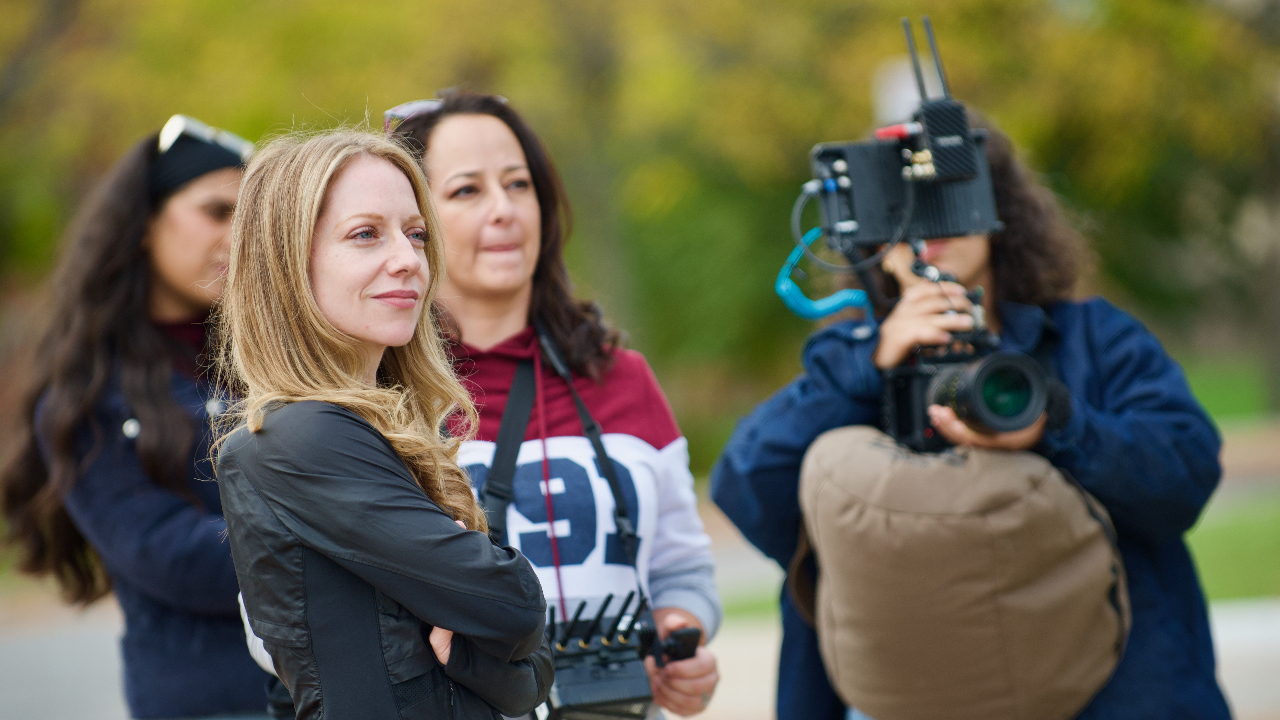
Ottawa filmmaker Krista Marchand was passionate about documenting the rise of women’s soccer in Canada, but first she had to become a business owner. Marchand grew up in Kanata, playing soccer. When she was offered a scholarship to play at the post-secondary level, she had to make a difficult decision. “When it came to that […]
Already a Subscriber? Log in
Get Instant Access to This Article
Become an Ottawa Business Journal Insider and get immediate access to all of our Insider-only content and much more.
Ottawa filmmaker Krista Marchand was passionate about documenting the rise of women’s soccer in Canada, but first she had to become a business owner.
Marchand grew up in Kanata, playing soccer. When she was offered a scholarship to play at the post-secondary level, she had to make a difficult decision.
“When it came to that moment where I thought about what I wanted to do with that aspect of my life, oddly enough, (I thought that) becoming an actor seemed more feasible than becoming a professional athlete. You might get a scholarship and play in the States, but it ends there. So I ended up not taking a soccer scholarship and I went to the Vancouver Film School instead,” Marchand told OBJ, adding that she’s been in the acting world for about 25 years now.
Two years ago, she became interested in producing and directing so she could tell stories that mattered to her. At the same time, she was hearing rumblings about a new Canadian professional women’s soccer league.
While she was happy to see opportunities opening up for a new generation of female athletes, she thought of the countless other women who never had those opportunities, including herself. And so she decided to produce a documentary to capture the moment in history.
She approached the new Northern Super League about the idea. “They said to me, ‘If you want to do a documentary about women’s sports in Canada in a broader sense, then you would have our backing 100 per cent.’ I started thinking that this was a much bigger project.”
And so Marchand took her idea to Bell Media in the fall of 2024.
“The NSL season hadn’t started yet, but it was a combination of me being really excited about it and the World Cup happening this year. I knew there was going to be a soccer frenzy. I knew people would be hungry for this type of content, so when I was pitching it, I spoke about the fact that women’s sports is on the rise,” Marchand said.
“But in pitching it, I was making some comparisons to my experience, and the woman who would become my producer said, ‘I love this. I think it’s going to be really relevant. But we really love your story.’ So it became a lot more about the generations that have brought us to this moment.”
With Bell on board, she went back and forth about financing. “You pitch a project to them (and) the amount that you are looking to receive to complete it. You create your budget and they give you the licensing fee. So they’re basically purchasing the show from you,” she said, adding that she was offered funding at the beginning, middle and end of the project.
While Bell retains exclusivity rights for 90 days, Marchand said she can shop the project around to other distributors. “It becomes an asset, like any other sort of product that you can resell.”
But in order to accept the funding, Marchand and her business partner needed to form a production company. And so Further & Co., an Ottawa-based independent company creating documentary and narrative content “rooted in character and community,” was born.
Marchand said, “That was really the impetus to start. All of the values and passion had been there, but we needed to have a corporation to accept the funding.”
Filming for A League Of Her Own began last August and wrapped in October, with materials delivered to Bell at the end of March 2026.
The four-part docuseries follows three generations of female soccer players: the older generation, like Marchand, who didn’t have clear professional pathways; the current generation, highlighting the Algonquin Wolves and its star player Kassandra Da Cruz; and girls at the youth level who can now have realistic aspirations to play pro.
It was Marchand’s first foray into unscripted entertainment. “There is a learning curve, because we’re used to, ‘Action, cut, get the scene, good to go.’ But with this, you’re rolling the whole time and waiting for magic, waiting for the story to unfold.”
Focusing on Ottawa felt natural, Marchand added. “We often create art about our lives and what we know. I grew up doing this. I’m a mom and a coach in it now … It was this full-circle moment where I was tapping into layers of my own story. So keeping the story local felt like the stars kept aligning.”
With A League of Her Own set to premiere on Bell Fibe TV-1 on May 21, Marchand is starting to look at new projects, while keeping her interest in women in sports. She said Ottawa is a great place for new ideas, and businesses, to grow.
“Between the pandemic and industry strikes, Ottawa has been able to almost coast through this because of the amount of (made-for-television movies) that get made here. Just by servicing networks like Hallmark, the producers behind those projects have really built a community here. They’ve built up crews … It’s gotten to the point where we’re more than capable and not trying to prove ourselves by any means.”
Now, she said, the local industry is evolving past made-for-television movies. “We’re at that point where we’ve built (the industry) up so much and we want to create something that’s ours. I feel like a lot of creatives are itching for that now. It’s about who’s ready to step up.”
Stepping up would be easier with access to funding opportunities such as the Northern Ontario Heritage Fund Corp.’s program for film and television, she added.
“They are matching a certain percentage of the spend that happens in northern Ontario, and not just in film and television. It’s to bring many different industries up there. If we had something like that, it would certainly help to incentivize more filming in Ottawa,” she said, adding that a film studio would also help bring productions to the capital year-round.
Ottawa does offer a better tax credit for screen productions than in the GTA, Marchand said, and has a screen industry that is growing every year as a result.
“The industry overall has absolutely taken hits over the past several years and there’s volatility to that. But, strangely, it also feels like one of the most possible moments. If you’ve ever wanted to take a real swing creatively – and maybe be a little delusional about what’s possible – this actually feels like the time to do it.”