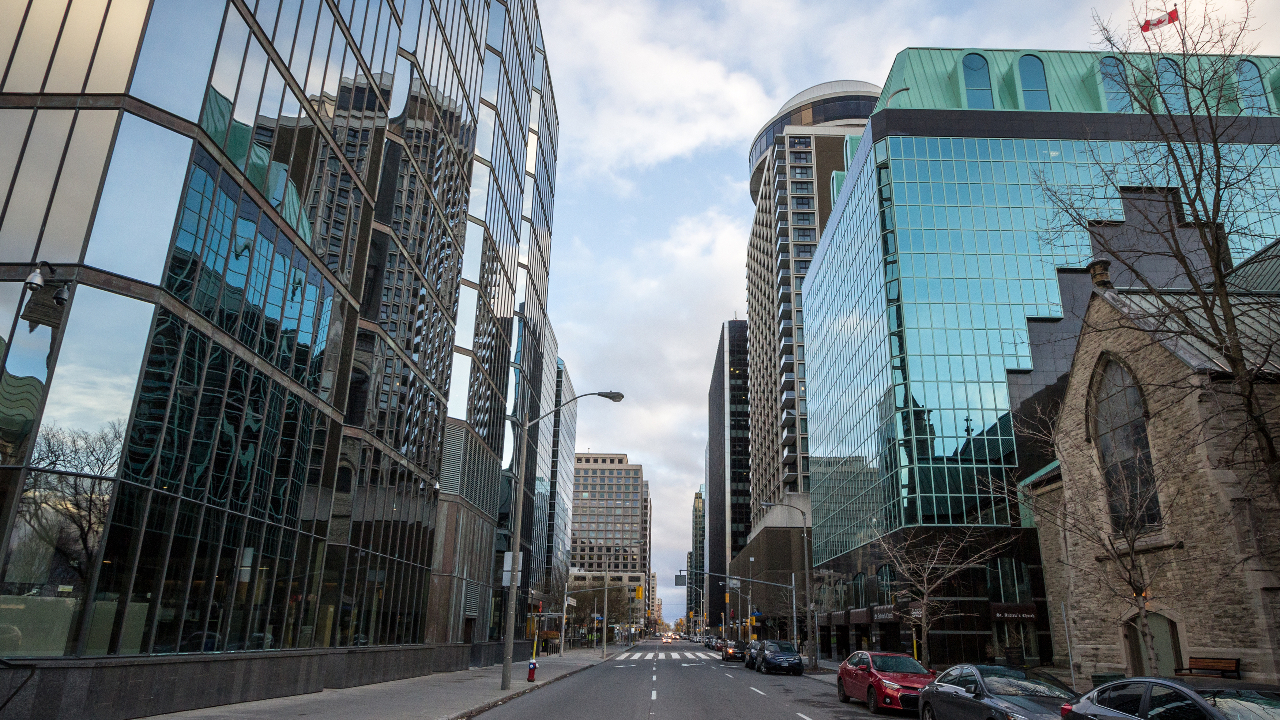
As more employees return to the office, commercial tenants in downtown Ottawa are seeking longer leases to give themselves more time to pay back the soaring costs of retrofitting space, real estate brokers and landlords say. Shawn Hamilton, a principal at Proveras Commercial Realty, recently told OBJ that when he began working in the industry […]
Get Instant Access to This Article
Become an Ottawa Business Journal Insider and get immediate access to all of our Insider-only content and much more.
As more employees return to the office, commercial tenants in downtown Ottawa are seeking longer leases to give themselves more time to pay back the soaring costs of retrofitting space, real estate brokers and landlords say.
Shawn Hamilton, a principal at Proveras Commercial Realty, recently told OBJ that when he began working in the industry 30 years ago, more than two-thirds of the leasing deals he negotiated had five-year terms, with the rest typically being 10 years.
In the years leading up to the pandemic, Hamilton said, the ratio flipped, with 60 to 70 per cent of leases consisting of 10-year terms and most of the remainder being five.
But as the costs of energy and materials used to renovate offices have skyrocketed over the past few years, more tenants are locking in to long-term leases of 10 years or more in an effort to spread out the expense of remodelling their work spaces, he added.
“I’ve seen more 15-year terms in the last three years than I have in the previous 30 years combined,” Hamilton said in an interview last week. “Lease terms are getting longer so that people can amortize these larger construction costs over a longer period of time.”
Brent Arseneau, vice-president of leasing at Ottawa-based commercial property manager and developer Colonnade BridgePort, said that while many landlords are still sweetening the pot with subsidies of $50 to $60 a square foot for tenants looking to make improvements to existing spaces, it no longer comes close to covering the total cost of most projects.
“Where we used to be able to build for $60 a (square) foot, it's now $100 to $120,” Arseneau told OBJ last week.
That means more tenants are being forced to foot some of the bill for retrofits.
“That’s challenging,” he said.
As a result, office occupiers are getting pickier, he added. They’re seeking spaces that already have a laundry list of amenities so they don’t have to do a total makeover of their new digs, and when they sign on the dotted line, it’s more often for a term of 10 years.
“Even though you’re not getting the perfect facility, you’re getting something that works,” he explained.
Dominic Dostie, a vice-president at CBRE’s Ottawa office who heads up leasing for Constitution Square, said he’s also seeing a shift in tenants’ leasing preferences.
“Construction costs are higher than they’ve ever been, so anyone contemplating a relocation needs to amortize the investment over a longer period,” he said. “We’re seeing longer-term transactions as a result.”
He also agreed a growing number of companies are trying to rein in costs by taking office space that’s already been recently modernized, “but those existing leaseholds that are reusable are tough to find.”
The trend toward longer lease terms comes as tenants are still grappling with another key issue: how much real estate they actually need.
Space needs growing?
According to a report released late last month by brokerage and real estate management firm Colliers, officer users’ appetite for space is growing.
A survey of 253 tenants in the company’s 35-million-square-foot national portfolio in late 2025 found that only 11 per cent wanted to decrease their office footprints, down from 26 per cent in the second quarter of 2024.
Meanwhile, 17 per cent of office occupiers said they planned to take more space, compared with seven per cent the previous year.
The median unit size for tenants in Colliers’ national portfolio was 3,900 square feet in the fourth quarter of 2025. That’s a jump from 3,350 square feet in 2022 and not far off the mark of 4,064 square feet in early 2020, before COVID-19 triggered a widespread shift to remote work that upended the commercial real estate industry.
“As companies move beyond the ‘wait-and-see’ phase and re-evaluate the role of their office, confidence is beginning to return,” the report’s authors said.
However, industry insiders say the situation in Ottawa might not mirror what’s happening in other major Canadian cities.
The only significant office property in Colliers’ local management portfolio is Minto Place, which includes three buildings covering about 950,000 square feet of leasable space on Kent Street, Laurier Avenue and Slater Street.
Compared with many other cities where Colliers does business, that’s a small sample size, making it difficult to accurately gauge whether the report reflects the Ottawa market as a whole, noted Warren Wilkinson, senior managing director of Colliers’ Ottawa office.
“I trust the data, but the Ottawa contribution to it is more limited than it is in other major markets,” Wilkinson told OBJ last week, adding he “can’t say with any certainty” that local tenants have upped their space requirements significantly in the past year.
“We’re seeing smaller footprints in higher-quality space as all private companies continue to adjust for hybrid work,” he said.
“Leasing activity in Ottawa is very episodic. It’s driven by federal government consolidation and their space planning cycles. I’ve said it before: when the federal government sneezes, Ottawa gets a cold. It means fewer, but often larger, transactions when they happen. (Ottawa) is more uneven when it comes to absorption patterns compared to other markets like Vancouver or Toronto or Montreal, where private-sector demand is more consistent.”
Colonnade BridgePort, which manages about seven million square feet of commercial space in the National Capital Region, is seeing a spike in interest from tenants in the tech and defence sectors, Arseneau said.
But companies in the professional services sector such as accounting and law firms still have a “healthy work-from-home ratio” and are typically renting less space than they did before the pandemic, he added.
“We’re not seeing the market being driven by those traditional office users,” Arseneau said. “We’re seeing tech and defence and the federal government as real opportunities.”
Hamilton estimates that when he started out in the business in the early 1990s, the average office tenant rented about 250 square feet per employee.
Today, the number is “probably half that,” he said, describing the decrease as a “natural progression” as tenants figure out more efficient ways to use real estate.
“Eighty per cent is the new hundred per cent,” Hamilton said. “This next jump, I wouldn’t view as a negative thing. I would just call it an evolution in how we allocate space to people.”
Dostie had a slightly different perspective.
“Not every tenant looks at real estate in the same way, but certainly many of the occupiers that we’re talking to, they're mostly back to where they were before the pandemic in terms of space requirements,” he said.
Among the survey’s other findings, Colliers said tenants cited transportation accessibility – that is, how easy offices are to get to by car or public transport and how easy and affordable it is to park – as the second-most important factor in determining where they want to set up shop, behind only rent costs.
Hamilton said ongoing issues with the city’s light-rail system are prompting more commuters to drive to the office, straining downtown Ottawa’s road and parking infrastructure to the breaking point.
“It is a conversation that I’m having with every tenant that we’re dealing with,” he said. “We need more parking. We need the transit to start working to alleviate the parking problem. Until that trust (in transit) is restored, it is going to be a problem, and it's probably going to be magnified once all the federal government (workers) come back to the office.”
Commercial broker Darren Fleming agreed transit and parking woes are a major deterrent for some potential downtown tenants.
“We moved to Constitution Square,” said Fleming, the CEO of Real Strategy Advisors. “It is hard to get people to come visit us because they don’t want to deal with it. If you’re not familiar with the core, you don’t know where to park. It’s frustrating. I would use the words ‘rage-inducing.’”
Arseneau said the longer people perceive Ottawa’s transit system as being unreliable, the worse the problem will become.
“Parking is an issue,” he said. “It was in the background last year, and finally it’s in the forefront. We’re even seeing parking scarcity outside the core, and the (parking) rates are being pushed up because of that. It’s going to be something we have to figure out, and that’s a bigger conversation around public transit and reliability and controlling parking to bring more people downtown again.”