Ottawa’s industrial market is “showing signs of stabilization” after several years of rapid growth, a new report says, with average asking rents falling as demand for space levels off. The city’s industrial vacancy rate was 2.5 per cent in the first quarter of 2026, Colliers said in its latest market report, down from 2.7 per […]
Get Instant Access to This Article
Become an Ottawa Business Journal Insider and get immediate access to all of our Insider-only content and much more.
Ottawa’s industrial market is “showing signs of stabilization” after several years of rapid growth, a new report says, with average asking rents falling as demand for space levels off.
The city’s industrial vacancy rate was 2.5 per cent in the first quarter of 2026, Colliers said in its latest market report, down from 2.7 per cent in the fourth quarter of 2025. The availability rate – which includes space that is empty plus space that is occupied but on the market for future lease or sublease – dropped a tenth of a percentage point to 3.4 per cent.
The local market experienced net absorption of about 66,000 square feet in the first three months of 2026, Colliers said.
But the firm also said leasing and touring activity was “slightly lower than typical levels” seen over the past few years, when vacancy rates typically hovered between one and two per cent, with tenants becoming “more cautious” about renting space.
“I don’t think we’re going to see any major, massive swings upwards or downwards,” Warren Wilkinson, senior managing director at Colliers’ Ottawa office, said Monday. “The unbridled growth that we experienced over the past couple of years I think has certainly subsided.”
The average asking rental rate in Ottawa was $16.75 per square foot in the first quarter, a two per cent decrease from the previous quarter and a one per cent drop from a year ago.
Colliers said small-bay buildings of under 20,000 square feet in the east, south and central-west areas of the city continued to draw the most interest. The company said there were several large contract renewals in the first quarter as “occupiers chose to remain in place due to limited relocation options and rising tenant improvement costs.”
With little inventory to choose from, some tenants are broadening their search for small-bay space to tertiary markets such as Hawkesbury and the Highway 401 corridor, Colliers added.
Wilkinson said he doesn’t expect any relief in sight for tenants seeking small-bay space in the tight Ottawa market.
“It doesn’t make economic sense to build it, so the existing product that’s in the market is highly sought after,” he explained.
At the same time, economic factors are weighing on the sector, Wilkinson added. Ongoing uncertainty surrounding the impact of U.S. tariffs and rising energy costs may be causing tenants to rethink their real estate needs, he said, potentially dampening demand for larger properties.
Local companies drove much of the leasing activity at new developments such as Avenue 31’s National Capital Business Park in the city’s south end, Wilkinson said. But that might need to change if larger vacancies such as Rosefellow’s 230,000-square-foot building on Huntmar Drive in Kanata are to be filled, he added.
“A lot of that was Ottawa-based organic absorption due to pent-up demand for new properties,” Wilkinson said. “We may have seen the end of that, or certainly the tapering off of that. We saw very little organic growth from companies (new) to the Ottawa market. We’ll need to see some more of that in order for us to absorb some of those new pockets. That could very well be right around the corner with increased federal government defence spending.”
A limited pool of sale properties has pushed prices of buildings being purchased by owner-occupiers to record highs of more than $350 per square foot for well-located properties in good condition, Wilkinson noted.
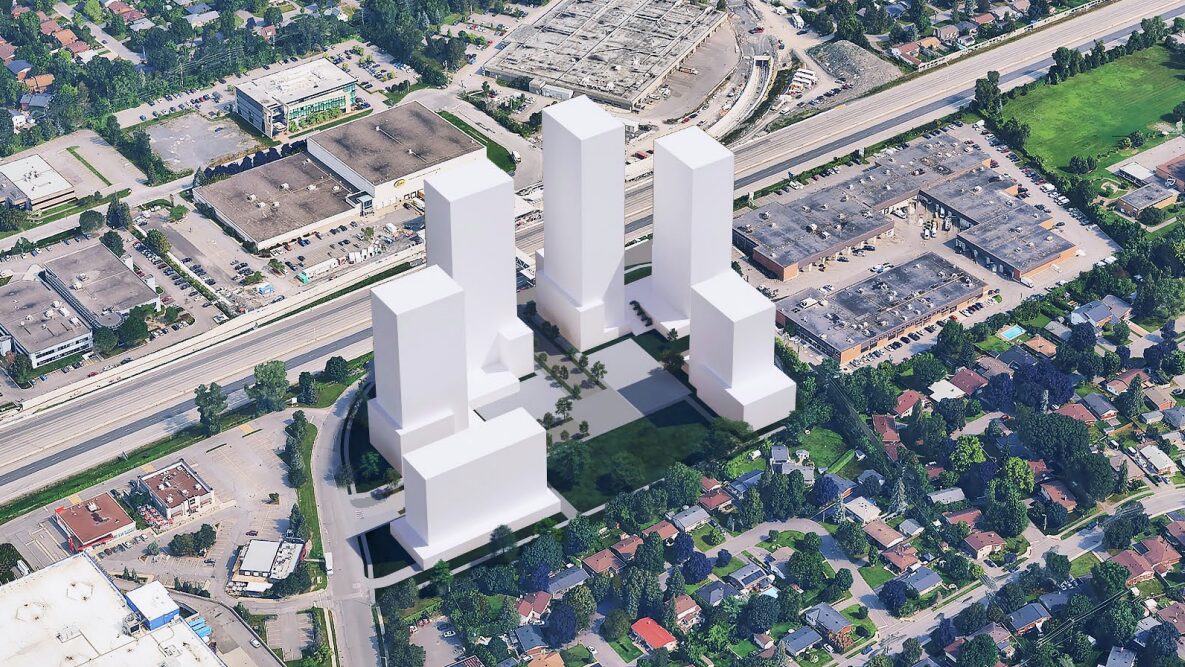
Meanwhile, owners of older industrial buildings may be “increasingly motivated to pursue residential redevelopment” of those sites as the city looks to prioritize intensification near major transit corridors, Colliers said in its report.
The company pointed to Regional Group’s proposal to demolish the Ottawa Citizen building on Baxter Road and replace it with a seven-block subdivision with as many as six highrises containing 1,400 new residential units.
Turning point?
Nationally, Canada's commercial real estate sector could be at a turning point after the national vacancy rates for both office and industrial properties simultaneously declined for the first time since 2020, a new analysis from Colliers found.
The report from Colliers International said the national office vacancy rate was 13.6 per cent in the first quarter of 2026, down one percentage point year-over-year and marking one of the most significant improvements since the COVID-19 pandemic.
Canada's industrial market, meanwhile, recorded its first national vacancy decline since 2022, down to 3.5 per cent.
The report said these trends suggest the commercial real estate market as a whole is moving toward a more balanced environment.
"It was quite unprecedented how long, especially office vacancy, went up," said Adam Jacobs, head of research for Colliers Canada, in an interview.
"It was a good five or six years of rising rates ... but the return-to-office momentum we've seen, especially in Toronto, has been very rapid in the last six months and it's really turned the market around quite quickly."
He said leasing demand is still concentrated in the "best of the best" buildings, and it could take some time for that momentum to trickle down to other less coveted properties.
Toronto and other major urban centres in Canada are still working through an oversupply of existing office space after a post-pandemic surge of completions, said Ben Haythornthwaite, CoStar Group’s director of market analytics.
"The office market is like if you had a patient in the intensive care ward, they've now moved into the general ward," said Haythornthwaite. "It's still sick, but it's not getting any worse and that's why we're seeing vacancy tighten up."
While many companies have moved their employees back to the office for at least part of the week, inventory growth is grinding to "a near-total halt," the Colliers report said.
Less than two million square feet of new office space is currently under construction, marking a major downswing from the period of 2021 to 2023. Each quarter during that stretch, an average of 1.8 million square feet of new supply was delivered nationally.
The slowdown in new office builds means Canada is unlikely to see any meaningful supply gains before the end of the decade, given that construction can take roughly three to seven years per project, said Veritas Investment Research analyst Shalabh Garg.
He predicted vacancy rates will continue falling, especially as more office space is also converted for residential use, but won't reach pre-pandemic levels.
"Five to 10 per cent vacancy rate is what's optimal, but it's hard to see us getting there," he said, noting the last time construction activity was this slow was the early 2000s. "We would need to see lots more conversion of older office space into some different use."
On the industrial side, Jacobs said the market is coming back strong from a brief shock caused by tariffs and trade uncertainty last year.
Market absorption outpaced new supply in the quarter, with more than 3.6 million square feet newly taken up, compared with three million square feet delivered, according to the report.
Jacobs said the trend shows the market is stabilizing after inventory had been piling up.
"Anywhere you live, you can notice a lot of new warehouse space was built in the last five years and there is just kind of a natural cycle to every market," he said.
"It takes a while to absorb it. But I think we're kind of through the other side of that in both the office market and the industrial, where a lot was built, it was difficult to build it all and now the building is really slowing down and we're starting to see those spaces fill up."
Colliers said industrial construction starts were resilient in the first quarter, with 5.6 million square feet of new projects breaking ground. Toronto, Vancouver, and Calgary drove 76 per cent of all new starts.
"For the most part, I think we're going to continue seeing demand increase for industrial space and we will see that space absorbed," said Haythornthwaite.
He said industrial markets should continue tightening in the coming years. However, the looming renegotiation of the Canada-United States-Mexico Agreement continues to cast a shadow of uncertainty in the short-term.
"I think we're probably going to see a slowdown in leasing over the next couple of months, just while people wait and see what happens with that because we're getting so close to it now," said Haythornthwaite.
– With additional reporting from The Canadian Press