

For the National Capital Commission (NCC), building LeBreton Flats is about more than constructing a new district – it’s about establishing a forward-looking community designed for the long term.
A major part of that vision is the use of a district energy system, an approach that captures heat where it’s not needed and transfers that energy to buildings that can put it to use.
Scott Demark, a partner with Theia Partners Inc. and technical adviser for the LeBreton district energy system, offered an example of how that will work by alluding to the future arena at LeBreton Flats.
“Let’s say you have a Taylor Swift concert in the new arena on a fall night, and you have a huge crowd that generates a lot of heat,” he explains. “The building is going to have to control that heat. Instead of dissipating it using a chiller and electricity at the stadium, we’ll pump that excess heat into the district energy system, and we will move that heat over to, say, an apartment building that needs it on that fall night.
“Essentially, the crowd is providing the heating to the apartment building, and that happens all the time, all over the place, in district energy systems. Instead of air conditioning being dissipated to the atmosphere, you’re putting that heat into a system that needs it.”
District energy systems typically result in dramatic thermal efficiency gains and significantly lower emissions.
A model for sustainable urban development
For the NCC, the district energy system will be the cornerstone of its sustainability commitments at LeBreton Flats. The system will ensure that the community’s energy system is not only sustainable, but also reliable, affordable, and adaptable.
“LeBreton Flats is being built for the long term, and district energy is the kind of infrastructure that supports that,” says Bill Leonard, vice-president of real estate and development at the NCC. “We’re showing what low-carbon city-building can look like at a large scale.”
Leonard emphasizes that strong partnerships are key to making the vision a reality. The NCC is working with Hydro Ottawa and Theia Partners to leverage the federal government’s Energy Service Acquisition Program (ESAP) to deliver reliable, efficient heating and cooling. ESAP is a century-long leader in district energy and the force behind one of North America’s largest modernizations of a public district energy system, which was transformed from aging steam plants to a state-of-the-art low-temperature hot water and electric chiller network – making it one of the most advanced systems of its scale.
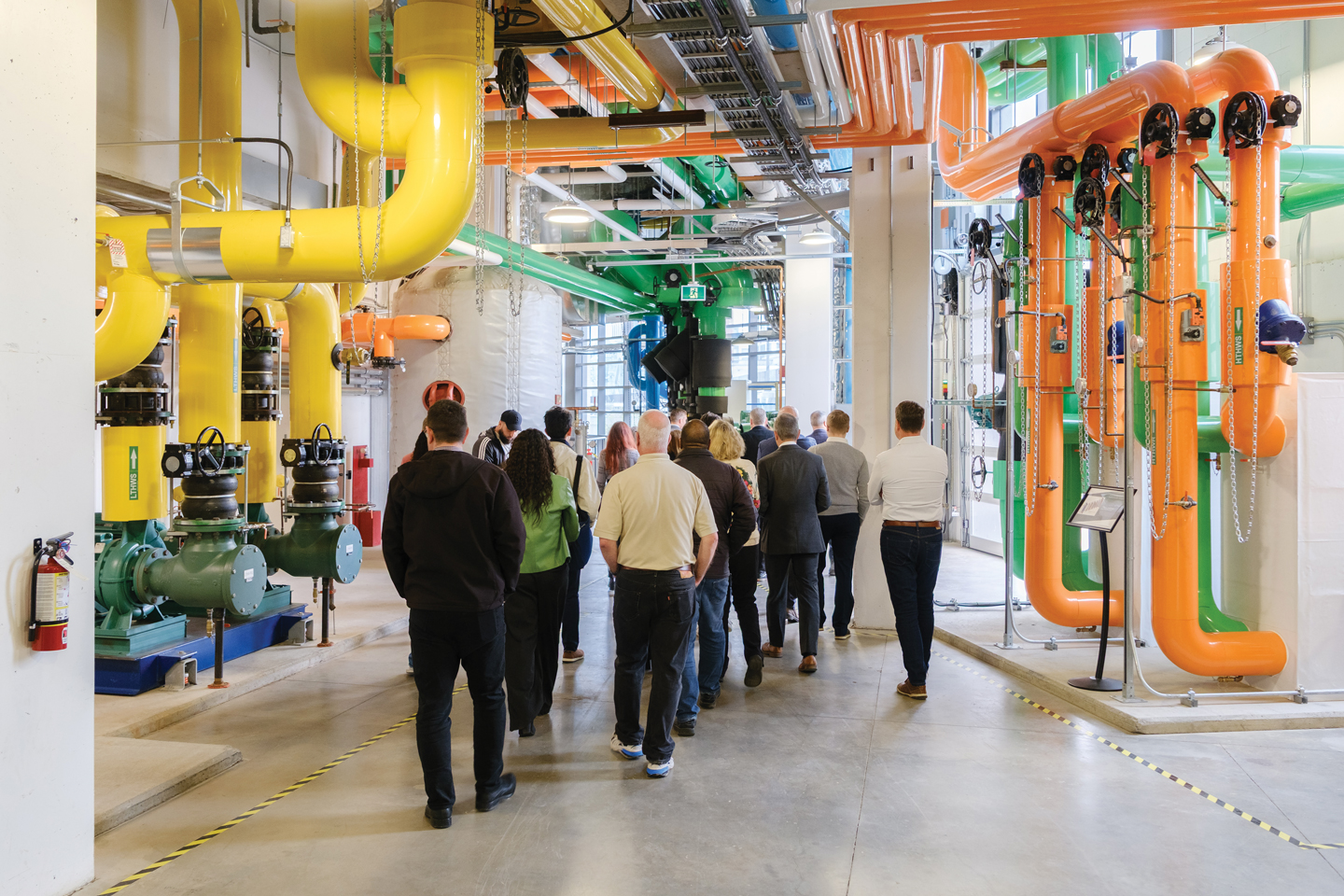
Through this collaborative approach, the LeBreton district energy system will deliver major emissions reductions to connected buildings.
“Our partnership on LeBreton Flats underscores Hydro Ottawa Group’s commitment to building a resilient, energy-smart National Capital Region,” says Guillaume Paradis, executive vice-president, distribution, generation and COO at Hydro Ottawa Group. “By deploying this district energy system, we are not only establishing a new benchmark for energy efficiency and reliability in large-scale urban development, but ensuring our infrastructure can seamlessly integrate future clean technologies to foster a sustainable energy future for all residents.”
Once the remainder of the community at LeBreton Flats is built in the coming decades, Demark says the impact will represent a reduction of about 11 kilotons of emissions annually – benefits that will continue to increase as new low-carbon technologies advance.
“This project represents a significant long-term investment in low-carbon infrastructure, built to deliver lasting environmental and economic benefits while charting a clear path toward a cleaner energy future,” says Paradis.
Equally important to the NCC is the affordability of the system, particularly when it comes to the rates that future residents and businesses will pay.
“Centralized clean heating and cooling will significantly cut emissions across the community, while keeping costs to residents comparable to natural gas,” Leonard says. “By taking this approach, we’re demonstrating that major urban redevelopment can support affordability and deliver public value while advancing climate goals.”
With a district energy system at its foundation, LeBreton Flats is poised to become a model for sustainable, future-ready urban development. The project will also demonstrate how thoughtful planning and strong partnerships can bring low-carbon communities to life.
This article first appeared in the 2026 City Building in the April Magazine. That publication is available in it’s digital format below: