
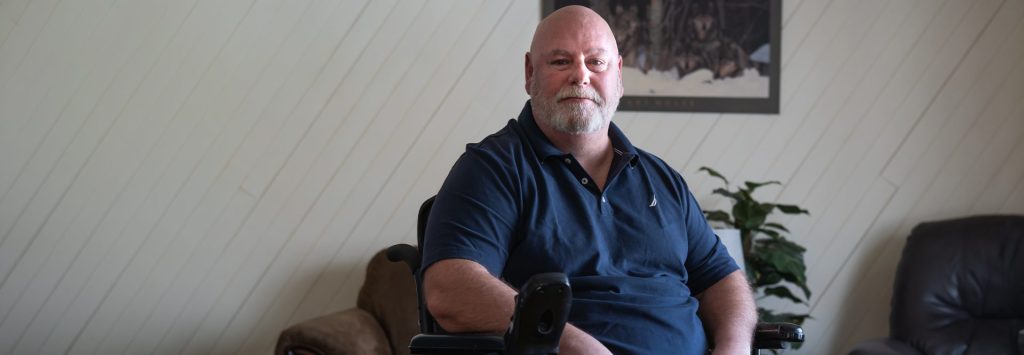
On Christmas Day in 2023, retired Master Warrant Officer Jody Stang fell to the kitchen floor. When his brother stopped by some time later, he found the Canadian Armed Forces veteran of 31 years – who had served six operational tours in theatres such as Afghanistan and Croatia – sitting with his back pressed against the cupboards, unable to get back up on his own.
What had started as numbness in his baby toe months earlier was clearly becoming something much more serious.
Stang was soon brought to The Ottawa Hospital (TOH), the only centre in the region equipped to provide the advanced neurological care he needed. It wasn’t long before a very rare tumour in his spinal cord was detected.
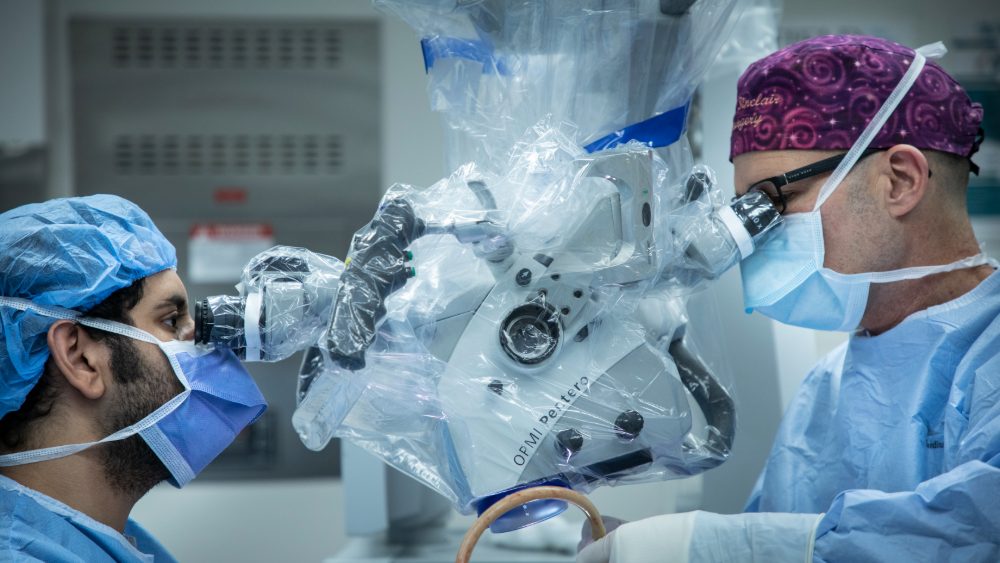
That’s when TOH neurosurgeon Dr. Safraz Mohammed recommended an unconventional option: A groundbreaking surgery with a fluorescence-guided microscope, funded by generous community donors.
An innovative, life-saving surgery at TOH
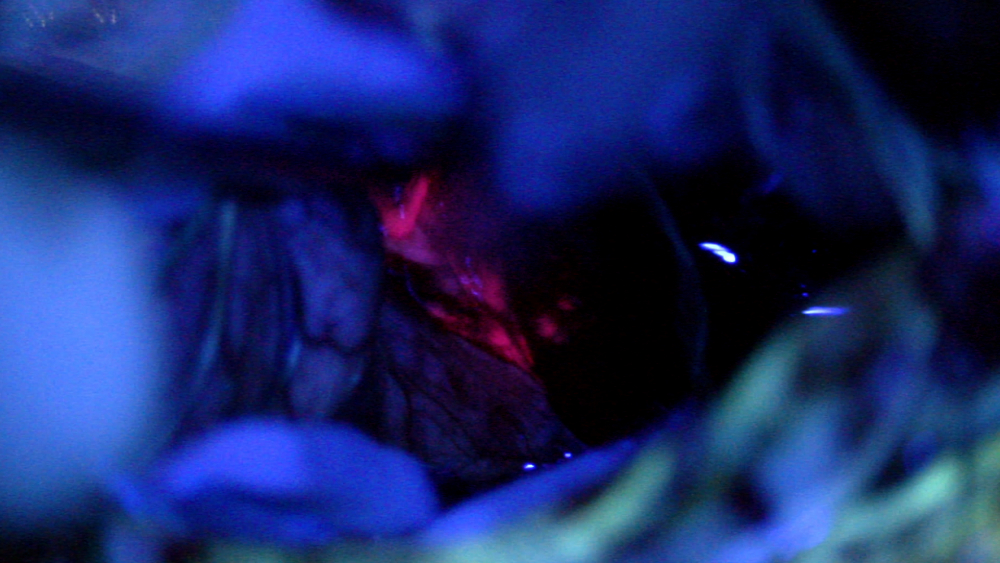
Several hours before the operation, Stang drank a liquid containing 5-aminolevulinic acid (5-ALA), a compound that accumulates in cancerous cells. Under a specific blue wavelength of light generated by a fluorescence-guided microscope, the malignant glioma in Stang’s spine soon glowed a fluorescent pink while his normal tissue remained dark.
Such contrast helps surgeons clearly see where the tumour ends and healthy tissue begins. This allows surgical teams to remove tumours with extraordinary precision, while preserving as much surrounding healthy tissue as possible.
Even though the surgery is often used for brain tumours, Stang’s case was unique. “While this technology has been used in brain tumour surgery, it had never been applied to the spine in Canada,” explains Dr. Mohammed.
A Canadian leader in fluorescence-guided surgery
The idea of fluorescence in medicine has been around for more than a century. In 1871, a German chemist created a glowing compound called fluorescein, which was later used in many scientific and medical fields.
Fluorescence imaging was mainly used in eye care and in studying blood vessels. Over the past 30 years, however, the technology has advanced rapidly and has become an important tool in brain tumour surgery.
The procedure was brought to TOH by Dr. John Sinclair in the 2010s, after he completed specialized training in fluorescence-guided brain surgery in Switzerland. He first performed the procedure at TOH in 2018 as part of a clinical trial utilizing a borrowed microscope.
TOH acquired its own microscope in 2019 following a $1-million fundraising campaign and was the first centre in Canada to adopt widespread routine use of 5-ALA in tumour surgery.
Today, the hospital is considered a national leader in fluorescence-guided neurosurgery, and Dr. Sinclair trains physicians across the country on the procedure.
Increasing the rate of complete tumour removal
Seeing tumour cells more clearly can make a major difference during these complex surgeries: In many cases, the rate of complete tumour removal has increased from about 30 per cent to as high as 70 per cent.
That’s because with fluorescence-guided surgery and 5-ALA, surgeons are often able to remove more of the tumour safely.
“5-ALA is an absolutely brilliant tool that allows us to remove more cancerous cells during surgery, improving outcomes, longevity, and quality of life for our patients,” says Dr. Mohammed.
“Using 5-ALA in the spinal cord allows us to push surgical boundaries that have not previously been reached in Canada, and that is incredibly exciting for both surgeons and patients.”
Supporting patient care innovation to improve health outcomes
Innovations like fluorescence-guided surgery are made possible through research, advanced technology, and the generous support of donors.
When donors support The Ottawa Hospital Foundation, they help equip surgeons with the latest tools to improve patient outcomes and bring groundbreaking treatments to patients who need them most.
They also help provide more successful health outcomes for patients like Stang, offering something many don’t expect after such a diagnosis – more time with loved ones.
“I’m incredibly thankful,” he says. “For the care I received from my healthcare team and for the chance to have more time with friends and family.”