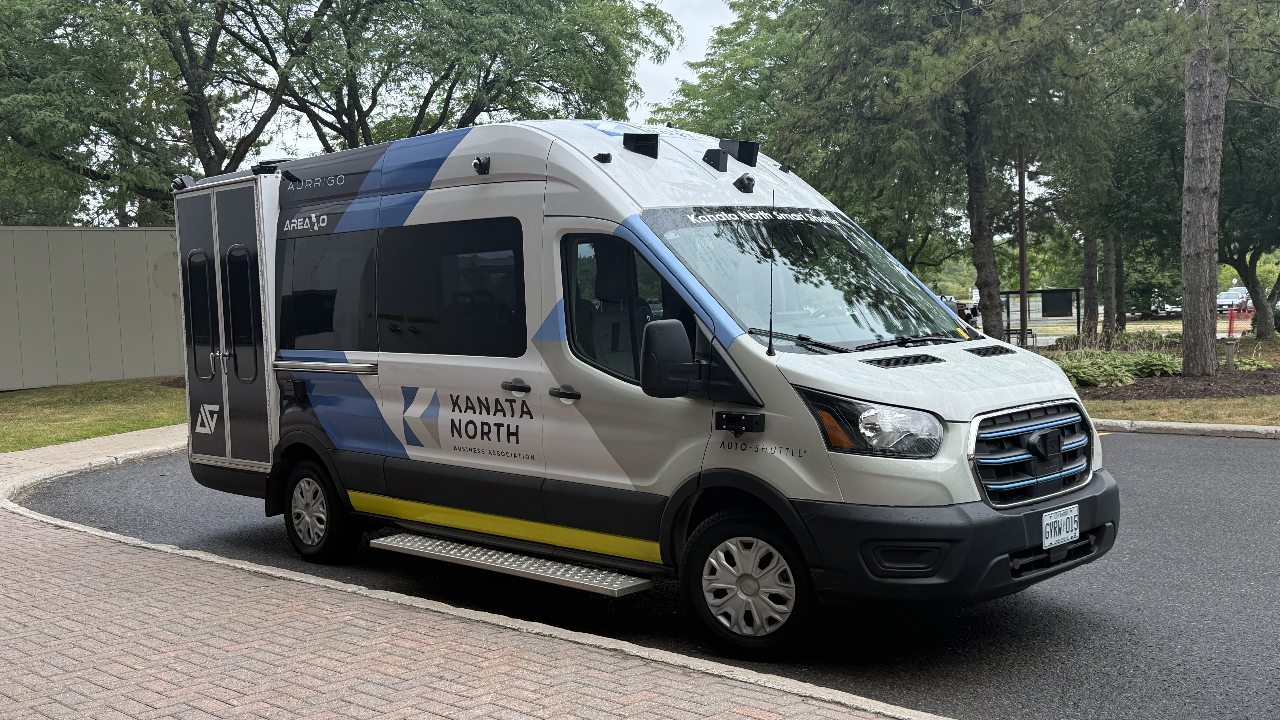
The Kanata North Business Association hopes its autonomous shuttle pilot project that launches next month will serve as a model for other parts of the city or even as inspiration for other municipalities. The pilot, which runs from Oct. 9 to the end of January, will see self-driving vehicles take passengers from the Kanata tech […]
Get Instant Access to This Article
Become an Ottawa Business Journal Insider and get immediate access to all of our Insider-only content and much more.
The Kanata North Business Association hopes its autonomous shuttle pilot project that launches next month will serve as a model for other parts of the city or even as inspiration for other municipalities.
The pilot, which runs from Oct. 9 to the end of January, will see self-driving vehicles take passengers from the Kanata tech park to eight stops along a 4.5-kilometre route starting at 350 Legget Dr. and proceeding down Terry Fox Drive and Herzberg Road, free of charge.
The autonomous vehicles can reach speeds up to 50 kilometres per hour and have been tested in all weather conditions.
“We would hope this would end up being a last-mile (transit) solution. We have the LRT coming (near) the tech park. If this could be a connection to the transit system, I think that’s definitely what we’re hoping for – to prove that it would be a viable solution for the city,” said Tracey Godin, KNBA’s senior project manager.
According to the KNBA website, “By supplementing existing public transport and addressing transportation challenges faced by employees, visitors and students within the tech park, this project aims to explore future sustainable and accessible transportation options.”
Hours of operation will be available on the KNBA website and an automated map will allow riders to locate the shuttles along the route.
“We’ll have a survey on the shuttle where riders can provide feedback on what worked and what didn’t work,” Godin said.
Objectives for the pilot include supporting the safe development and implementation of future transportation solutions; contributing to the creation of evidence-based transportation policy frameworks for autonomous vehicles in Canada; and validating transportation solutions for the City of Ottawa and the Kanata North Tech Park.
With the hope that others will adopt the technology if the project is a success, Godin said the possibilities for its integration are endless.
“I certainly hope there’s interest. We have academia here. We have the autonomous vehicle research team at uOttawa that might take note … I can only speculate, but there has been some talk about it continuing on,” Godin said.
According to KNBA’s executive director Kelly Daize, the pilot project builds on insights gleaned from previous trials.
“It is not only a historic first for Canada — it’s a powerful example of how industry, government, and community can come together to test real-world solutions that improve accessibility, advance safety, and create a blueprint for the future of transportation in all seasons,” she said in a press release last month.
The vehicles were tested at Area X.O, a 1,866-acre research and development complex on Woodroffe Avenue operated by Invest Ottawa.
David Keene, CEO of U.K.-based manufacturer Aurrigo, the company that created the vehicles, said that the project will provide insights on the company’s future AV solutions.
“We have been working with Kanata North Business Association for over six years on how we can effectively bring autonomous vehicles to the streets of Canada … This important project accelerates this vision, and we believe we have the real-world technology in place in Auto-Shuttle that will prove that driverless vehicles can operate safely and effectively in all weather conditions. In my opinion, this could be the testbed that unlocks further AV developments in North America and across the rest of the globe,” Keene said in the release.
In addition to Aurrigo, four Canadian companies were part of the project. Ottawa-based EcoSafeSense engineered the air-quality sensors inside and outside the vehicles and Toronto-based Deaf AI will integrate its sign language avatars to announce the next stop and when a shuttle is approaching. Ottawa-based Zendelity will provide on-board safety operators with an automated checklist, while Ottawa-based software company Solink is also a project partner. Solink specializes in using AI to mine insights from digital security footage.
“The operator will have to go through a series of checks and it’ll be facilitated through the software. They will have to complete that checklist before the shuttle is able to move,” Godin said of the Zendelity technology.
The vehicles will be able to seat up to nine people, including two to three safety operators. Godin said the intent of having in-person safety operators was to ease people’s fears of boarding a self-driving vehicle.