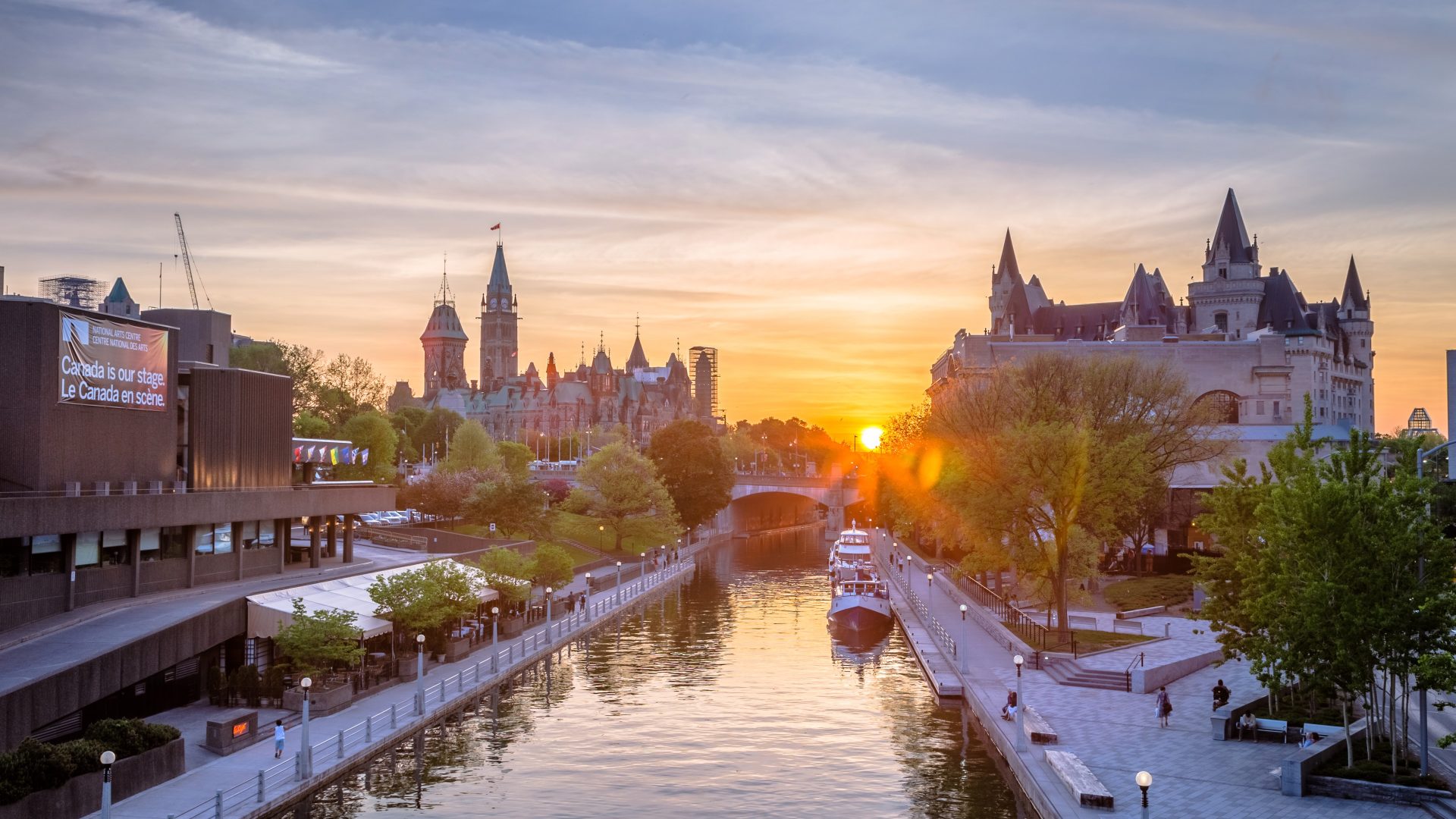
Germany’s Thomas Scheele says European cities are experimenting with ways to bring community activities to the water and Ottawa has the opportunity to do the same.
Already a Subscriber? Log in
Get Instant Access to This Article
Become an Ottawa Business Journal Insider and get immediate access to all of our Insider-only content and much more.
A morning dip in Dow’s Lake? A rock band touring on a barge on the Rideau Canal?
Germany’s Thomas Scheele says European cities are experimenting with ways to bring community activities to the water and Ottawa has the opportunity to do the same.
“More and more cities are redefining their relationship with the water,” Scheele said during his talk at last week’s Canada After Dark conference, a two-day summit exploring the future of nighttime economies. The event was co-presented by the City of Ottawa’s Nightlife Office and the Ottawa Music Industry Coalition.
Ottawa isn’t a complete stranger to using the water as a cultural space – the Rideau Canal Skateway is one of the city's most popular tourist destinations in the winter. But the rest of the year poses a different sort of challenge.
Scheele, who is based in Berlin, Germany, is the senior project manager for international research and advocacy agency Vibelab, which supports the development and preservation of nightlife culture. He said his visit to Ottawa for the nightlife conference at the National Arts Centre was his first time presenting the organization’s waterways research outside of Europe.
“Nightlife, for me, means we need to break the codes and I feel there’s a hunger for this in the city,” said Scheele during his presentation. “If people ask me, do you think we can become a cool city? I say yes, of course. You can do it, but you need to want it. You need to want that for your city.”
While the use of waterways might look different in the Canadian context, Scheele pointed out that waterways – including rivers and canals – make up nine per cent of Ottawa’s urban surface, representing a significant “untapped spatial resource” for community and cultural development.
The relationship of cities to their waterways is constantly changing, Scheele said.
“Ottawa wouldn’t exist if it wasn’t for the river – it’s a natural resource that allowed a settlement,” he said. “And then, with the Industrial Revolution, rivers became a kind of dumping ground for cities, where all the sewage was thrown away. With the post-Industrial age, a lot of factories were re-thought as residential buildings and cultural centres and cities rediscovered their waterfront.”
Nowadays, he said waterways are used and viewed primarily as transit routes.
“They’re public spaces, but they’re usually used like liquid highways,” he said. “In most cities, they are traffic routes for commercial or touristic shipping. They’re not leisure spaces.”
Scheele said part of the problem is that innovation has stopped at the shore. Cities developed parks, housing and community centres next to rivers, but left the water alone. With climate change expected to raise temperatures, Scheele expects more people will seek proximity to cooler spaces.
That means the water itself, he said, is the next frontier. “If we can turn liquid highways into liquid cultural spaces or public spaces, a lot can be won,” he said.
One example he used was the Fluctuations Festival, where a 40-metre barge was transformed into a floating stage that travelled along various European rivers, docking in different cities for events. Festival-goers would gather on the riverbanks for music performances, art displays, workshops and talks.
Scheele called it a wild and complicated endeavour, but its success from city to city was eye-opening.
“I realized we need to look at the much wider phenomenon across Europe,” he said. “Who’s starting stuff on the water and how do they do it? There’s no guide. There’s no playbook or formal system. No city in the world has a creative river strategy or policies.”
As part of Vibelab’s subsequent research, Scheele said 36 vessels of various shapes and sizes were identified across the continent, all of which had found different ways to provide cultural experiences on the water.
One was a former deep-sea fishing vessel that had become an award-winning nightclub. Others were smaller motorboats that would gather in packs for guerilla concerts that didn’t always follow the letter of the law, he said.
“It’s such a huge diversity,” said Scheele. “Each of these ships is a strategy to stage culture on water, to bring creativity to the water. There is no one-size-fits-all strategy.”
Scheele said some cities are starting to put considerable funds behind waterway revitalization. Paris, France is a significant recent example. Ahead of the 2024 Summer Olympics, Scheele said the city invested 1.4 billion euros ($2.1 billion) to clean up the Seine, which was then used in the opening ceremony and multiple aquatic events.
But months after the athletes left the city, Scheele said the Seine is still teeming with activity as a result of the investment, which included building infrastructure in and around the waterways.
Ottawa has already started its own experiments. In addition to boat tours that are popular among tourists, the National Arts Centre got creative last summer offering free boat concerts along the Rideau Canal. Members of the NAC Orchestra serenade walkers and runners, as well as music enthusiasts, as they sail past.
This year, the National Capital Commission opened a recreational dock on Dow’s Lake as a pilot project to encourage more people to connect with the water and, perhaps eventually, go for a swim.
With so much water available, Scheele said Ottawa has plenty of opportunity to experiment.
“You have a great diversity, with the Ottawa River, the Rideau River and the Rideau Canal,” he said. “There are natural waterscapes, there are bays, there are lakes, there’s built canals and there’s natural shorelines … We should zoom in on particular places and think, how can we be more nuanced in the way we think about rivers and start prototyping new ideas in certain pockets.”