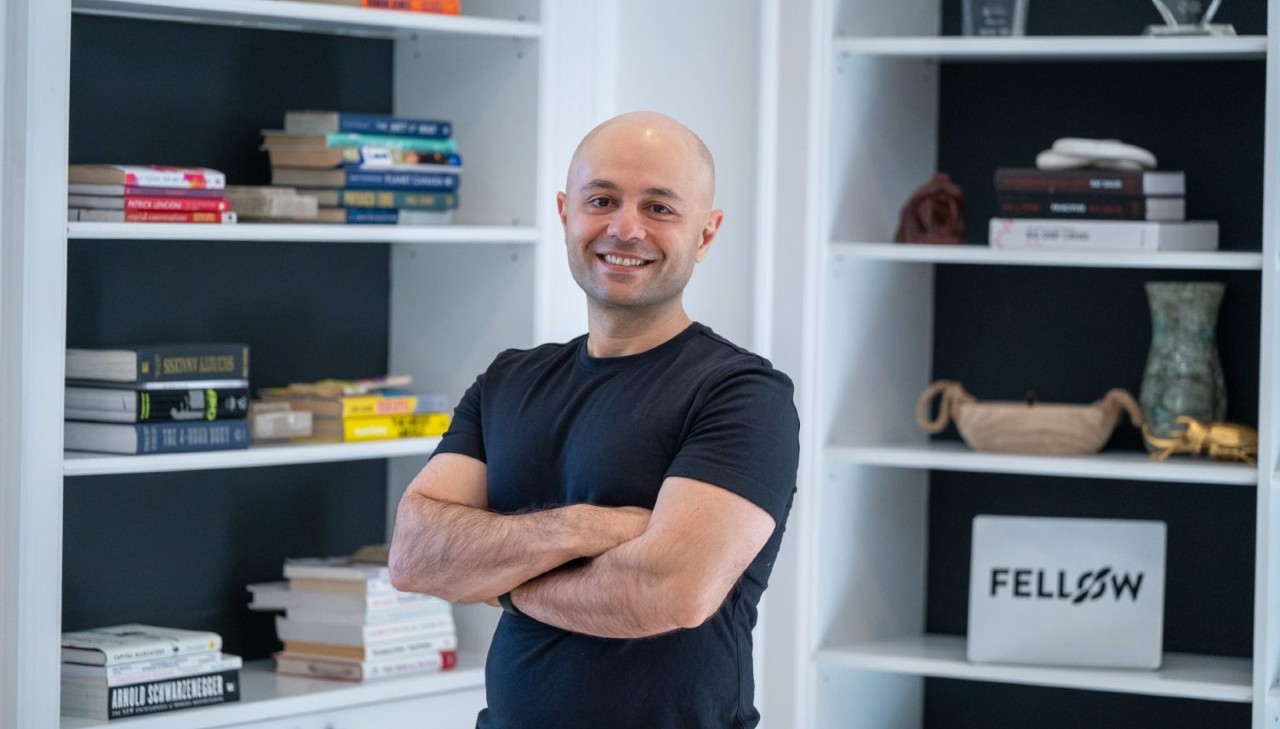
In this instalment of Top of Mind in Tech, Mirzaee breaks down what the mainstreaming of AI has meant for client priorities and how it’s changing the marketing landscape as we know it.
Get Instant Access to This Article
Become an Ottawa Business Journal Insider and get immediate access to all of our Insider-only content and much more.
Even for AI companies, artificial intelligence is changing the game.
Aydin Mirzaee, CEO of Ottawa-based tech company Fellow, said his company is constantly finding ways to use new AI technologies to improve the way it manages its business.
A self-proclaimed tech-loving entrepreneur, Mirzaee has jumped feet-first into artificial intelligence. He founded his AI-powered meeting management software company in 2019, just months before the pandemic triggered a boom in virtual meetings.
Prior to that, he co-founded online survey provider Fluidware in 2008 and sold the company to SurveyMonkey six and a half years later. He then had a two-year stint as a senior manager at SurveyMonkey, serving first as general manager of FluidReview, then as director of product management.
In this instalment of Top of Mind in Tech, Mirzaee breaks down what the mainstreaming of AI has meant for client priorities, why it’s freeing up time for customer support agents, and how it’s changing the marketing landscape as we know it.
This transcript has been edited for length and clarity.
The mainstreaming of artificial intelligence
“AI is becoming a lot more mainstream. In late 2022, when ChatGPT came out, it was much more like, ‘Wow. This is something cool and really mind-blowing and novel.’ In 2023, people were starting to think about, ‘Okay, this is something very real and I can see how it can really impact my business.’ We saw how it could potentially be transformative but were not quite sure how. I would say 2023 was the age of experimental AI budgets, where people were thinking about allocating more budget for AI.
“Now in 2024, AI is becoming more mainstream. A lot of that experimental budget is starting to turn into something very real. Now we’re looking for permanent solutions because AI is transformative and people are starting to look at their AI expenditure with a lot more of a traditional lens. (They’re) thinking about privacy and security and all those traditional things that matter.
“The thing that we’re hearing a lot more from our customers is, if I use the Fellow meeting assistant in my meetings, how do I make sure that I have privacy rules in place, to say these ones get recorded, those ones don’t get recorded, and these get deleted after three months? Do we have redaction capabilities? Do we have the ability to go on the record or off the record? In 2023, people didn’t really care much about that, because it was new and they wanted to experiment. Now that I think the experiment is over, people want to find permanent solutions for those traditional enterprise needs. That’s a big trend we’re seeing and it’s shaping the way we’re thinking about our growth in ’24 and ’25.”
Automated customer support frees time for complex problems
“There’s a lot of companies in this space (AI customer support). One of the big ones is actually Canadian, Ada AI. What’s happening is that a lot of the workflows, a lot of the questions that customers are asking, are also being automated, and it’s really changing where customer support specialists are spending their time. For example, at Fellow, a lot of our people who work in our customer support department are now a lot more focused on writing content and answering in a generic way to speak through AI, so the AI can do the responding.
“What they’re doing also is spending most of their time on actually really complex questions, versus the kinds of things that can be answered by an AI that spreads all of your support and help content. And it’s very interesting because our strategy has shifted to, ‘let's write a bunch of great content for the AI’ versus ‘let’s spend our time directly responding to a bunch of questions.’ AI will never sleep. It’ll be there at all times and be a super great communicator with customers. Then when a problem actually becomes complex and your human level support is needed, they can tackle those sorts of problems. It’s really a shift in how our time is spent internally.”
AI changing the marketing playbook
“AI is not only changing the way we run our companies and the tools that we use, but it’s also changing go-to-market merchants as well. At Fellow, one of our primary ways that we would get customers was to write a lot of thought leadership content, primarily optimized for search engines. What has changed, though, is the search landscape. Now there is (AI-powered answer engine) Perplexity. OpenAI just launched their search competitor to Google. And what’s different about these search platforms is that you no longer visit the website of the person or company that wrote the article, you get the answer on ChatGPT or Gemini or wherever else. You’re not actually travelling to those pages.
“That changes everything. All of a sudden, people aren’t going to your website, just consuming the content elsewhere. That has made a drastic shift in the way companies acquire customers. You no longer write things and hope that search engines are going to send you traffic because you did a good job answering certain questions. That’s a major, major change in marketing. A whole generation of marketers have to relearn new methods in which to gain an audience. One of the most significant channels of the last 20 years is being completely transformed.
“That leads to another thing, which is outbound sales. Traditionally, you have sales folks sending emails or cold calls (to potential clients), but that landscape has drastically changed. There are a lot of companies springing up and effectively creating AI agents that do these things, that will send the outbound emails. They’ll do everything from researching who would be a good customer for you to finding their contacts and creating automated sequences tailored to that person.
For the people on the receiving end, it means a much larger volume of communication, but also communication that is actually really good and starts to become hard to decipher between humans and AI sending it. There’s a bunch of cool startups that are doing this. All the traditional playbooks that I would say all of us have learned from the beginning of SaaS really dominated the last two decades. But AI has completely changed the way we’re doing go-to-market.”