If there’s one thing architect Andrew Reeves learned on a recent trip to Europe, it’s that the best cities are built with intention.
Get Instant Access to This Article
Become an Ottawa Business Journal Insider and get immediate access to all of our Insider-only content and much more.
If there’s one thing architect Andrew Reeves learned on a recent trip to Europe, it’s that the best cities are built with intention.
The owner and founder of Ottawa-based architect firm Linebox, Reeves spent two weeks this fall visiting Berlin, Hamburg and Copenhagen to learn more about how those cities have succeeded in creating exciting, vibrant and livable communities.
“It’s good to travel,” Reeves told OBJ following his return to Ottawa. “I think for everybody in every industry, whatever you do, it’s good to see other countries and other cultures, to see people doing different things and just observe.”
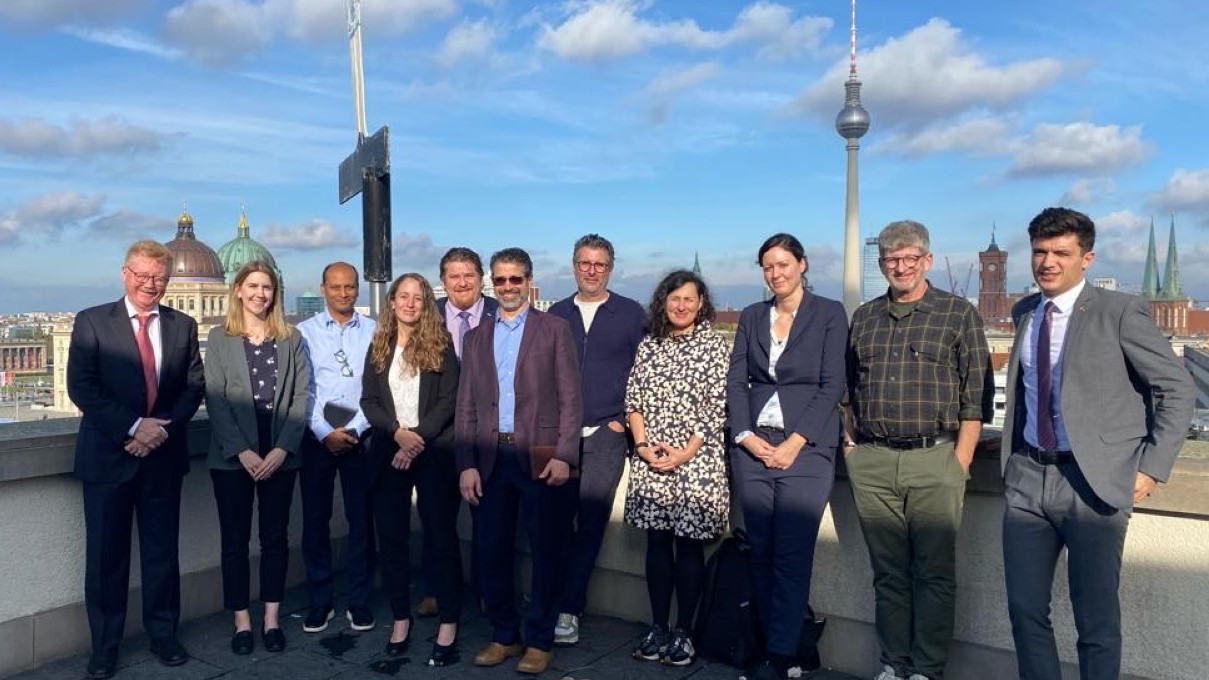
Reeves was invited through the Kanata North Business Association to represent Linebox on the German leg of the trip, which was facilitated by the German Embassy in Canada. The trip highlighted Germany’s “smart cities,” and how to sustainably shape growing urban areas in a post-COVID world.
Reeves was joined by a mix of Canadian professionals from across industries, including tech, urban planning and business. Jeffrey Stanier, an R&D leader with Ericsson Canada — which has a major research-and-development site in Kanata — also attended.
While this leg of the trip focused primarily on how cities can use tech and data for planning and management, Reeves said it also highlighted the importance of developing a city with intention at every stage.
“As an architect, you always look at how people eat, how people sleep, how they jog through the city,” he said. “If things change, how does that impact how people jog, how they bike, where they eat? So as things evolve, we’ve always got to be conscious of the culture side and the human side of things, that one doesn’t influence the other so much that it creates more damage.”
When it comes to Ottawa, Reeves said that sense of purpose is lacking.
“We seem to be a city that’s building buildings without intention,” he said. “When we go to Copenhagen, Berlin or Hamburg, you can see that it’s evident that people really do care. It’s just part of their core values, and that is reflective in their architecture, their food and all those things. They don’t just talk about those things, they actually implement them.”
The lack of value placed on thoughtful planning and architecture is a larger cultural problem, but it isn’t the only reason why Reeves believes cities like Ottawa struggle to compare.
According to Reeves, European cities thrive on a top-down approach, where monetary investment and steadfast dedication to a cohesive master plan are core tenets of development.
“They’re proud of these amazing buildings. They invest the money needed for these things and these artifacts are now there forever,” he said. “I definitely learned that the government needs to be a major player in all these initiatives. There has to be real investment.
“We’re not bold enough. We can’t just say that the government needs to pay for it. There has to be a commitment from our country and our citizens,” he added. “(Germany) is very much, ‘You need it, you get it done.’ Here, we talk about and debate it, then by the time whoever’s in charge politically gets to the point, someone else is coming in.”
Pandemic exposed shortcomings of North American cities, says Reeves
After completing his time in Germany, Reeves met up with his wife Melissa in Copenhagen, where they spent a week touring the city with a local architect.
According to Reeves, Copenhagen is designed in a community-centric way, consisting primarily of mixed-use mid-rise buildings that concentrate essential amenities together.
“Copenhagen is a very similar size (to Ottawa),” said Reeves. “But their commitment is to health, wellness, happiness. (The architect) kept saying that they invest in happiness. It’s a financial commitment.”
Throughout the city, residential units are built in the same buildings as schools, offices, gyms, restaurants and retail shops. Despite its population, the city itself is a quarter of the size of Ottawa due to its high density, Reeves noted.
“We toured a community centre, and I asked the architect we were with, ‘How do you get all these people together?’ And she said, ‘You go to the community and ask about the community’s needs and you build a building that has those things in them.’”
A project like that would be much more difficult to achieve in Ottawa, where the responsibility for building amenities is siloed and communication is lacking, Reeves added.
“We have all these fragmented buildings with duplicate services,” he said. “Everyone has broken off into their own interests. They don’t ever talk to each other.”
This fragmentation became more evident during the pandemic, especially in the downtown core.
Many office buildings remain empty as companies take on more permanent hybrid work models, lowering foot traffic for restaurants and businesses that have been forced to close their doors.
“COVID didn’t cause these problems; it exposed them,” Reeves said. “These cities are designed wrong. COVID exposed mass transit problems.
“It exposed that our ratio of residential-to-commercial downtown was always wrong. It exposed that people don’t inhabit those tall buildings,” he continued. “There’s a lot of things, but that presents opportunity.”
That opportunity currently includes office-to-residential conversion projects, which have been proposed in unused office buildings across the downtown core, to improve the balance between workers and residents.
“There is an opportunity to fix all those things,” he said. “With Copenhagen, you don’t have to fix anything because it wasn’t wrong in the first place. Their buildings were mixed properly. The density is right. How they go about their city was right. I think this has given us time to realize that maybe everybody living in the suburbs and driving to one building and going up a giant tower isn’t right.”
While the downtown core readjusts, Reeves said Ottawa has an opportunity to build an intentional community from the ground up as the Kanata North tech park builds residential developments for the first time.
“Why can’t we have those things? Places like Copenhagen prove that it can be done,” he said.
“It shouldn’t be on individuals to build individual buildings in Kanata North, because that would be building without intention. If a company builds a building, they serve their needs, but there’s no attention to what this community is,” Reeves continued. “If Kanata North wants to be a true community, then you start with your buildings; you make a plan and stick with it.”
It’s no easy feat, he said, but it starts with a commitment to, and an investment in, people’s happiness.
“It takes a ton of work to make something interesting,” he said. “There’s no way you come back from Copenhagen or Germany and think it’s easy. It’s an insane amount of work and commitment.
“They’re not just being whimsical; it’s a lot of effort, a lot of taxing, a lot of challenges,” Reeves said. “They have all the challenges we have. We want to do something good instead of bad.”