
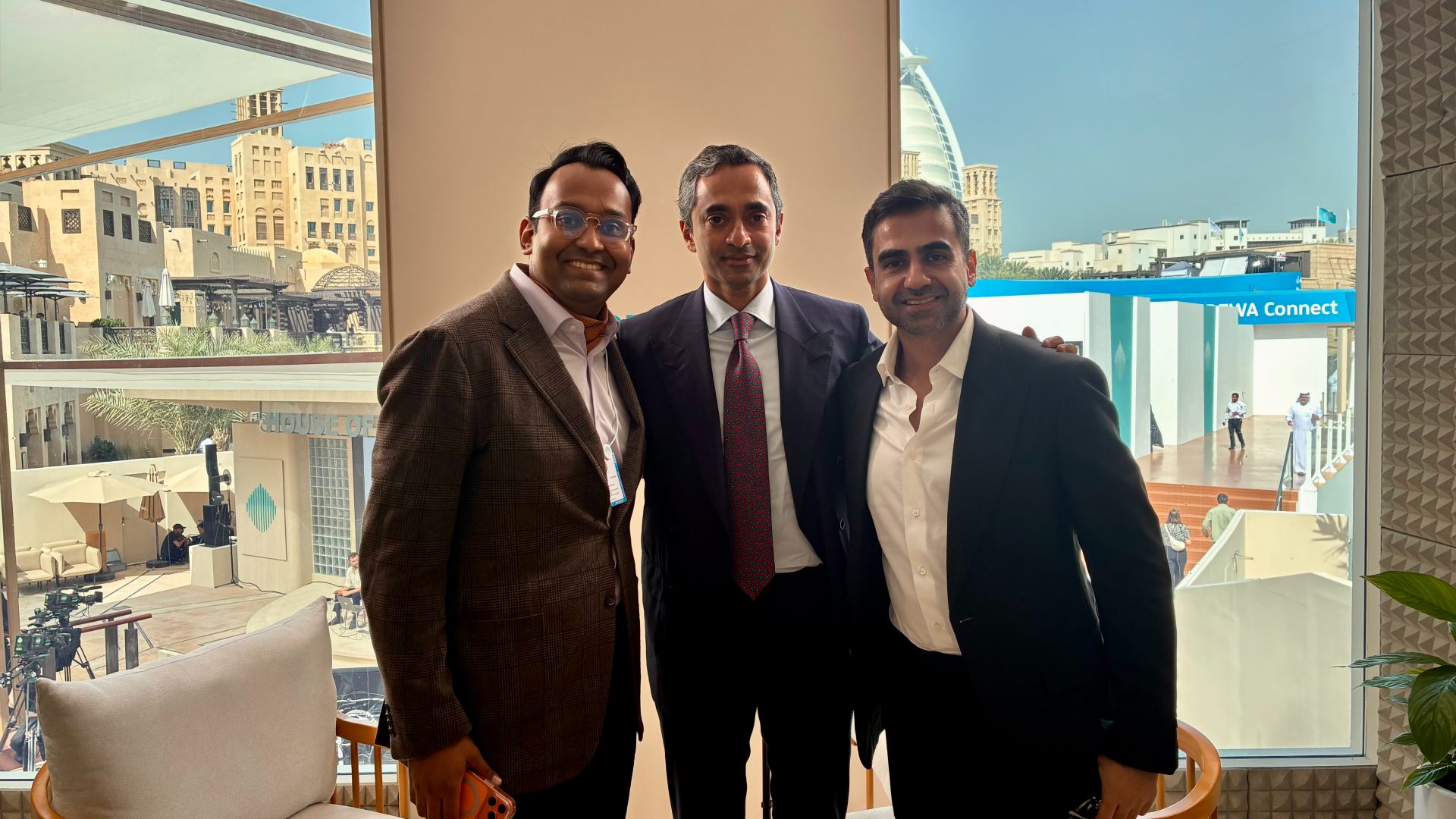

Dr. Anirudh “AK” Kumar sits in CarMa’s headquarters at the ByWard Market, still visibly energized despite having landed from Dubai less than 24 hours ago. The founder and CEO of CarMa Institute just spent three days at the World Governments Summit (WGS) 2026, a private gathering that, in his words, “felt less like a summit and more like a coordinated acceleration.”
He made the journey alongside friend and prominent investor Chamath Palihapitiya, whose presence underscored the summit’s growing magnetism for global capital allocators.
For those unfamiliar, WGS has quietly evolved from a regional policy forum into one of the most strategically significant gatherings on the global calendar. Held annually in Dubai, the 2026 edition brought together representatives from over 150 countries, including heads of state, sovereign wealth fund managers, technology leaders, and infrastructure investors.
Unlike Davos, which often feels retrospective, WGS is explicitly forward-looking.
“What struck me immediately,” Kumar says, “was the tone. There was a palpable sense of urgency, but not the kind driven by crisis. It was urgency driven by opportunity. People weren’t there to debate whether change was coming – they were there to coordinate how to build for it.”
From reflection to acceleration
The structure of WGS itself reinforces this forward orientation. Unlike traditional summits that prioritize keynote speeches and panel discussions, WGS dedicates significant time to closed-door ministerial meetings, masterclasses, dialogues, and bilateral discussions between sovereign investors and technology leaders – all explicitly designed to help governments respond to today’s challenges and design tomorrow’s solutions.
The summit’s emphasis on actionable partnerships rather than theoretical debate creates an environment where strategic decisions are made in real-time. “You could feel the momentum building,” Kumar recalls. “Conversations that might typically take months to arrange were happening in real-time. There was a shared recognition that the pace of global change is accelerating, and institutions need to move faster to keep up.”
Kumar says he noticed a consistent shift in emphasis from short-term growth metrics to long-term capability building. Infrastructure, supply chains, and technological sovereignty surfaced repeatedly.
The implication, he suggests, is that the world is entering a new phase of globalization: one characterized not by uniform integration, but by strategic interdependence.
The rise of physical AI
For much of the past two years, the global AI narrative has centered on generative AI and digital productivity tools. At WGS, however, Kumar observed a marked shift in focus. “One of the strongest themes was the rise of physical AI. There was a growing recognition that AI is no longer confined to software applications. It’s rapidly becoming embedded in manufacturing, logistics, energy systems, robotics, and national infrastructure.” says Kumar.
This transition, Kumar explains, represents a fundamental change in how nations think about competitiveness. The first wave of AI primarily enhanced cognitive productivity by automating tasks, generating content, and improving decision-making. The next wave is poised to reshape industrial output itself. “Countries are increasingly focused on the infrastructure required to deploy AI at scale,” he notes.
Several sessions at WGS 2026 explored how governments and private investors are collaborating to build this infrastructure. Discussions centered on digital transformation, cybersecurity resilience, and the integration of AI into national infrastructure systems.
What does this mean for a country like Canada, which has historically excelled in AI research but struggled with commercialization and deployment at scale?
“Canada has world-class AI talent and strong research institutions,” he responds. “The opportunity now is to connect those assets to the kind of capital and strategic partnerships that were being discussed at the WGS 2026 in Dubai. That’s where Ottawa, specifically, has a unique advantage.”
Healthcare as national infrastructure
“Healthcare was everywhere” at WGS, he says emphatically. “But the framing was different. It wasn’t discussed as a cost center or even a clinical challenge. It was discussed as strategic infrastructure that directly impacts economic productivity, national security, and long-term competitiveness.
“The conversation has shifted to how healthcare systems can be strengthened for the future. Countries that invest in robust healthcare infrastructure today are positioning themselves for sustained advantage in the decades ahead,” he adds.
This reframing has significant implications for how healthcare innovation is funded and deployed. Rather than viewing healthcare through the narrow lens of cost containment or incremental efficiency gains, governments and investors are increasingly recognizing it as a foundational system that enables everything else.
“A resilient healthcare system means a healthier, more productive workforce. It means faster responses to public health threats. It means better data for AI-driven diagnostics and personalized medicine. All of that translates into economic and strategic advantage,” explains Kumar.
This global shift validates CarMa’s approach. Rather than building point solutions for individual clinics or hospitals, CarMa is focused on infrastructure systems that enable better diagnostics, more efficient data sharing, and more resilient healthcare delivery at scale.
“We’re not just building for today’s healthcare system,” Kumar explains. “We’re building for the healthcare system that needs to exist in 2035 or 2045. That requires thinking about infrastructure, not just applications.”
The new geography of innovation
For decades, the dominant model assumed that technological breakthroughs would emerge from a handful of Western hubs such as Silicon Valley, Boston, or London and diffuse outward. That model, he argues, is rapidly becoming obsolete.
“Global investors are paying close attention to regional innovation ecosystems,” Kumar says. “Technology is increasingly being designed for local populations, local infrastructure, and local priorities. The era of one-size-fits-all innovation is ending.”
This shift was apparent at WGS 2026. Delegations from the Middle East, Southeast Asia, Africa, and Latin America were not merely attending to learn from Western models – they were presenting their own strategies, forming their own partnerships, and building their own innovation ecosystems.
“Globalization isn’t ending,” Kumar clarifies. “It’s transforming into a multi-polar network of innovation hubs, each with its own strategic priorities and comparative advantages. The question for Canadian cities like Ottawa is: where do we fit in that network?”
Ottawa’s strategic position within the new globalization
But what does all of this mean for our city?
“Ottawa has significant structural advantages,” Kumar says. “We have strong research institutions, universities, federal labs and regulators such as the National Research Council. We have a deep pool of technical talent. We have a government presence that understands the intersection of policy, technology, and national priorities. We have a growing ecosystem of companies working on exactly the kinds of infrastructure challenges that were being discussed at the WGS.”
The challenge, he suggests, is ensuring that Ottawa’s ecosystem is connected to the global networks where capital, strategic partnerships, and long-term infrastructure investments are being coordinated.
“There were very few Canadian voices in the rooms where these conversations were happening,” Kumar observes. “That’s a missed opportunity. Because the work being done in Ottawa – in healthcare, in AI, in clean tech, in advanced manufacturing – aligns almost perfectly with the themes that dominated WGS.”
He points to CarMa’s own experience as an example. The company’s focus on drug development, healthcare, and health data infrastructure has positioned it at the intersection of three major trends discussed at the summit: capital, physical AI deployment, and healthcare as strategic infrastructure.
“We’re building systems that won’t reach full maturity for another decade,” Kumar explains. “That requires capital. It requires partnerships with governments and healthcare systems and it requires thinking about infrastructure, not just products.”
Kumar sees an opportunity to position the city and its innovation ecosystem as a hub for infrastructure-focused innovation, particularly in sectors where long-term strategic thinking is essential.
“We should lean into what makes us distinct: deep technical expertise, proximity to government, strong research institutions, and a culture of building things that last. That’s exactly what sovereign capital is looking for.”
Building across borders, disciplines, and generations
The next decade of innovation, Kumar says, “Will belong to those willing to build across borders, across disciplines, and across generations. The companies and cities that succeed will be the ones that understand infrastructure isn’t just physical, it’s strategic, it’s collaborative, and it’s long-term.”
For Ottawa, that means thinking beyond quarterly growth metrics or annual funding cycles. It means building relationships with the sovereign funds, family offices, and institutional investors who are committing capital with long-term horizons. It means ensuring that local innovators have access to the global networks where strategic partnerships are being forged.
“We have the talent. We have the research. We have the expertise,” Kumar says. “The question is whether we’re willing to think as strategically, as provocatively, and as collaboratively as the rest of the world is starting to think.”