


In uOttawa’s Desjardins Elevator Pitch Competition, a single team member stands before the judges, pitching for three minutes, fielding questions for five. There are no decks, notes, props or prototypes allowed. They persuade with words and presence.
Relying on these essentials – and generous cash prizes – the competition aims to cultivate and showcase uOttawa’s class of budding entrepreneurs.
“I am consistently amazed by the competitors,” says event coordinator Eric Nelson, a professor at uOttawa’s Telfer School of Management and one of the organizers of the Nov. 25 event. “I predict that in 5 to 10 years, virtually all of tonight’s teams will be self-employed, pursuing their passion.”
Creating a campus-wide entrepreneurial mindset
Now in its sixth year, it is the jewel in the crown of uOttawa’s wide-ranging efforts to create an entrepreneurial mindset campus-wide.
In a first, the pitch competition’s 2025 edition fielded entrants from all 10 of the university’s faculties. The 49 teams included 97 students, 22 of whom were graduate students. Six of the nine finalists had accessed programs offered by uOttawa’s e-Hub intended to nurture entrepreneurs.
“This is all a clear sign of good health in our entrepreneurial ecosystem,” says Nelson.
Finalists pitched to a distinguished panel of judges, including uOttawa alumni and staff; Desjardins representatives and key technology leaders; and legal and accounting professionals who advise technology companies.
The judges’ questions help to “move the business down the road,” says Nelson, who’s often seen teams rebrand their venture or pivot their idea as a result.
The three categories (each with three finalists) represent the different stages of a venture:
- The Idea category is for ideas in relative infancy that could benefit from the judges’ feedback.
- Winner: Axera, which aims to improve the prescribing of psychiatric drugs by analyzing their interaction with the gut’s microbiome.
- The Validation category is for finalists whose developed ideas need product or customer validation.
- Winner: Sielo Robotics, designers of an AI-assisted arm to help users of a power chair perform everyday tasks.
- The Traction category is for ventures that have already achieved significant milestones, such as validating their market opportunity or even achieving initial sales.
- Winner: Cleer, a technology venture that already provides dental practices with automated insurance verification.
-
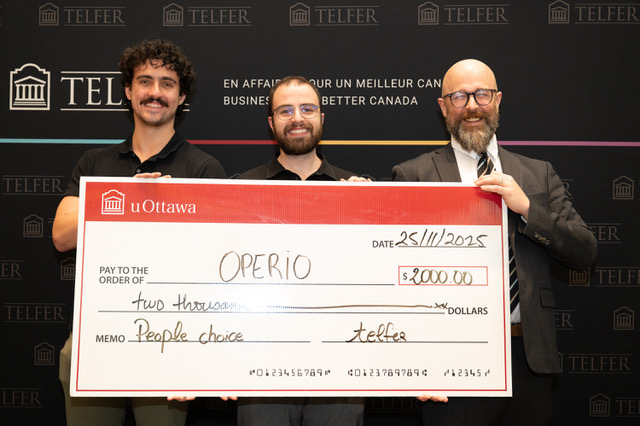 Photo of Nicholas Laflamme, Albino Nikolla, and Eric Nelson (People’s Choice award winner)
 -
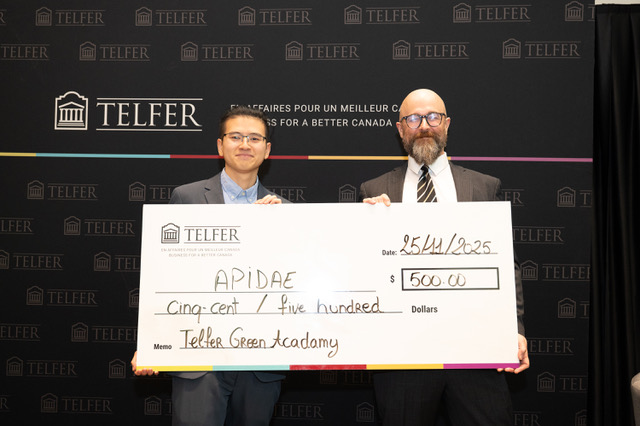 Photo of Ming Chen (Telfer Green Academy Prize Winner) and Eric Nelson
 -
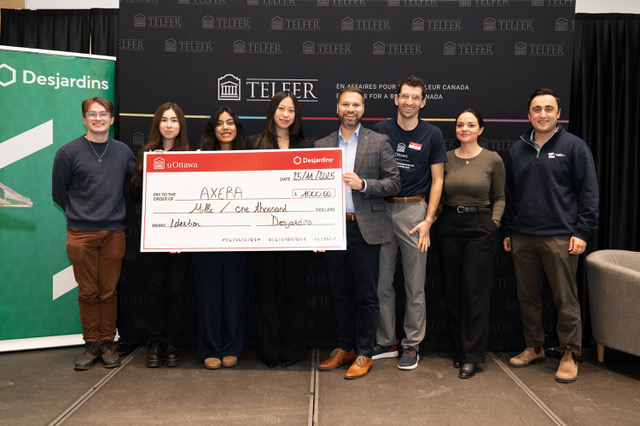 Photo of Graham Taylor, Emma Pollett, Shelina Poudel, Anna Ye, Nishant Raizada, Nolan Beanlands, Olivia Villata and Raj Oberoi (Idea category winner and judges)
 -
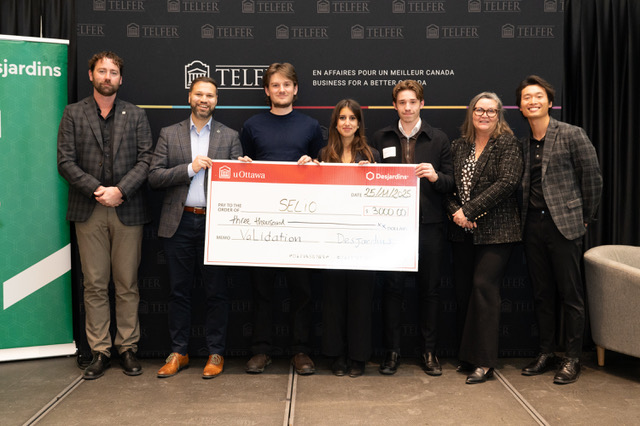 Photo of Sean Geddies, Nishant Raizada, Rafaël Hébert, Laila Burns, Evan Zeglinski-Spinney, Mirela Pirlea, Wilson Li (Validation category winner and judges)
 -
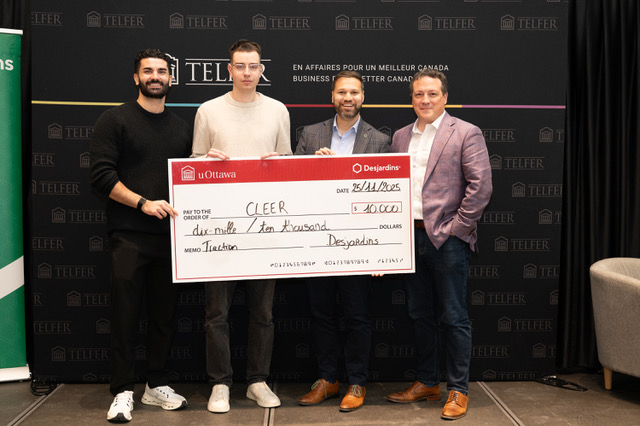 Photo of Kian Tabesh, Petar Slatinac, Nishant Raizada, and Sébastien Dignard (Traction Category winner and judges)




“The university has been really helpful from the beginning,” says Kian Tabesh, Cleer’s co-founder and CEO. He and fellow co-founder and CTO Petar Latina earned co-op credits by working on their startup, and were given workspace that their interns still use.
“We really wouldn’t be here if it wasn’t for all that,” says Tabesh.
This year marks the third year that Desjardins has sponsored the entrepreneurship competition. The cooperative financial group has a long history of encouraging founders and focusing on innovation that meets a need in the market.
“We’re committed to supporting quality entrepreneurship programs that have the structure and the expertise young innovators need to take their idea to the next step,” says Jean-Yves Bourgeois, executive vice-president for business services at Desjardins Group. “We want to foster a competitive startup ecosystem across the country and provide resources to the people who are driving the economy forward.”
All cash prizes are provided by Desjardins, including:
- $10,000 for first place, $5,000 for second and $1,000 for third in the Traction category
- $3,000 for the winner of the Validation category
- $1,000 for the winner of the Idea category
Providing valuable experience to the next generation of business owners
The $2,000 People’s Choice Award was voted on by attendees. It went to Operio, designers of a new VR headset to help medical students train. The $500 Green Academy at Telfer prize went to Apidae Systems. It proposes to use sensors and robotics to improve crop yields and productivity on small farms.
Finalists for each category were selected through preliminary rounds of pitching during Global Entrepreneurship Month. The top three teams in each category advanced to the final. Nelson says the process gives entrants valuable experience they can draw on to push their ventures further.
“From seeing others pitch, all the contestants mature rapidly in their own ability,” he explains. “The competition and exposure give them opportunity, direction, and confidence.”
Winners also receive professional guidance and services from Invest Ottawa, local firms, and other stakeholders.
While the judges deliberated, the audience listened to a fireside chat with Probal Lala, chair of Maple Leaf Angels Capital Corporation and former CEO of Fluent.ai, about the evolution of AI markets.
