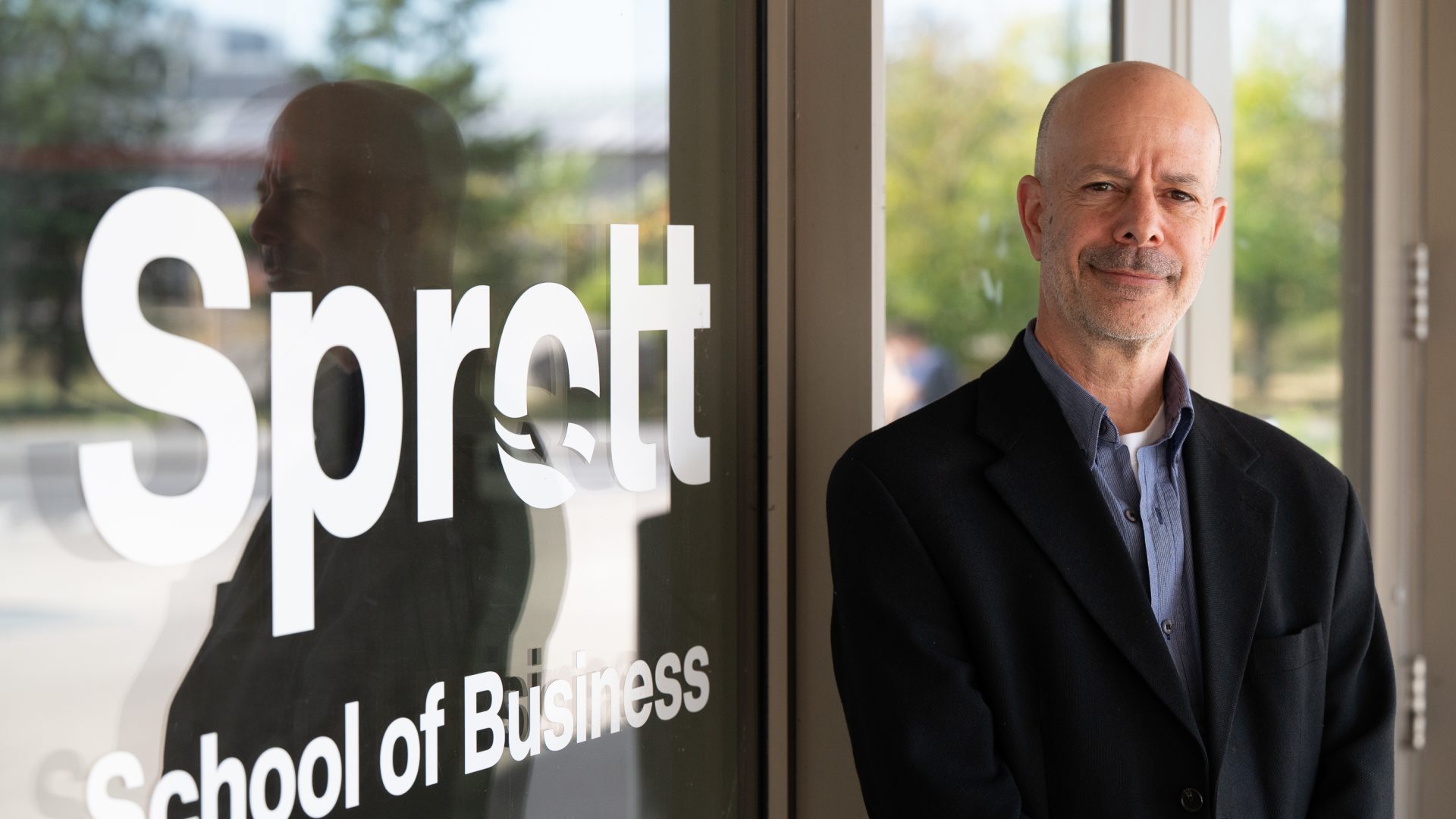

Montreal-born finance professor Howard Nemiroff says he didn’t necessarily expect to take a leadership role after returning to Canada in 2006, following several years abroad.
Nemiroff says he was content teaching and researching finance at Carleton University’s Sprott School of Business. But he was then approached about an associate dean position, back in 2013.
“And the rest is history,” says Nemiroff, who this past July was named the new dean of the Sprott School of Business after a decade spent as associate dean and two years as interim dean.
“Coming from pure academia, I never thought I’d end up in a managerial role. But being involved with the C-suite and the financial implications of decisions has made me think about things very differently.”
It’s that experience, Nemiroff says, that helped form the bedrock of the school’s new Strategic Plan. It’s a three-pronged, flexible roadmap meant to guide the school – and the community it serves – through unprecedented times, both in business and Canadian academia.
The need for agility in an ever-changing business climate
Guided by Nemiroff and with the support of the faculty and Sprott Manager of Strategy and Quality Emily Mantha, alongside extensive community engagement and consultation, Sprott’s new strategic plan is based on a spirit of flexibility and agility.
Rather than being driven by specific curriculum or program items, it’s a framework with the flexibility to capitalize on a business and technology environment moving at breakneck speed.
“We were very conscious about setting up a plan that allowed for that flexibility and agility,” he explains, “so we’re not setting ourselves up so that we must do ‘X’.
“Two to three years from now, our programs we have will likely be very different than they are today – and we don’t yet know what that’s going to look like. The technology of tomorrow will be different. So that flexibility, that agility, is critical, and that’s why we built it that way. We need to be responsive so our students benefit from current and timely education.”
A focus on community and societal impact
Along with the flexibility required to quickly pivot and address societal needs as they arise, the plan’s three strategic priorities have one common theme among them – the need for shared responsibility for the world around us.
Business, after all, doesn’t take place in a vacuum. The goal of a business education, Nemiroff says, is ultimately about solving problems and improving the prosperity of one’s community – “the ‘why,’” he explains.
“We are all where we are today because we’re standing on the shoulders of giants before us. It’s critical to remind our students to turn around and lend a hand to those around them, to pay it forward.”
The plan is based on three interrelated strategic priorities:
- Transformational education for lifelong learning: Innovative and flexible educational experiences underpinned by a contemporary and agile curriculum and premier experiential learning opportunities, such as the school’s Student Investment Fund, which manages $3.25 million in real dollars.
-
Research excellence with societal impact: Based on strong industry partnerships and the bridging of theory and practice to advance knowledge creation that addresses pressing societal and business challenges.
“The research is about things that matter,” Nemiroff says. “Maybe a company is having difficulty with its distribution network in terms of supply chain. How can we help fix that? Our faculty are engaged in research aligned with industry priorities, such as empowering Canadian SMEs to compete with e-commerce giants through AI-driven collaboration, promoting circular solutions to reduce food waste in the supply chain, and understanding the opportunities and challenges of global digital work. Sharing their research insights, data and findings can advance knowledge and help industry in their decision-making.” -
Community engagement for shared prosperity: Maintaining a strong link to local, national, and international communities through engaged alumni, strong employer connections, and by being a partner in Ottawa’s prosperity. Among the school’s initiatives is the Sprott Student Consulting Group, last year alone providing 10,000 service hours free of charge to support over 13 organizations in addressing their current business challenges.
“This is the community-building piece,” he says. “It’s about students, alumni, and partners coming together with bold ideas to challenge the status quo and drive innovation.”
‘The dean’s door is always open’
Mantha says the flexible nature of the new Strategic Plan means Sprott will continue to engage the community – from Carleton University alumni, to local business owners and other community members – long after its release.
“Howard’s door is always open,” she says, “and that’s a key piece. Come and talk to us. We want to collaborate. You graduated from Sprott 20 years ago or even last year? You have a voice at Sprott and we can learn from one another to shape what comes next.”
Nemiroff agrees, adding that Sprott’s focus is squarely on the local community and how the school can help improve prosperity for everyone in the region.
“First and foremost, the Sprott School of Business is supported by our local community, the greater Ottawa region. We unequivocally support our community and recognize our role in helping our community grow – if local industry has access to Sprott’s talent pool, if our students and researchers help those companies grow, then we all do well.”