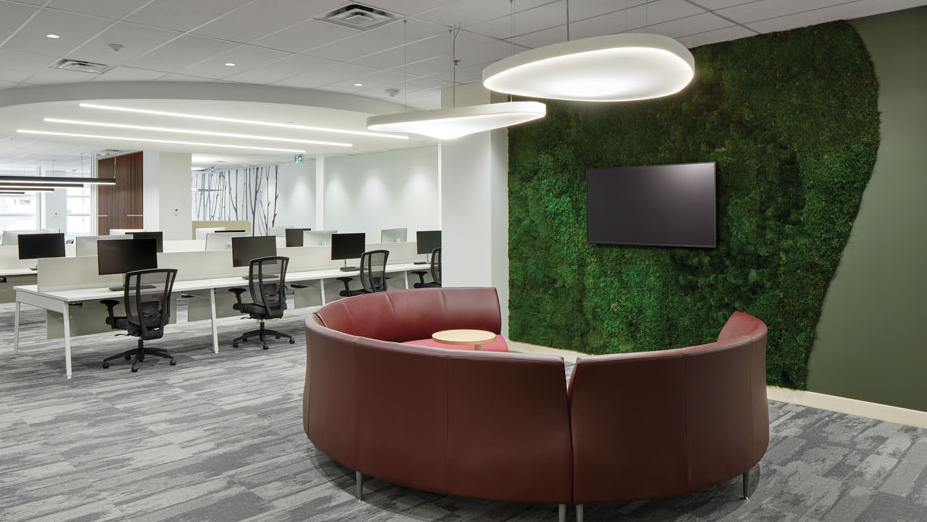

When designer and architect Emily Webster Mason first saw her client’s federal government agency space, she immediately identified an opportunity to bring some of the rare greenery that surrounded the first-floor office building inside by way of furnishings and finishes.
Webster Mason is an associate at Watson MacEwen Teramura Architects (WMTA) and her government client — which she can’t disclose for security reasons — was looking for an office to be designed based on the hybrid nature of work these days.
“It’s a calculation of how many types of workstations are needed based on the user and their workstyle using GCWorkplace standards,” Webster Mason says. “It’s a pretty open floor plate on the first level of a tower. It has lots of green space around it, and big windows. You can’t see in, but you can still see out. We tried to bring all of the greenery back in to the space, even though the owner of the building mandated that we had to use the grey carpet.”
The resulting design is sleek and modern, with lots of natural textures that recall the outdoor environment seen through the window.
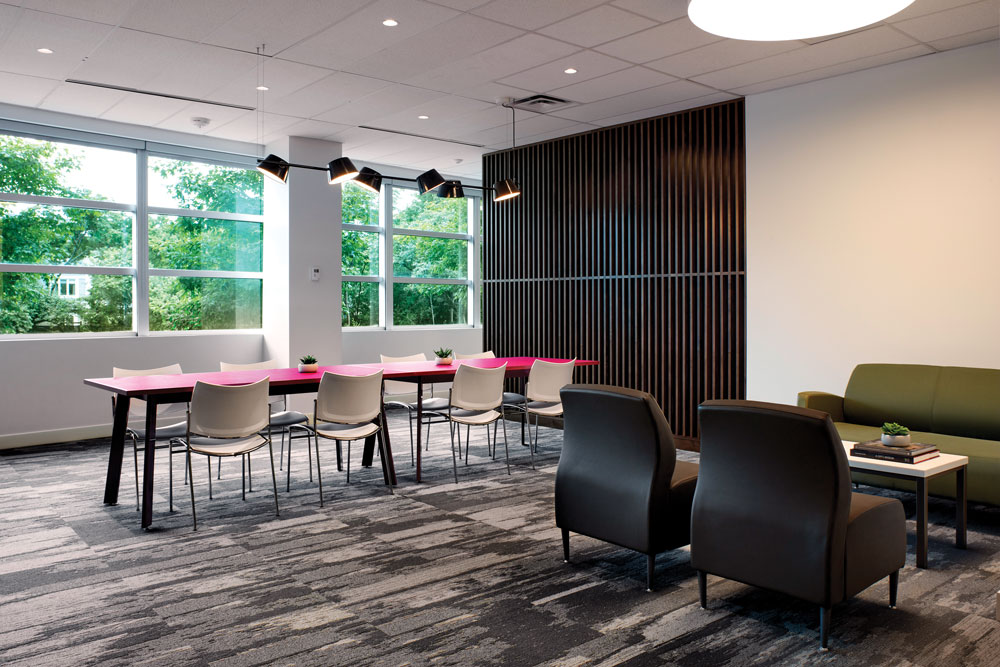
“We tried to work with what we had. And so again, with nature, you’ll see a lot of the textures are very natural. We’ve got the rich textures with concrete panels; we’ve got woods. All of the glazing of the glass has a fritting that looks like a tree branch graphic. So that’s a pattern that we introduced to create a little privacy, but it also keeps that theme of nature.”
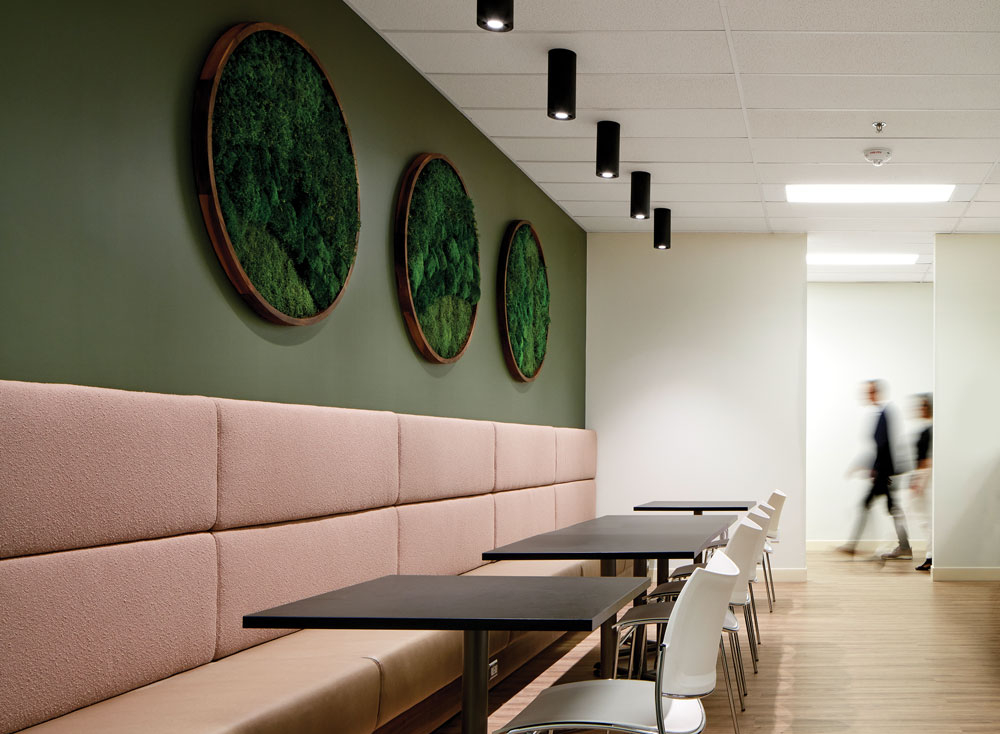
A wall in the boardroom addresses acoustics and esthetics with a rich felt finish. Biophelia is introduced with moss that doubles as art on the walls of the lunchroom and breakout areas.
“Everything’s very textural, very simple,” Webster Mason says.
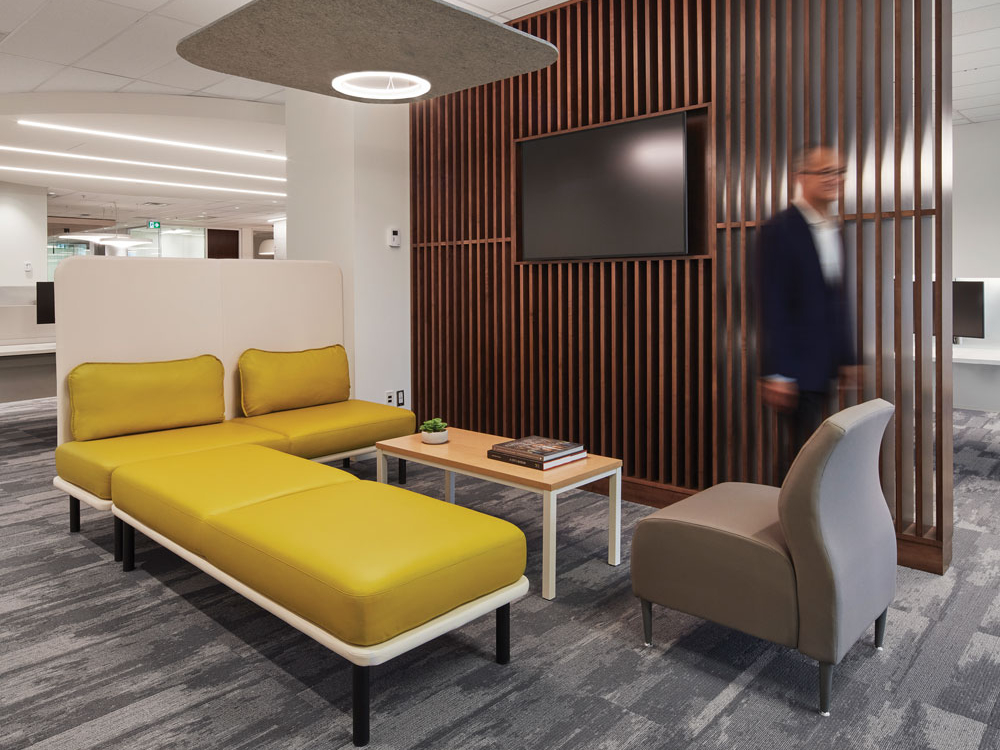
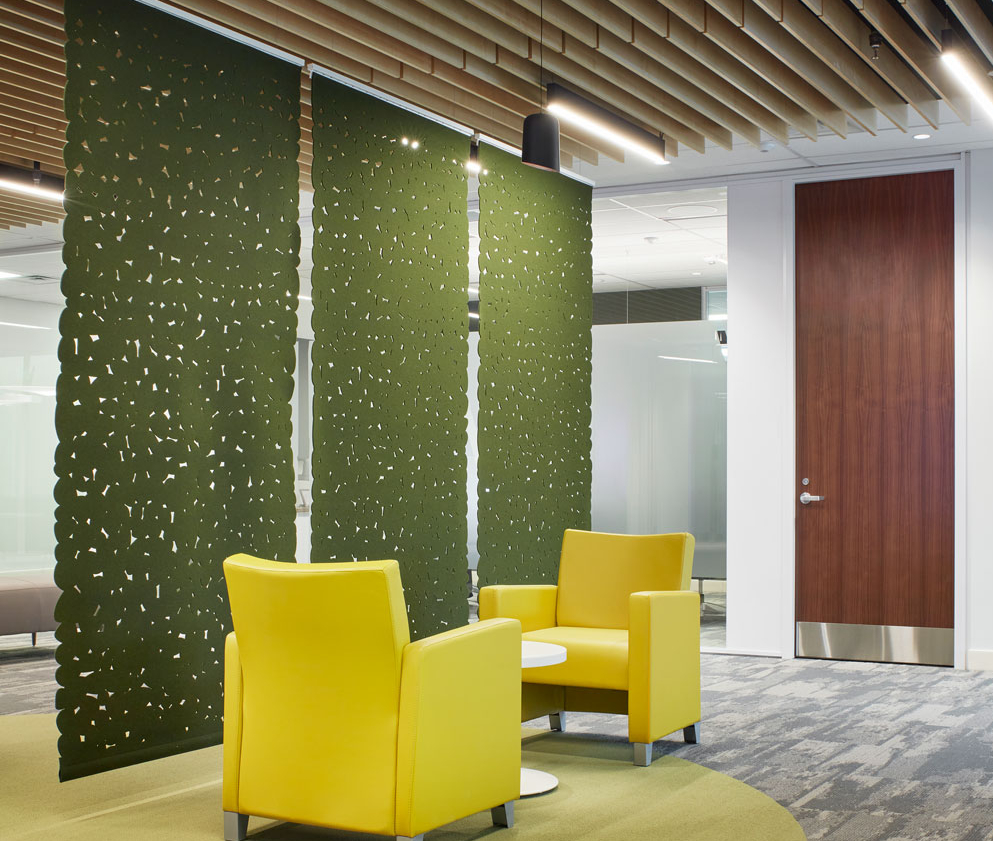
She tried to keep the base colour palette to natural colours, enhancing the grey carpets with concrete walls and walls with decorative wood elements, but then she added pops of colour — mustard yellow, magenta, pale pink, army green throughout by way of screens to divide open spaces, as well as furnishings.
“The furniture is where we were able to introduce the bold colour,” she says. “The client was really open to my ideas on that. We did have to work on the ceilings to tamper sound travel throughout the space, but the look is pretty wide open, except for the closed meeting spaces and quiet little workspaces.”
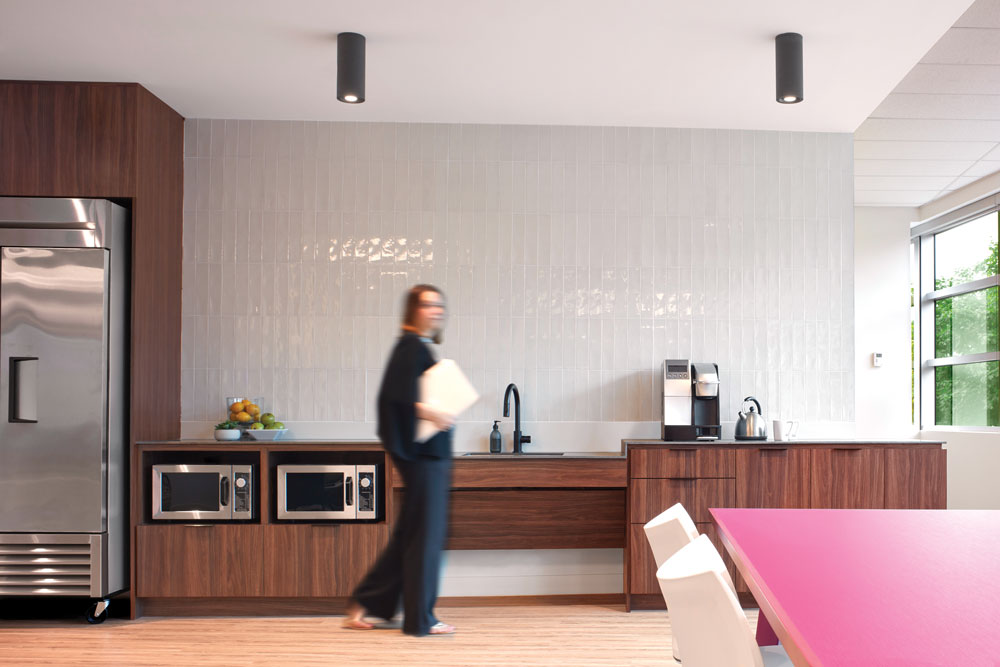
There’s a wall of soft pink benches in the main building’s kitchenette; a deep blue one for team meetings, a lounge space with a mustard yellow sectional couch, a group meeting space enclosed by a circular burgundy bench and a magenta table in the main kitchenette.
“When you pull all of that fun stuff back, it’s a very soft, muted and calm space,” she says. “We used some bold colours as accents. I never think colour is offensive, but some people are a bit shy with colour and were off-put by samples initially. So where we put strong elements, it was, for example, against a window or where they had space to breathe.”
When working with government clients, designers such as Webster Mason also have to work with the government’s procurement methods.
“So you want it to look a certain way, and then you have to work with the awarded vendors to customize and make it work with everything you’ve planned,” Webster Mason says. “We did that with three different vendors for this project.”
The building is certified LEED silver so WMTA had to work within the certification on everything they did. Since it’s a drop-in space, it’s also in constant use, so everything had to be durable and there needed to be some flexibility in furnishings and spaces.
“So if someone needed a different style chair, there are options stored within the space that they can easily swap out and use,” Webster Mason says.
COVID challenges
The designer says there were lots of moving parts in the project, as it started in the middle of the COVID-19 pandemic.
“When you consider that we were working with limitations of what’s going to be available or not knowing if something would ultimately be available, the project turned out to be quite successful,” she says. “I can walk into a space and I know what it will look like before I’ve even done it, but it’s always nice when you have so many hoops to jump through and you get to the other end and it’s what you imagined.”
She says there were plenty of challenges with suppliers, workforce, security and then there was the added uncertainty that COVID presented.
“There were certainly things along the way that made it exciting in ways you don’t always want it to be, but being able to get to the end and having the client be just as excited and happy with it as you are is gratifying,” she says.
In thinking back on this project, Webster Mason says her key message would be that “offices don’t have to be stuffy” — even government offices.
“You can still be professional, you can use simple base building materials, and you can still introduce fun in a way that’s really elegant and inspiring, so that people want to go to work and they’re excited to be there, that there’s a space for everybody,” she says. “That’s the most important thing — being excited about being in a space and feeling inspired when you’re there.”
Webster Mason says it’s gratifying to know that people who work on the other floors of the building are keen to work in this new space — and they often do.
This article first appeared in the September 2025 special “Best Offices Ottawa” issue of the Ottawa Business Journal. That publication is available in its digital edition below.