
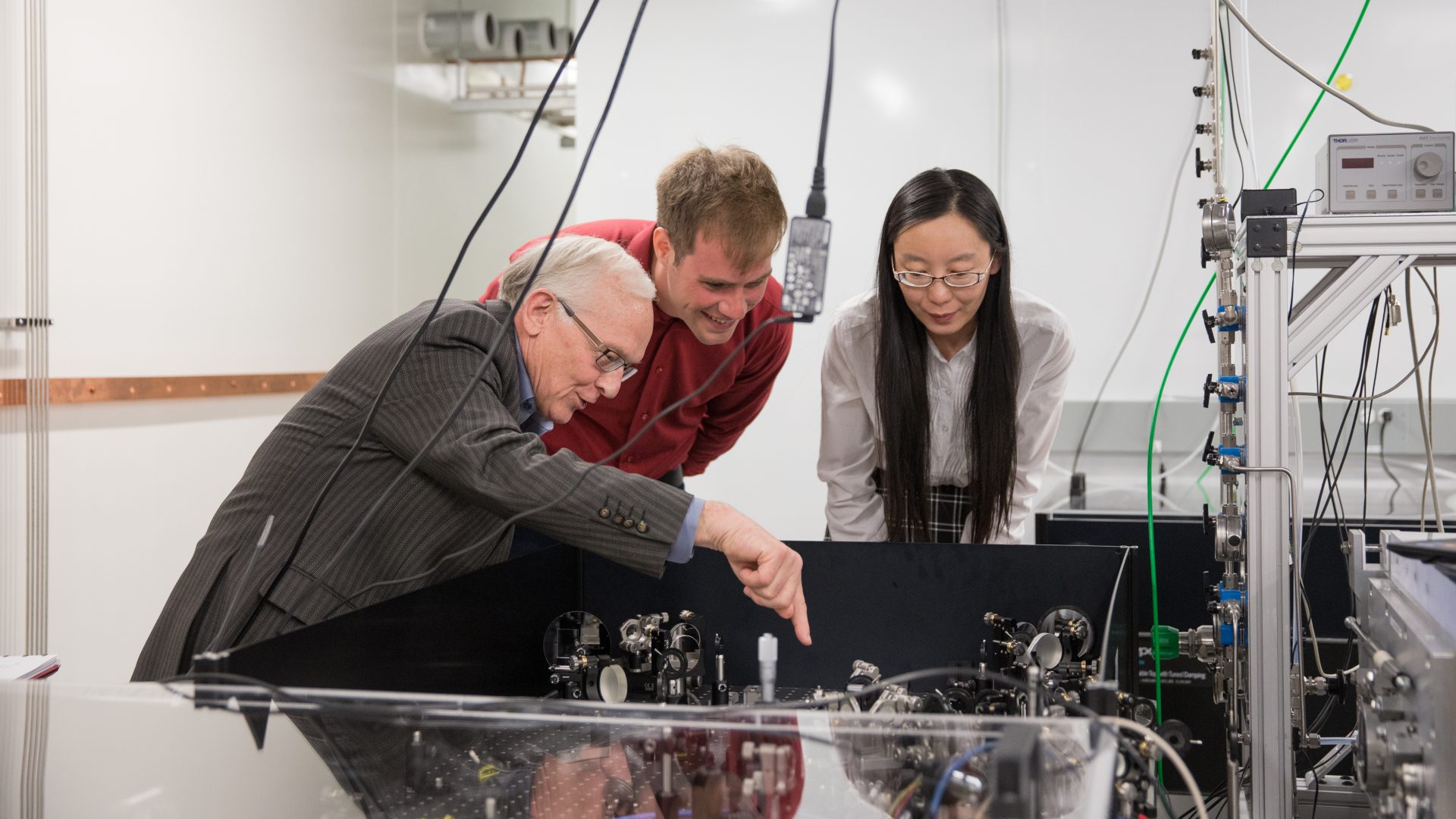

uOttawa’s Nexus for Quantum Technologies (NexQT) Institute is at the forefront of one of the most exciting technology fields to emerge in the past decade. Through its work with the uOttawa Kanata North campus, the institute and its researchers are building strong connections with companies in Canada’s largest tech park, sparking collaborations that address industry challenges and innovation while driving both economic growth and societal impact.
“We have over 80 researchers in this institute, so there’s a lot of expertise to call upon,” says director and associate professor of physics at uOttawa Jeff Lundeen.
“We also have extensive laser and photonics facilities – one of the best array of laser and light sources in the world,” adds Lundeen, also the Canada Research Chair (Tier II) in Quantum Photonics and head of the Lundeen Lab for Quantum Photonics.

The NexQT Institute is interdisciplinary, spanning many uOttawa faculties including science, social sciences, medicine, engineering and law, reflecting the wide range of potential applications of quantum technology around computing, communications, materials and sensing. Research and applications in those fields have surged over the past ten years, says Lundeen.
The institute brings together world-class research initiatives and infrastructure under one institute, uniting expertise across quantum sensing, photonics, and nanofabrication. Its flagship facilities include:
- The NanoFab Facility, a $20-million nanofabrication hub in the Advanced Research Complex with cleanrooms, wet labs, and precision metrology spaces
- The Joint Centre for Extreme Photonics (JCEP), a uOttawa–National Research Council partnership advancing both high- and low-intensity photonics research
- The Max Planck-uOttawa Centre for Extreme and Quantum Photonics – one of three in the Americas – which connects Canadian researchers with leading German institutes for joint projects, exchanges, and workshops. Together, these centres position NexQT as a global leader in advancing and commercializing quantum technologies
Multiple applications for quantum sensing across industries, from geospatial to automotive to healthcare
One area of research strength at NexQT is quantum sensing, which has multiple applications: It can sense a gravitational field beneath the Earth’s surface to find geological deposits or locate underground utilities, or can be a substitute for GPS for aviation navigation, says Lundeen.
“If GPS drops out, which it does every now and then, particularly in military applications, you want to be able to know where you are on the Earth without having a reference to any GPS system.” The way you do that is through a sensor in your device that can accurately display your movements based on the acceleration of the device, he explains.
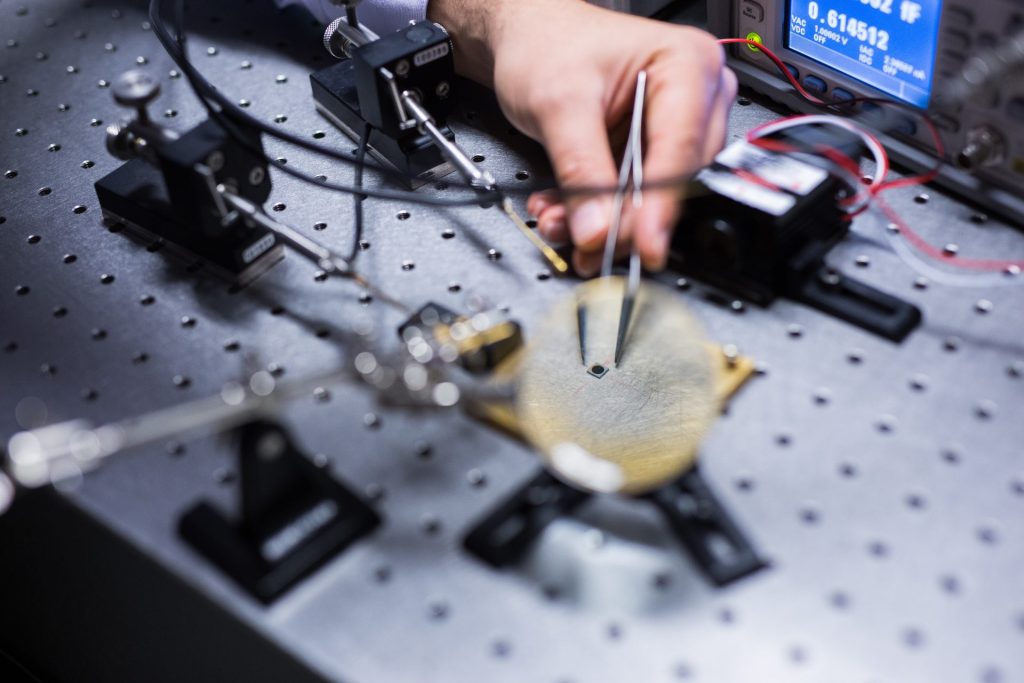
Quantum sensing can also measure very small magnetic fields using a magnetometer, which can improve healthcare through “an MRI machine that isn’t a gigantic tube – one that you could wear on top of your head, and wouldn’t need to stay still for.”
“Making much smaller, more sensitive sensors means you can get away from some of these traditional constraints.”
In addition to quantum sensing, NexQT’s expertise spans quantum communication and cryptography, quantum computing and simulation, quantum materials, and quantum photonics.
NexQT researchers are developing secure communication systems using quantum key distribution (QKD) as quantum algorithms to accelerate drug discovery, optimize manufacturing, and model advanced materials.
Leveraging the NanoFab Facility and partnerships like the JCEP and Max Planck-uOttawa Centre, the institute is advancing the devices, lasers, and single-photon sources that will power the next generation of quantum technologies.
The uOttawa Kanata North Campus: Facilitating academic-industry collaborations, commercialization, and impact
From its strategic position in Kanata North, home to Canada’s largest technology park, the uOttawa Kanata North campus is continuing to create powerful pathways for NexQT researchers to connect and engage with industry leaders and government partners who share an interest in unlocking quantum’s potential.
The campus’s proximity to Kanata North companies helps foster agile collaborations where research breakthroughs can be tested, refined, and deployed in real-world applications, whether in aerospace navigation, advanced manufacturing, or secure communications.
“As a leading research-intensive university in Canada, with a campus in the heart of the Kanata North tech park, we’re uniquely positioned to bridge cutting-edge research with the companies that can scale it globally,” says Sean Geddes, director, innovation and partnerships with the uOttawa Kanata North campus.
“Kanata North allows our researchers to work shoulder-to-shoulder with industry to accelerate R&D, drive specialized talent development, and translate innovations into solutions the world needs. For quantum technologies, that connection to the marketplace is a game-changer.”
Kanata North industry partnerships with NexQT researchers have already accelerated R&D initiatives, reduced time-to-market for emerging technologies, and opened doors to funding opportunities through joint industry-academic grants.
For Ottawa’s tech ecosystem, this collaboration helps local firms expand their innovation capacity and enhance their global competitiveness in a field projected to generate billions in economic value over the next decade, while keeping intellectual property and high-value jobs in the region.
